The Mille Miglia is a legendary Italian road race that has captured the imagination of car enthusiasts and history buffs alike. Its name, which translates to “Thousand Miles,” hints at both its challenging distance and its storied past.
The word “milli” is a prefix meaning a thousandth, originating from the Latin word “mille,” which means “thousand.” In science and everyday life, “milli-” is used for small subdivisions, such as milligrams, milliliters, millimeters, and milliseconds. This contrasts with “kilo-” for large multiples and “micro-” for a millionth.
Table of Contents
- Why «Mille Miglia became more than a race
- The history of speed, roads, and danger
- Aristocrats, money, and the gambling mood
- Drivers who played with death
- Tragedies, pressure, and the end of an era
- The modern Mille Miglia legacy
- FAQ
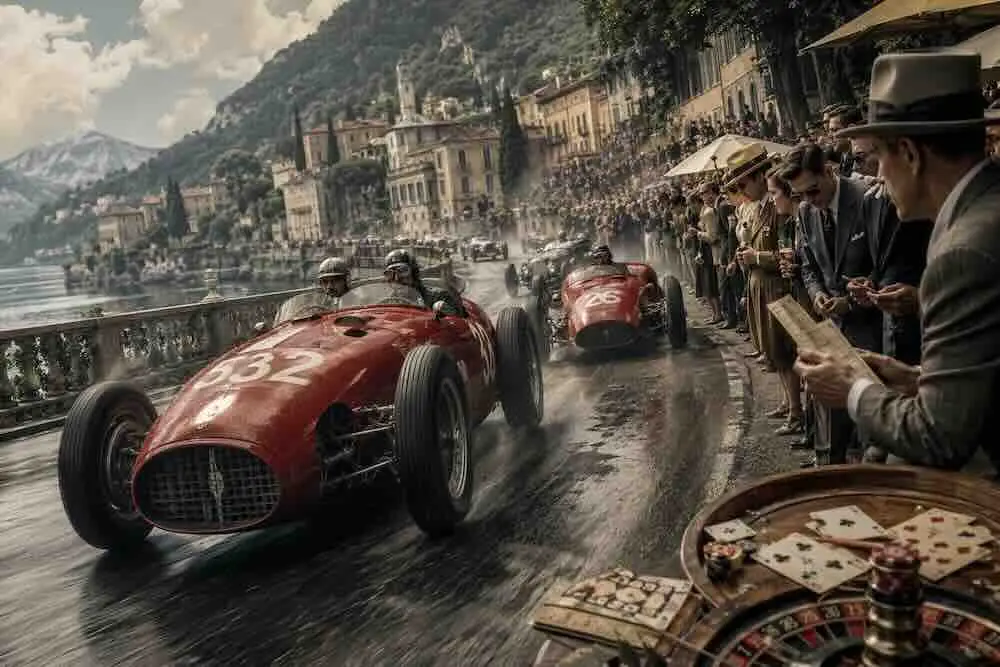
This article looks at «Mille Miglia as a legendary Italian road race where old cars, early supercars, money, prestige, and danger met on public roads. For Canadian readers used to modern motorsport safety, the original Mille Miglia feels almost unreal: part race, part social spectacle, and part casino on wheels.
Why «Mille Miglia Became More Than a Race
The original Mille Miglia was established in 1927 by a group including Counts Aymo Maggi and Franco Mazzotti as an open-road endurance race from Brescia to Rome and back. Its name means “Thousand Miles,” and the race is often called the ‘Thousand Miles’ in English. The original course covered approximately 1,500 km, or a thousand Roman miles, winding through Italian towns, highways, and countryside roads. Unlike a closed circuit, the course was open to the public, with real Italy and real people standing dangerously close to the action. This article will explore details about the race’s history, route, and cultural impact.
Here, speed was not measured only in kilometres per hour. Life, reputation, and money were all on the line. For spectators, it had the emotional rhythm of gambling: choosing a favourite, watching the odds shift with every checkpoint, and hoping the automobile would survive. The evolution of the automobile and its pivotal role in racing history were showcased in every running of the Mille Miglia.
The History of Speed, Roads, and Danger
How the race began
The first Mille Miglia took place on March 26, 1927, with 77 starters, 51 finishers, and Giuseppe Morandi as the winner, completing the race in just under 21 hours at an average speed of nearly 78 km/h (48 mph).
Mille Miglia was founded by Counts Aymo Maggi and Franco Mazzotti, together with Renzo Castagneto and Giovanni Canestrini, after Brescia lost the Italian Grand Prix to Monza. They wanted to bring racing glory back to their city.
The idea was simple and wild:
- Start in Brescia
- Race to Rome
- Return to Brescia
- Use ordinary public roads
- Let time decide the winner
Early vehicles were closer to old cars than today’s polished racing machines, but Mille Miglia helped make brands like Alfa Romeo, Ferrari, Maserati, Mercedes-Benz, Porsche, and BMW famous.
Rules that made it feel risky
Cars started at intervals, often by time order. In later editions, car numbers could reflect start times. Drivers passed through checkpoints, navigated towns, and pushed through open roads with minimal protection. Many accidents occurred, especially on the fastest parts of the route, making the event notorious for its danger. Over its 30-year history, the Mille Miglia saw a total of 56 deaths, including 24 drivers and 32 spectators, with several being killed in high-speed crashes. In contrast to other racing formats where some oval, banked speedways or unpaved tracks used only half the length of a standard circuit to reduce risk, the Mille Miglia’s full-length open-road course contributed to its perilous reputation. In 1957, for example, the race was run almost entirely on public roads over about 992 miles.
Aristocrats, Money, and the Gambling Mood
Who followed the race?
The Mille Miglia attracted wealthy Italians, aristocrats, business figures, mechanics, journalists, and ordinary fans. Its founders themselves came from elite circles, and the event quickly became a social stage as much as a sporting one.
Direct evidence of organized betting markets is limited, so it is better to treat the “casino on wheels” idea as a metaphor, not as a proven formal betting system. Still, the atmosphere clearly had gambling energy. Spectators backed favourites emotionally, discussed winners at roadside stops, and followed checkpoint news like odds changing at a table.
Drivers Who Played With Death
Stirling Moss and the ultimate calculated risk
The most famous Mille Miglia performance came in 1955, when Stirling Moss and navigator Denis Jenkinson won in a Mercedes-Benz 300 SLR. Their run became legendary because it mixed speed, preparation, trust, and nerve.
Moss later described the personal experience of driving Mille Miglia like this: “every one of those 1000 miles was a great big adventure.”
That quote captures the psychology perfectly. Drivers were not simply controlling supercars. They were making constant decisions under pressure: brake or trust the road, attack or preserve the car, follow instinct or listen to the navigator.
Strategy versus pure courage
Some drivers survived by being fast everywhere, often piloting cars built to specific racing formulas, such as the Formula One-derived Mercedes-Benz W196. Others won by knowing when not to gamble. Piero Taruffi, who won the final 1957 edition for Ferrari, completed the distance at an average speed of about 152.6 km/h and did it without a navigator.
That was not blind bravery. It was discipline. In Mille Miglia, the smartest racer was often the one who knew when risk became too expensive.
Tragedies, Pressure, and the End of an Era
The race’s danger was real. The course wound through mountainous terrain, including steep and winding sections that increased the risk, especially near key cities like Siena. In 1957, Alfonso de Portago’s Ferrari crashed, killing the driver, co-driver Edmund Nelson, and nine spectators. Another fatal crash that year brought the death toll to twelve, and the Italian government ended the Mille Miglia as a flat-out public-road race. After the end of the original race, the owner of the Mille Miglia trademark became the Automobile Club Brescia.
This is where the casino metaphor turns dark. In a normal game, someone loses money. In the original Mille Miglia, the loss could be a car, a career, or a life.
Resumption of the Mille Miglia
After the devastation of World War II, the Mille Miglia resumed in 1947, signaling a new chapter for both the race and Italy itself. The event was released as a revived race that year, marking its official return to the public after the war. The Italian government played a pivotal role in bringing the event back to life, providing precious gasoline to registered entrants despite ongoing rationing. Pirelli, the renowned tire manufacturer, also stepped in, offering free tires to all cars officially entered in the race. This combination of incentives led to a flood of registrations, with many drivers eager to secure these valuable resources—sometimes more for the fuel and tires than for the thrill of competition.
The first post-war Mille Miglia was a distinctly Italian affair. With much of Europe still recovering and facing currency restrictions, the field was almost exclusively made up of Italian drivers and cars. British, French, and German teams were largely absent, either due to political barriers or economic hardship. Yet, this period saw a surge of national pride, as Italian manufacturers and drivers dominated the event, rekindling the spirit of the original race. The Mille Miglia resumed not just as a motorsport spectacle, but as a symbol of resilience and renewal for a country eager to reclaim its place in the world of racing.
The Red Arrow: Symbol of the Race
No symbol captures the spirit of the Mille Miglia quite like the iconic Red Arrow. Instantly recognizable, the Red Arrow serves as a sign that represents the spirit and identity of the Mille Miglia, embodying the race’s blend of speed, style, and Italian ingenuity. It appears everywhere: emblazoned on the sides of competing cars, stitched onto drivers’ suits, and featured on official merchandise and memorabilia. For drivers and fans alike, displaying the Red Arrow is a badge of honor—a tribute to the race’s storied origins and the generations of competitors who have chased glory along its thousand-mile route.
Beyond the race itself, the Red Arrow has taken on a life of its own in popular culture. It features prominently in films, books, documentaries, and even art, serving as a lasting reminder of the Mille Miglia’s unique place in automotive history. For many, the Red Arrow is more than just a logo; it’s a symbol of the race’s enduring legacy, a celebration of Italian excellence, and a rallying point for those who cherish the beauty and excitement of the Mille Miglia.
The Mille Miglia Brand
Over the decades, the Mille Miglia has transformed from a daring road race into a global brand synonymous with luxury, elegance, and automotive passion. The original race’s spirit lives on in the Mille Miglia brand, which now extends far beyond the roads of Italy. Today, the brand is celebrated through collaborations with high-end fashion houses, renowned watchmakers, and leading automotive manufacturers, each partnership reinforcing the Mille Miglia’s reputation for style and excellence.
The Mille Miglia’s official website and vibrant social media presence have created a worldwide community of enthusiasts, collectors, and drivers who share stories, photos, and memories of the event’s rich history. The brand’s influence can be seen in everything from exclusive timepieces to limited-edition cars, all inspired by the beauty and legacy of the original race. As a cultural phenomenon, the Mille Miglia brand continues to inspire new generations, ensuring that the legend of the thousand-mile adventure will endure for decades to come.
The Modern Mille Miglia Legacy
Today, the Mille Miglia race, once a legendary and perilous motorsport event, is no longer the same deadly sprint. Since the establishment of the revived event in 1977 as the Mille Miglia Storica, it has become a prestigious regularity rally for vintage vehicles, celebrating the legacy of the original race. Modern editions highlight design, heritage, tourism, and the charm of old cars rather than raw danger. Recent descriptions of the event showcase a multi-day Brescia–Rome–Brescia route of around 1,600 km, with selected historic cars and a much safer format.
For Canadian fans, the appeal is clear. It combines European road culture, luxury machines, motorsport history, and the romance of risk without the brutality of the original race.
FAQ
What was Mille Miglia?
Mille Miglia was an Italian open-road endurance race held from 1927 to 1957, usually running from Brescia to Rome and back.
Why is it compared to a casino?
Because the race involved uncertainty, pressure, money, prestige, and dangerous risk. The comparison is mostly symbolic, not proof of official betting.
Were supercars involved?
Yes. Mille Miglia helped build the reputation of brands later associated with supercars, including Ferrari, Maserati, Mercedes-Benz, Porsche, and Alfa Romeo.
Does Mille Miglia still exist?
Yes, but today it is a historic regularity event for classic cars rather than the original flat-out road race.