Reading time: 8 minutes
Table of Contents:
- Context of the late 1950s: Prestige on the racetrack
- Ford’s failed Ferrari acquisition: Revenge as strategy
- Birth of the Ford GT40: Victory at any cost
- Early trials and setbacks
- Triumph at Le Mans 1966
- Legacy of the GT40
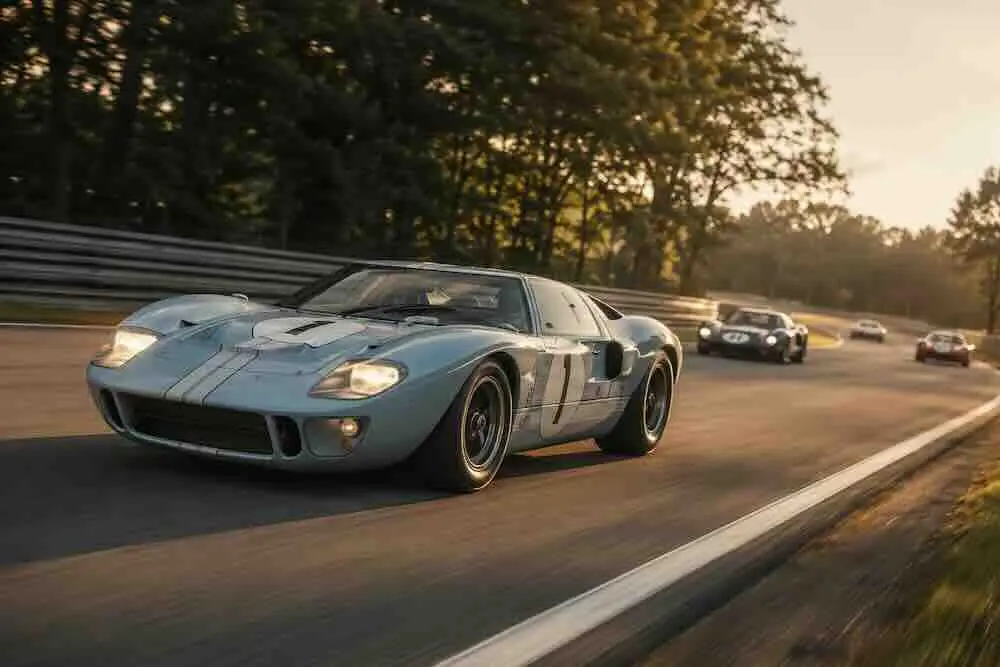
This article explores the story of the Ford GT40, a car born out of rivalry with Ferrari, relentless ambition, and a passion for racing that redefined automotive excellence and left a lasting legacy in motorsport culture. The GT40 project was spearheaded by Carroll Shelby’s team, which played a crucial role in transforming early prototypes into race-winning machines. The development process involved collaboration with notable engineering firms such as Kar Kraft, Ford’s performance division responsible for assembling and refining key components, including the transmission and chassis. The GT40’s design incorporated advanced aerodynamic principles, including a low-slung profile and the innovative “Kamm tail” to reduce drag and enhance stability at high speeds, crucial for success in endurance races like the 24 Hours of Le Mans. The car’s powertrain featured robust American V8 engines, initially the 289 cubic inch (4.7 L) unit in the Mk I, later upgraded to the 427 cubic inch (7.0 L) engine in the Mk II and Mk IV models, delivering formidable torque and speed. Beyond its racing achievements, the GT40’s purchase price and rarity have made it a coveted collector’s item, with values appreciating significantly in recent years, especially for examples with documented racing history. The legacy of the GT40 also inspired continuation models and licensed replicas, ensuring the spirit of this blue oval icon endures among enthusiasts and collectors worldwide. Its story is intertwined with the history of American manufacturers challenging European dominance, marking a pivotal chapter in automotive and racing history.
Context of the late 1950s: Prestige on the racetrack
By the end of the 1950s, international auto racing had become a high-stakes arena where brands competed not just for wins but for prestige and technological dominance. Racing success signaled engineering prowess, market influence, and global recognition. In this context, Ford Motor Company eyed Ferrari as a symbol of speed and prestige in endurance racing, especially in Europe, where the major marquee events were centered.
Ford’s failed Ferrari acquisition: Revenge as strategy
Ford attempted to purchase Ferrari, but negotiations fell through at the last moment due to Enzo Ferrari’s hesitation to relinquish control of his racing team.
“Enzo Ferrari’s pride and control over his racing legacy led to one of the most pivotal business rivalries in automotive history.”
Feeling spurned, Henry Ford II saw this as an opportunity to turn disappointment into determination. The goal: defeat Ferrari on the racetrack. This move blended business strategy with a high-risk, emotionally charged game, setting the stage for the GT40 project through Ford Advanced Vehicles in the UK, with early work rooted in England.
Birth of the Ford GT40 by Ford Advanced Vehicles: Victory at any cost
Henry Ford II commissioned a secret race car program to design the GT40, with the initial Mk I intended to defeat Ferrari at Le Mans. Engineers and drivers were selected for their expertise and tenacity, and early prototypes were developed around a lightweight chassis to improve performance and reliability. The GT40 combined aerodynamic efficiency, a powerful V8 engine, and cutting-edge technology of the era.
This was more than a racing car—it embodied a philosophy: speed, strategy, and daring ambition fused into steel and engine power, with specific features shaped by the demands of Le Mans.
Early trials and setbacks
Initial races with the GT40 were challenging, from each early test session to the Le Mans trials that exposed how difficult its development phase would be. Mechanical failures and strategic missteps, including trouble with the brakes and suspension, led to early defeats. However, each setback fueled learning and refinement. The team analyzed every failure, and components were sometimes rebuilt between events to improve front suspension behavior and overall handling, proving that perseverance and calculated risk-taking were as crucial as raw horsepower.
Triumph at Le Mans 1966
The pinnacle came in 1966, when the Ford GT40 secured Ford’s Le Mans victory and first win in the Le Mans race over Ferrari. The finish remains famous because, despite the orchestrated photo finish, the winning car had covered more ground. This triumph marked a historic shift: Ford established itself as a legitimate competitor in international motorsport, with Daytona also serving as a key proving ground and first place finishes in major events reinforcing that status. Ken Miles and Bruce McLaren were central to the 1966 story, each as a leading driver. The victory was not only a technical achievement but also a vindication of Henry Ford II’s ambition and audacious gamble, delivered through Shelby American, Holman Moody, and the leadership of Carroll Shelby to complete the win.
Legacy of the GT40
The Ford GT40 remains a symbol of engineering excellence, competitive spirit, and audacious vision, and the later Ford GT is often seen as a newer generation in the same lineage. Different versions, including the Mk II, became iconic racers in part because production was limited and each competition spec evolved with purpose. Its impact extends beyond racing: it influenced automotive design, inspired collectors, and exemplifies how passion, risk, and strategy can converge to create legendary achievements. Collectors still track which buyers pursued each car, what its sale history shows, and how hard it can be to find the right buyer when owners try to sell privately. Authenticity often comes down to chassis records, serial number documentation, and original model details. Many examples now spend more time in a garage than on the road, because driving one can be hot inside and demanding at the wheel. GT40 is celebrated not just for its speed, but for the story of rivalry, innovation, and relentless pursuit of victory that it embodies.
Synthesis:The GT40 story is a testament to how emotions, competition, and engineering ingenuity can combine to produce extraordinary accomplishments. Passion and audacity drove a car that forever changed motorsport history.