
⏱ Reading time: ~8 minutes.
Table of Contents:
- A glimpse at the legendary winged muscle cars;
- When Aerodynamics Became a Weapon – How Dodge and Plymouth transformed their cars for speed;
- Machines That Broke Speed Records – NASCAR’s record-shattering performances;
- NASCAR vs. the Aero Warriors – How rules changed in response to dominance;
- Why Daytona and Superbird Became Legends – The lasting impression on racing and collectors;
- Legacy: Speed, Risk, and American Obsession – How these cars shaped automotive culture;
- FAQ – Answers to common questions
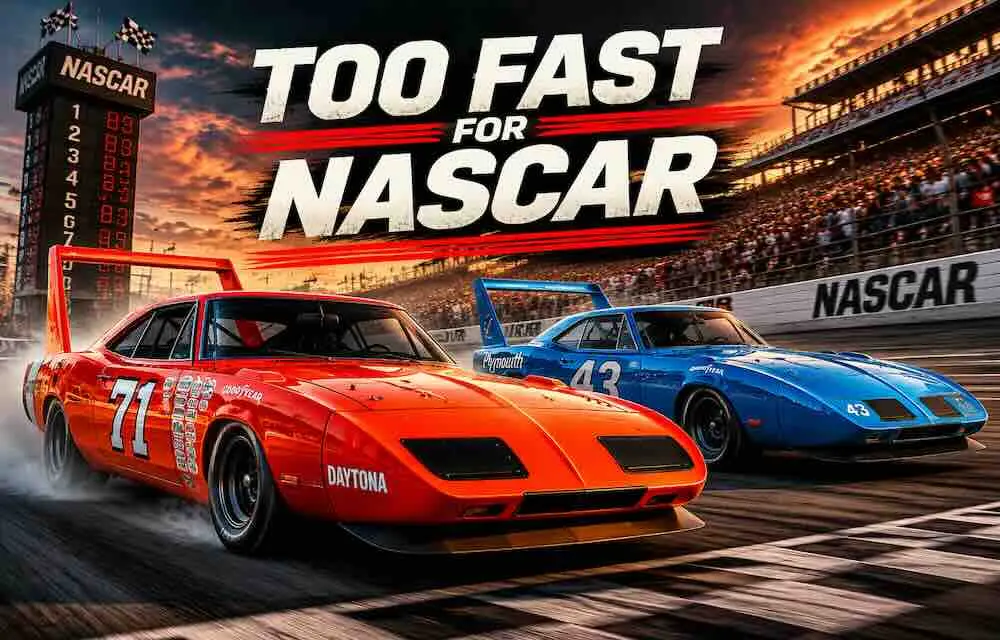
In the late 1960s, stock car racing was in the midst of a revolution. Factory-backed teams in NASCAR were locked in fierce battles, and car manufacturers were constantly looking for any edge. As engine power surged, controlling raw speed became critical. Ordinary muscle cars were hitting their limits on super-speedways — and then came two extraordinary machines: the Dodge Charger Daytona and the Plymouth Superbird. Their radical designs looked almost futuristic, yet every line served a purpose: to dominate on the track.
When Aerodynamics Became a Weapon
Why Muscle Cars Needed Help
By the late 1960s, standard muscle cars were struggling at top speeds. Powerful engines could push them to incredible velocities, but uncontrolled airflow caused lift and instability at over 200 mph (~322 km/h). Aerodynamics became the new battleground.
Dodge’s Bold Answer
For 1969, Dodge engineers completely reimagined the Charger. The resulting Daytona featured a dramatic nose cone and a towering 23-inch rear wing. These weren’t stylistic flourishes — they were functional, designed to reduce drag and increase downforce at high speeds.
A former Chrysler aerodynamicist once said:
“We weren’t designing for looks. Every inch of that nose and wing was engineered to put power down and cut through the air.”
Plymouth’s Response: The Superbird
Not to be outdone, Plymouth unveiled the Superbird in 1970 — a radical evolution of their Road Runner. It sported a longer nose and an even taller rear wing, carefully sculpted for airflow management. Every exaggerated curve had a purpose, making these cars truly functional aero machines.
Machines That Broke Speed Records
Record-Breaking Performance
The Dodge Charger Daytona quickly proved its dominance on NASCAR tracks. In March 1970, Buddy Baker drove the Daytona to become the first stock car to surpass 200 mph (~322 km/h) in competition — a jaw-dropping feat.
The Superbird followed closely, winning more races in the 1970 season. Together, these aerodynamic marvels became known as the “Aero Warriors”, demonstrating that smart design could be just as important as horsepower.
Fans and Racers React
Spectators and rivals alike were amazed. Heavy street machines had transformed into serious racing weapons. Yet this dominance also sparked debate about fairness, setting the stage for NASCAR to rethink its regulations.
NASCAR vs. the Aero Warriors
The dominance of winged cars — including other models from Ford and Mercury — forced NASCAR to revise its rules by 1971. Engine sizes were restricted for aerodynamic cars, and eventually most were phased out of competition.
As one NASCAR official later explained, the era of unrestricted aero machines had “exceeded even the sport’s appetite for speed.” This marked a shift from raw innovation to balancing technological advantage with fair racing.
Why Daytona and Superbird Became Legends
Their time in top-level NASCAR racing was brief, but unforgettable. Their radical designs were unmatched — before or since.
Today, the Dodge Charger Daytona and Plymouth Superbird are among the most collectible muscle cars in the world. Limited production numbers, racing pedigree, and iconic design make them highly sought-after by collectors, including enthusiasts in Canada and beyond.
Legacy: Speed, Risk, and American Obsession
The story of these cars goes beyond speed. It embodies the American obsession with pushing limits, daring engineering, and the willingness of manufacturers to risk reputation and money for supremacy on the track. Their influence persists in modern aerodynamics and continues to inspire performance-driven motorsports.
FAQ
Q: What made the Dodge Charger Daytona and Plymouth Superbird so fast?
A: Their aerodynamic bodies reduced drag and increased downforce, enabling speeds over 200 mph (~322 km/h) on NASCAR’s high-speed tracks.
Q: Were these cars banned from NASCAR?
A: NASCAR restricted aero-enhanced cars by engine size and eventually phased most out of competition after 1970.
Q: How rare are these cars today?
A: Extremely rare — with production in the hundreds for the Daytona and just under two thousand for Superbird street versions.