Reading Time: 12 min.
Table of Contents:
- The Origins of Touge Racing;
- Rules of Real Touge Duels;
- Legendary Touge Cars;
- Birth of Drift on Mountain Passes;
- Risks and the Dark Side of Touge;
- Initial D and Global Recognition;
- Legacy of Touge in Modern Motorsport
Long before professional drifting became a global phenomenon, Japanese drivers risked it all on narrow, winding mountain passes at night. Known as Touge, these clandestine races demanded not only skill and precision, but also courage, instinct, and respect for the road. The adrenaline-fueled duels forged a culture that would redefine motorsport and inspire legends like Initial D.
The Origins of Touge Racing
In the 1970s and 1980s, Japan experienced an economic boom that gave rise to affordable, high-performance sports cars. For young enthusiasts, these vehicles were more than transportation—they were symbols of freedom, rebellion, and skill. On quiet nights, small crews of teenagers would gather at remote mountain passes, forming clandestine racing teams. The steep, twisting roads of Hida, Kiso, and Akaishi mountains became their playground.
The allure of Touge lay not only in speed but in the intimacy of the challenge: narrow lanes, sharp hairpins, and sheer cliffs demanded absolute focus. One misstep could mean a crash or worse. Bethany Wat explains, “Racers use the mountain passes to practice their skills and satisfy their need for speed, usually under the cover of night as this sport is extremely illegal and dangerous” . The culture was as much about personal mastery as it was about competition—every corner tested courage and technique.
Rules of Real Touge Duels
Unlike organized circuit racing, Touge duels were deeply personal contests. The format was typically one-on-one: the lead driver would navigate uphill, while the challenger followed, attempting to match or surpass every maneuver. The chase system forced precision: the leader could not fall behind, and the chaser could not lose touch.
Victory depended on subtle skills—perfect braking points, cornering balance, and throttle control—rather than raw horsepower. Races often lasted just minutes, yet each moment carried immense tension. Mistakes were costly, and respect for both vehicle and rival was central. As one former racer recalled in an interview, “It was a silent agreement: we pushed our cars, but also ourselves. Winning wasn’t just about speed—it was about heart and instinct.”
Legendary Touge Cars
Touge demanded nimble, responsive vehicles over flashy supercars. Lightweight, balanced machines became legends:
- Toyota AE86: famed for its agility and reliability, perfect for hairpins.
- Nissan Silvia: a favorite among drift pioneers.
- Mazda RX-7: rotary engine allowed smooth power delivery.
- Honda Civic: adaptable and accessible.
- Nissan Skyline GT-R: the monster with balanced handling.
Racers modified their cars for cornering, not straight-line acceleration. Suspension tuning, weight reduction, and tire choice often determined victory. Keiichi Tsuchiya, later known as the “Drift King,” emphasized that on Touge, “Balance, not brute force, wins the mountain.” These machines weren’t just tools—they were extensions of the driver’s instincts, each turn a dialogue between man and machine.
Birth of Drift on Mountain Passes
Drifting as a technique was born from necessity. On tight mountain curves, maintaining speed required controlled slides. Racers discovered that by initiating oversteer at precise moments, they could glide through corners while retaining momentum. Takahashi Kunimitsu and Keiichi Tsuchiya pioneered this approach, transforming Touge into a laboratory for drift experimentation.
Each night brought new lessons: how to read a corner, how to sense traction, how to anticipate a rival’s move. Touge became more than a thrill; it was a school of patience, instinct, and timing. Many racers who began in these clandestine duels later became professional drivers, bringing lessons learned in darkness to national tracks and international competitions.
Risks and the Dark Side of Touge
Touge was as unforgiving as it was thrilling. Narrow mountain roads with steep drops, limited guardrails, and little room for error meant that danger was constant. Accidents were frequent, and fatalities, though rarely publicized, were part of the culture.
Police intervention grew more frequent as authorities cracked down on illegal racing. The golden era of Touge ended not from lack of passion but from a combination of accidents, legal pressure, and the inherent peril of racing on treacherous roads. Former racers recount nights filled with adrenaline and fear: “You felt alive, but you also respected the mountain. Every run was a dialogue with danger itself.”
Initial D and Global Recognition
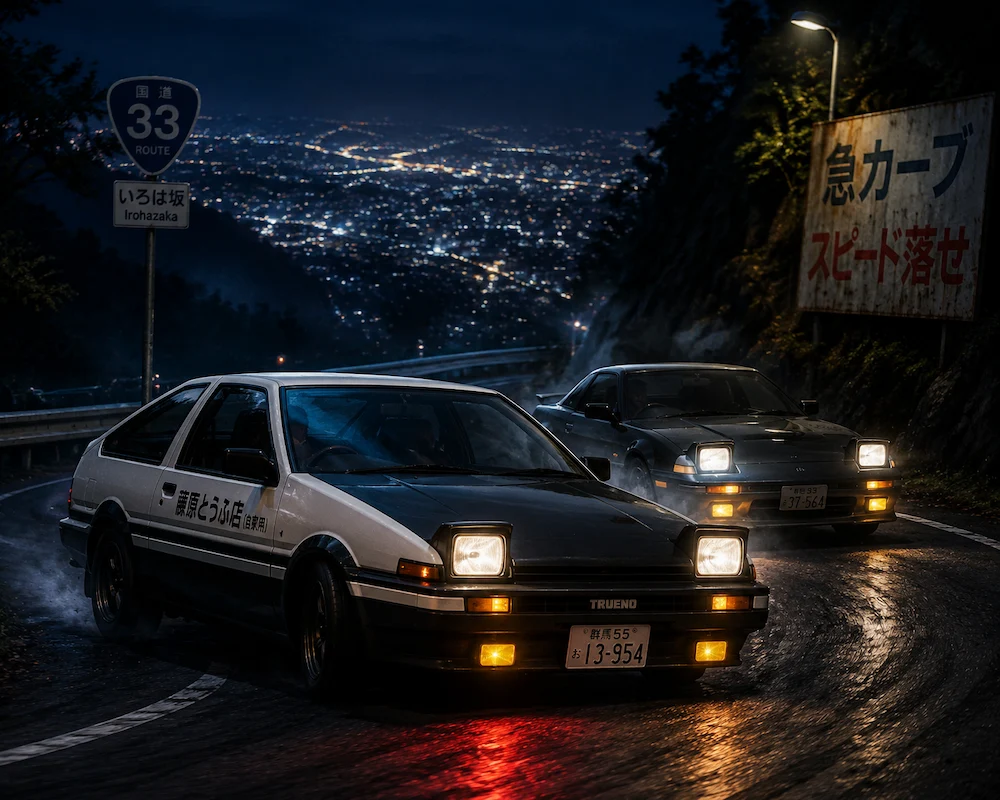
The manga and anime Initial D immortalized the Touge scene, bringing its drama and technique to the world. Real locations, such as Mount Haruna in Gunma Prefecture, and real vehicles inspired the fictional races. Fans across the globe experienced the tension of hairpin battles and the poetry of drifting through curves. Albo Agunday remarks, “It’s the anime Initial D come to life” , emphasizing the connection between reality and its artistic depiction. The series created a lasting fascination with JDM cars and Japanese drift culture worldwide.
Legacy of Touge in Modern Motorsport
Today, Touge is revered not just as a racing style but as a philosophy of skill, respect, and courage. Its influence is evident in professional drifting, the global JDM community, and the ongoing pursuit of mastery on winding roads. The story of Touge is a testament to human daring, creativity, and the drive to push beyond limits. From clandestine night duels to international drift competitions, the spirit of Touge continues to shape the heart of motorsport.