Reading time: ~5 minutes.
Table of Contents
- A frozen stage where nobody expected drama
- Why an aircraft company ended up in rally sport
- Erik Carlsson – the man who changed everything
- The quiet engineering that became a weapon
- When snow, gravel, and chaos became Saab’s playground
- Wins that reshaped perception of rally racing
- Why rivals didn’t understand what was happening
- Saab’s lasting influence on modern rally thinking
- FAQ
A Frozen Stage Where Nobody Expected Drama
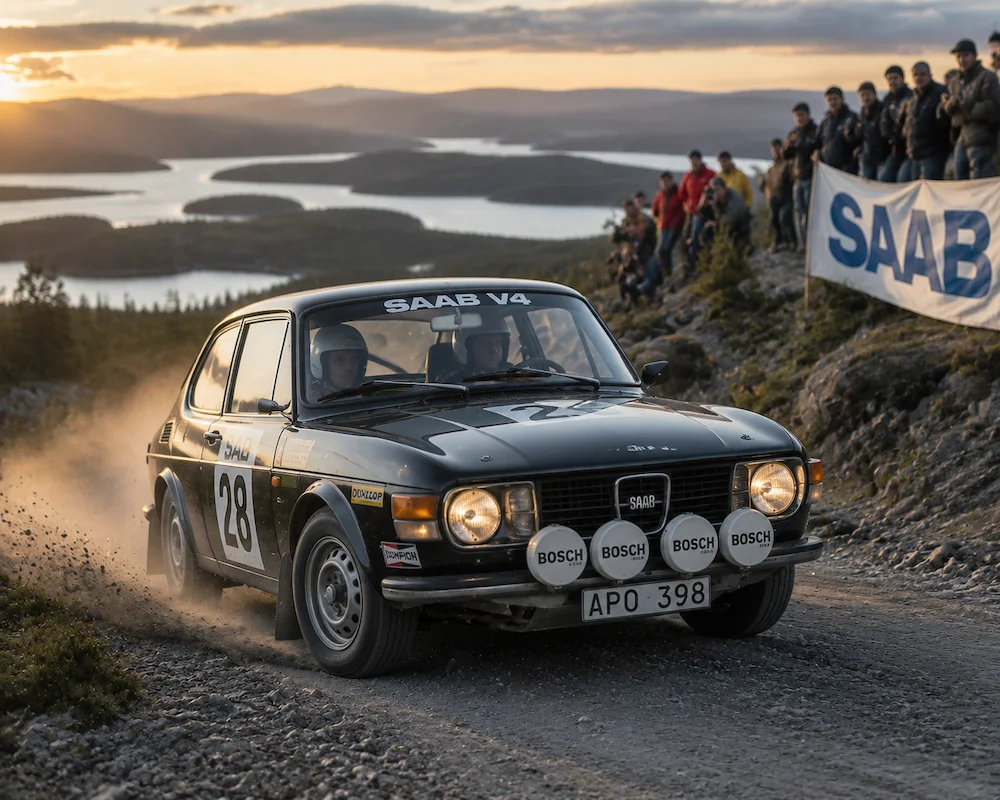
Picture a winter morning somewhere in Scandinavia. The air is sharp enough to sting your lungs, and the road ahead disappears into snow and forest shadows. Spectators stand quietly along frozen edges of gravel tracks, waiting for the usual suspects — powerful, loud, expensive machines.
But instead of a roaring exotic car, a small, almost modest Saab rolls up to the start line.
It doesn’t look aggressive. It doesn’t look fast. In fact, it looks like it belongs in a city parking lot rather than a rally stage carved through ice and trees.
Nobody is impressed.
And that’s exactly why Saab kept winning.
Because the moment the road turned unpredictable — everything changed.
Why an Aircraft Company Entered Rally Sport
Saab didn’t begin as a car company dreaming about trophies. It began in aviation, where engineers cared about lift, stability, airflow, and control under pressure. When that mindset moved into automobiles, the philosophy stayed the same: build something that behaves predictably when everything around it becomes unstable.
That’s why early Saab cars were never “flashy.” They were functional, almost stubbornly so. Rounded shapes, balanced weight distribution, and a focus on traction instead of top speed.
At first, people misunderstood this simplicity. It looked like hesitation.
In reality, it was preparation.
Erik Carlsson – The Man Who Changed Everything
Erik Carlsson was not just a driver. He was the moment Saab stopped being underestimated.
Known across motorsport as “Mr. Saab”, Carlsson had a driving style that looked almost impossible from the outside. He didn’t just brake late — he negotiated with physics. He used controlled slides, left-foot braking, and a level of car control that made spectators unsure whether he was saving the car or inventing a new way to drive.
According to his biography on Saab Planet, Carlsson became inseparable from the brand, turning every victory into a shared identity between man and machine.
One of his rivals once described him simply as someone who “never seemed to lose momentum — even when everyone else had already given up.”
That wasn’t luck. That was technique.
The Quiet Engineering That Became a Weapon
Saab never tried to out-muscle its competitors. Instead, it built cars that stayed calm when others panicked.
Front-wheel drive gave traction on snow-covered roads where rear-wheel-drive cars struggled. Lightweight construction meant quicker corrections in tight corners. Narrow bodies made the cars surprisingly stable on unpredictable gravel sections.
But the real advantage wasn’t a single feature — it was how everything worked together.
They weren’t chasing speed.
They were chasing control.
And in rally racing, control often wins more than horsepower.
When Chaos Became Saab’s Playground
Scandinavian rally stages are not gentle. Snow hides gravel. Ice appears without warning. Corners arrive faster than drivers expect, and mistakes are punished immediately.
Most manufacturers treated these conditions as a nightmare.
Saab treated them as home.
While others fought for traction, Saab cars simply kept moving forward — steady, predictable, almost patient. That patience became an advantage when everything else turned unpredictable.
Wins That Changed Perception
The turning point came when Erik Carlsson started winning consistently in major international rallies. His victories in the Monte Carlo Rally in the early 1960s shocked teams that had far more powerful cars.
The RAC Rally wins (1960–1962) weren’t just results — they were signals that something fundamental had shifted in how rally performance could be achieved.
Suddenly, paddocks stopped laughing at Saab.
They started studying it.
Why Rivals Didn’t Understand Saab
At first, Saab was dismissed as too small, too simple, too underpowered to matter in serious competition.
The mistake was obvious in hindsight: competitors assumed power was everything.
But Saab proved something different — that on unstable surfaces, too much power could actually become a disadvantage.
As one old rally philosophy goes:
“The fastest car is the one that stays on the road.”
Saab’s Lasting Influence on Rally Thinking
Even though Saab never became a dominant empire like some later manufacturers, its influence is still visible today.
Front-wheel-drive systems, winter rally strategies, and vehicle stability philosophies all carry traces of what Saab proved in the 1960s.
Erik Carlsson’s legacy remains a reference point in discussions about driving skill versus raw engineering.
In a way, Saab didn’t just compete in rallying — it quietly changed its rules.
FAQ
Why was Saab successful in rally racing?
Because its engineering prioritized traction and stability over raw power, especially on snow and gravel.
Who was Erik Carlsson?
A Swedish rally driver known as “Mr. Saab,” famous for his unique driving style and major 1960s victories.
Did Saab really beat stronger cars?
Yes. Saab regularly outperformed more powerful teams in winter and gravel conditions during major rallies.
Saab’s story is not about building the fastest car.
It’s about building the most honest one for the conditions it was meant to face.
And sometimes, in rally racing – and in engineering – honesty beats horsepower.