
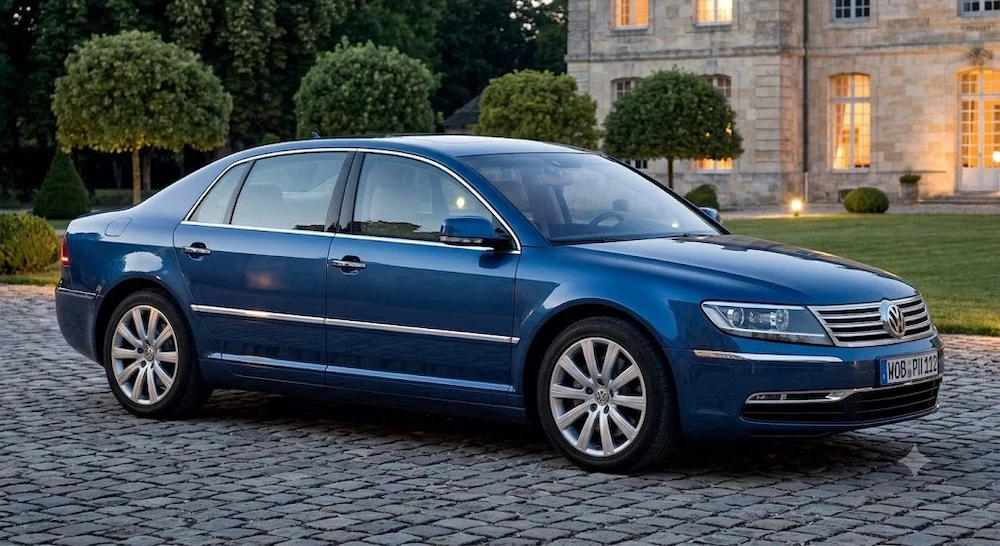
The Volkswagen Phaeton remains one of the strangest stories in modern automotive history. It was built with the ambition to compete against the most prestigious German luxury sedans, offering engineering quality close to Bentley standards. However, the car failed not because it was poorly designed, but because buyers could not accept the idea of paying luxury money for a Volkswagen. This is the story of how branding, timing and customer psychology defeated one of the most impressive cars of its era.
Why Volkswagen Phaeton Is Considered an Underrated Car Today
When Volkswagen introduced the Phaeton in 2002, the goal was extremely ambitious: create a luxury sedan capable of challenging the dominance of Mercedes-Benz S-Class and BMW 7 Series.
The project was strongly connected with Ferdinand Piëch, who wanted Volkswagen to prove that engineering excellence was not limited to traditional premium brands. The result was a technically advanced sedan featuring powerful engines, handcrafted details and exceptional comfort.
According to information about the model’s development, the Phaeton was designed around strict engineering goals, including maintaining a comfortable cabin temperature even at very high speeds. The car became a demonstration of what Volkswagen engineers could achieve.
But there was one major problem: the market did not see Volkswagen as a luxury brand.
Sometimes the biggest obstacle for a product is not its quality — it is the expectations people already have.
Buyers Simply Did Not Believe the Volkswagen Badge
The psychology of the premium segment
Luxury cars are not purchased only because of specifications. They represent identity, social status and personal achievement.
A buyer choosing a Mercedes-Benz S-Class or BMW 7 Series was not simply buying transportation. They were buying decades of reputation, prestige and recognition.
The Volkswagen Phaeton entered this world with a serious disadvantage. The badge on the hood created confusion.
Many customers asked a simple question:
“Why should I spend luxury money on a Volkswagen?”
This became the biggest marketing challenge for the entire project.
A personal owner review published by enthusiasts on automotive communities often highlights the same point: Phaeton owners appreciate the engineering, comfort and quality, but they also mention that explaining the car to other people is part of the ownership experience.
One owner described the feeling of driving the car as:
“It feels like a Bentley hidden under a Volkswagen badge.”
That sentence perfectly explains the Phaeton’s success and failure at the same time.
The Car Was Too Good for Its Time
Luxury technology ahead of the market
The Volkswagen Phaeton was packed with features that were impressive even compared with much more expensive competitors.
Inside, owners received:
- premium leather interiors;
- advanced climate control systems;
- sophisticated suspension technology;
- powerful V8 and W12 engines;
- exceptional sound insulation;
- extremely high build quality.
The connection with Bentley was not accidental. The Phaeton shared engineering ideas with the Bentley Continental GT, and many components reflected Volkswagen Group’s highest technical ambitions.
The problem was that customers did not always reward innovation.
In the early 2000s, many luxury buyers preferred traditional symbols of success rather than hidden engineering excellence.
The Phaeton was almost too rational. It offered what engineers valued, but not necessarily what luxury customers wanted.
Price Scared Even Volkswagen Fans
Paying premium money for a non-premium badge
The Volkswagen Phaeton was never a cheap car.
Depending on the market and equipment level, it competed directly with established luxury sedans. Buyers could choose between a Volkswagen and brands that had spent decades building premium reputations.
For many customers, the decision was simple:
Why buy an expensive Volkswagen when the same money could purchase a Mercedes-Benz or BMW?
The problem was not the price itself. The problem was the relationship between price and perception.
Luxury buyers often expect exclusivity. The Phaeton offered quality but lacked the emotional value attached to premium badges.
The Exterior Design Was Too Invisible
A luxury car that looked like a Passat
One of the most common criticisms of the Volkswagen Phaeton was its conservative appearance.
The design was elegant but extremely restrained. From a distance, some people confused it with the much cheaper Volkswagen Passat.
For ordinary vehicles, subtle styling can be a positive quality. In the luxury segment, however, visual presence matters.
A premium sedan is expected to announce success before the driver even opens the door.
The Phaeton had the opposite personality: it was a quiet masterpiece that many people simply ignored.
Complex Technology Created Ownership Problems
Expensive repairs and difficult maintenance
The same engineering ambition that made the Phaeton impressive also created challenges for used-car owners.
The sedan contained complicated systems, advanced electronics and expensive components. As the cars aged, maintenance costs became a major concern.
Common ownership difficulties included:
- costly suspension repairs;
- complex electrical systems;
- expensive engine servicing;
- limited availability of specialists.
For enthusiasts, these challenges are part of the experience. For average buyers searching for a used luxury car, they can become a reason to look elsewhere.
The Timing Was Almost Impossible
Fighting the German luxury giants
The Volkswagen Phaeton arrived during one of the toughest periods imaginable.
The luxury sedan market was controlled by established competitors with loyal customers and powerful brand images.
At the same time, customer preferences began changing. SUVs and crossovers became increasingly popular, reducing demand for traditional executive sedans.
The Phaeton was created for a market that was already beginning to disappear.
It was an extraordinary answer to a question fewer people were asking.
Why Volkswagen Phaeton Became a Hidden Gem
The second life of a forgotten luxury sedan
Years later, opinions about the Volkswagen Phaeton changed dramatically.
On the used market, the car became much more affordable, allowing enthusiasts to experience technology that once cost six figures.
Today, many automotive fans consider the Phaeton one of the best examples of depreciation creating unusual opportunities.
Buyers can get:
- Bentley-level engineering;
- limousine-like comfort;
- powerful engines;
- excellent highway performance;
for a fraction of the original price.
Of course, ownership still requires understanding maintenance costs. The Phaeton is not a cheap car to repair, but it offers a driving experience that few vehicles in its price range can match.
FAQ
Why did Volkswagen Phaeton fail?
The main reasons were poor brand positioning, high price, conservative design and competition from established luxury manufacturers.
Was Volkswagen Phaeton based on Bentley technology?
Yes. The Phaeton shared engineering development with other premium Volkswagen Group projects, including Bentley-related technology.
Is Volkswagen Phaeton worth buying today?
For enthusiasts who appreciate luxury engineering and can handle maintenance costs, the Phaeton can be an excellent used-car choice.
Why is Volkswagen Phaeton considered underrated?
Because its failure was mostly caused by marketing and customer perception rather than poor engineering.
The Volkswagen Phaeton proves that success in the automotive world is not determined only by engineering quality.
Volkswagen created a sedan that was comfortable, advanced and extremely well built. Yet buyers did not accept the idea that a Volkswagen could compete with traditional luxury icons.
The Phaeton became a lesson in branding: sometimes the market does not choose the best product – it chooses the product that feels right.
Buying a Volkswagen Phaeton during its original production years was a risky decision. Some saw a forgotten luxury car; others saw an impossible experiment. The automotive world is often like a game where the winner is not always the strongest competitor, but the one people are willing to believe in.