
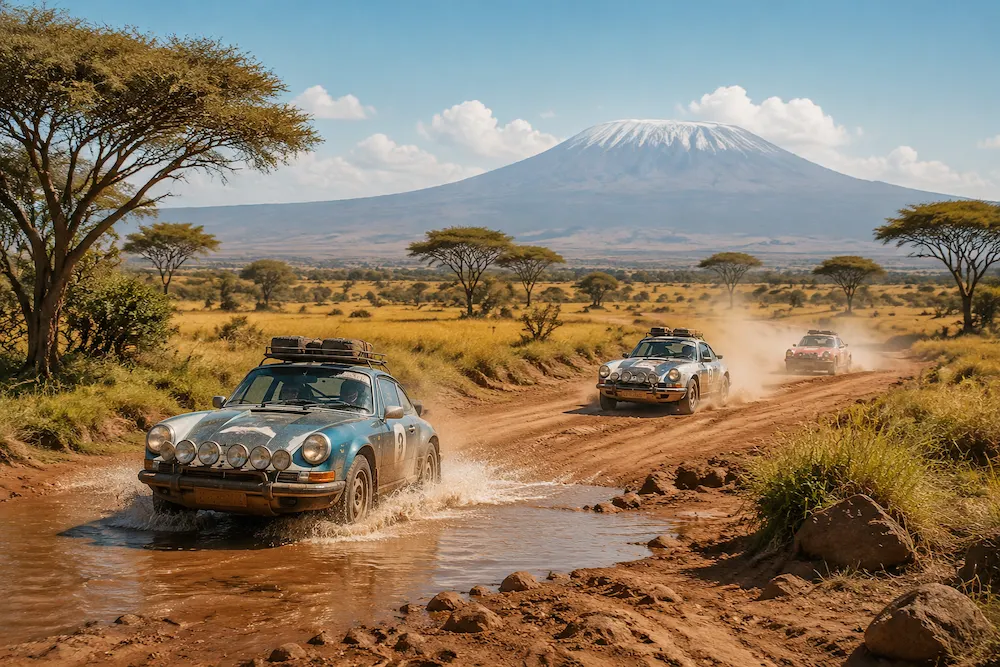
Today everyone knows the Dakar Rally, but almost nobody remembers the events that came before it. In the 1960s and 1970s, Africa was the last great frontier for motorsport: thousands of kilometers of unpredictable terrain, limited infrastructure and almost no external help. In those races, victory was important, but simply reaching the finish line was often the greatest achievement.
The birth of continent-spanning endurance races
Modern motorsport fans often associate extreme rallying with speed, technology and professional teams. However, half a century ago, endurance rallies were completely different. They were not only competitions – they were expeditions where drivers tested their courage, mechanical knowledge and ability to survive.
During the 1960s and 1970s, Africa offered a unique challenge. Vast territories had limited road networks, unpredictable weather and enormous distances between settlements. Organizers saw the continent as the perfect place for races that could push both humans and machines to their absolute limits.
For car manufacturers, these events became real-world laboratories. A production-based vehicle that survived thousands of kilometers through mud, rocks and heat proved its reliability better than any advertising campaign.
Unlike modern racing, where teams can analyze every detail with computers, those competitors relied on experience, preparation and instinct. A wrong decision could mean losing hours – or becoming stranded hundreds of kilometers from assistance.
East African Safari Rally – the beginning of a legend
Among all African endurance events, the East African Safari Rally became one of the most respected and feared competitions in motorsport history. Originally created in 1953, it was renamed the East African Safari Rally in 1960 and later became known simply as the Safari Rally.
The race was famous for conditions that destroyed even well-prepared cars:
- deep mud after tropical rains;
- dusty roads covered with loose sand;
- broken tracks through remote regions;
- extreme heat and unpredictable weather;
- thousands of kilometers with minimal recovery options.
The route could stretch around 5,000 kilometers, combining fast sections with brutal terrain where reliability often mattered more than pure speed.
Many drivers described the event as a battle against nature rather than against rivals. Porsche’s historical coverage of the rally highlighted the incredible challenge: competitors faced thousands of miles through sand, gravel, mud and dust, with endurance becoming the key factor.
One of the best descriptions of the Safari spirit came from experienced rally competitors. Jeff Zwart, after completing a modern classic version of the event, called the East African Safari Rally “probably the hardest event I’ve ever done.”
That attitude perfectly explains why these races became legendary: finishing itself was a victory.
London–Sydney and London–Cape Town: the era of giant journeys
Before specialized rally raids became popular, organizers experimented with massive international crossings.
Events such as London–Sydney and London–Cape Town challenged drivers to travel across continents rather than simply compete on closed stages.
These races involved:
- thousands of kilometers of driving;
- changing climates and landscapes;
- border crossings through multiple countries;
- limited technical support;
- nearly standard road cars.
The machines were not futuristic racing prototypes. Many were modified versions of cars that ordinary people could buy. Their success depended on durability, preparation and the skill of the crew.
These competitions created a new idea in motorsport: the adventure was not only about being fastest. The real challenge was surviving the journey.
World Cup Rally 1970 – the forgotten African marathon
The World Cup Rally 1970 remains one of the most impressive yet forgotten endurance races in history.
Designed as a celebration of football’s World Cup year, the event connected Europe and Africa in a massive route covering more than 16,000 kilometers. Drivers crossed countries, deserts and remote areas where a simple mechanical failure could end their adventure.
The race tested everything:
- engines pushed beyond normal limits;
- tires destroyed by rough terrain;
- exhaustion from constant driving;
- extreme temperatures;
- political instability along the route.
Unlike modern rallies, there was no immediate rescue system waiting nearby. A broken suspension component or damaged fuel system could turn a competitive battle into a survival situation.
The race represented a different philosophy of motorsport. Drivers were not only fighting opponents – they were fighting distance itself.
Why those races were more dangerous than modern Dakar
Modern rally raids are incredibly difficult, but competitors today have advantages that were unimaginable in the 1970s.
No GPS navigation
Drivers depended on paper maps, notes and their co-driver’s skills. A wrong turn could cost hours.
No satellite communication
Teams could not instantly call for help from anywhere on the route.
Limited medical assistance
Injuries or serious mechanical problems could become major emergencies.
Almost no rescue infrastructure
Competitors could be hundreds of kilometers away from the nearest settlement.
Real geographical risks
Routes sometimes passed through areas affected by political conflicts, poor roads or extreme isolation.
The uncertainty created a unique psychological challenge. Every decision mattered because nobody knew exactly what waited ahead.
Why these extreme rallies disappeared
Several factors changed motorsport forever.
Safety standards
Modern racing requires better medical systems, controlled routes and improved protection for competitors.
High organizational costs
Supporting a race across multiple countries requires enormous financial resources.
Political changes
International routes became more complicated because of border restrictions and regional instability.
Professionalization of motorsport
Rallying moved toward shorter stages, television-friendly formats and specialized vehicles.
The era of massive uncontrolled journeys gradually disappeared.
The legacy of forgotten endurance competitions
Although these races are rarely discussed today, they created the foundation for modern rally raids.
The Dakar Rally inherited many ideas from these pioneers:
- extreme distances;
- unpredictable environments;
- endurance over pure speed;
- the importance of navigation;
- respect for nature and terrain.
The old African marathons represented something impossible to fully recreate today. They offered a feeling of true exploration, when maps ended before the adventure did.
In those races, people were motivated not only by trophies. There was another kind of excitement – the desire to discover personal limits, accept uncertainty and choose a path nobody else wanted to take.
Modern rally events impress with technology, speed and precision. But the African races of the past had something unique: the feeling that every kilometer was a step into the unknown.
FAQ
What was the World Cup Rally 1970?
The World Cup Rally 1970 was a long-distance endurance race connecting Europe and Africa, covering more than 16,000 kilometers and testing drivers through extreme conditions.
Why was the East African Safari Rally considered so difficult?
Because competitors faced unpredictable weather, rough roads, mud, sand and enormous distances with limited support.
Were cars in these races specially built prototypes?
Many competitors used modified versions of production cars, making reliability and preparation essential.
Did these events influence the Dakar Rally?
Yes. The philosophy of endurance, navigation and survival became an important foundation for modern rally raids.
Why are these races almost forgotten today?
Changes in safety requirements, costs and the development of professional motorsport formats made such extreme international journeys difficult to organize.