
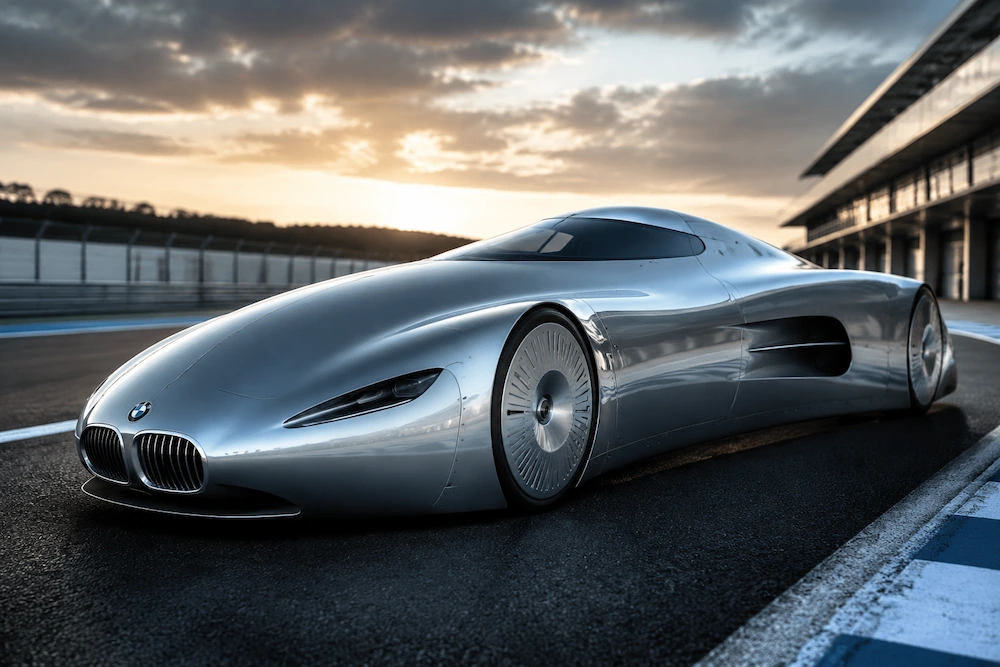
Most BMW fans know the brand for powerful engines, aggressive styling and the famous feeling of driving a rear-wheel-drive performance car. But in the early 2000s, BMW created something that looked like it belonged in a science-fiction movie rather than on a race track.
The BMW H2R was a strange, futuristic machine built around one ambitious idea: proving that hydrogen could power a high-performance vehicle without destroying the emotions drivers loved.
Nicknamed the “turbine on wheels,” this BMW experimental car combined a liquid hydrogen fuel system, a powerful V12 engine and extreme aerodynamics. It was never designed for dealerships or everyday roads. It was built to answer a simple but important question:
Could the future of clean transportation still be exciting?
From gasoline to hydrogen: why BMW built the H2R
At the beginning of the 2000s, the automotive world was searching for the next generation of mobility.
Electric cars were still far from becoming mainstream, and many manufacturers were exploring different solutions. Hydrogen was considered one of the most promising alternatives because it offered the possibility of cleaner transportation without completely abandoning traditional engine technology.
BMW chose a unique path.
Instead of creating a fuel-cell vehicle, the company decided to modify a classic internal combustion engine and make it run on hydrogen.
The result was the BMW H2R – short for Hydrogen Record Car.
The idea behind the project was not to create a practical family vehicle. BMW wanted to demonstrate that hydrogen could be used in a high-performance machine.
The engineers were asking a question that sounded almost impossible at the time:
Could a car with alternative fuel still have the soul of a BMW?
The H2R became the answer.
BMW H2R design: a car from another planet
The first impression of the BMW H2R is unforgettable.
It does not look like a normal BMW. There is no traditional grille, no familiar sports-car silhouette and no attempt to follow conventional design rules.
Instead, the H2R looks like a mixture of a Le Mans prototype, an aircraft and a futuristic land-speed record vehicle.
Its body was created with one priority: reducing air resistance.
The design included:
- a long teardrop-shaped body;
- fully covered wheels;
- an extremely low profile;
- lightweight aluminum construction;
- carbon-fiber body elements.
Every line had a purpose.
BMW engineers were not trying to create a beautiful showroom model. They were trying to build a machine that could slice through the air as efficiently as possible.
The aerodynamic result was impressive, with a drag coefficient of around 0.21 — a number that remains remarkable even today.
Looking at the H2R decades later, it still feels unusual. Many concept cars from that era now look outdated, but this one still appears like a prototype from the future.
The heart of the machine: BMW’s hydrogen V12 engine
Under the futuristic body was something surprisingly familiar — a BMW V12 engine.
The BMW H2R used a 6.0-liter twelve-cylinder engine adapted to run on liquid hydrogen instead of gasoline.
This decision separated BMW from many other hydrogen projects.
The company did not want to replace the emotional side of driving. Engineers wanted to prove that alternative energy could still work with a traditional performance engine.
However, converting a V12 to hydrogen was not simple.
The team had to solve several challenges:
- hydrogen required completely different fuel management;
- liquid hydrogen had to be stored at extremely low temperatures;
- combustion characteristics were different from gasoline;
- safety systems needed to be redesigned.
The result was a fascinating combination: futuristic fuel technology paired with classic mechanical engineering.
That is what makes the BMW H2R so interesting. It was not simply an eco-friendly prototype. It was an experiment trying to protect the character of performance cars in a changing world.
BMW H2R speed records: when hydrogen became exciting
The H2R was not created just for exhibitions.
BMW wanted real proof that the technology worked, so the car was developed specifically for high-speed testing.
During record attempts, the BMW H2R achieved a top speed of approximately 302 km/h and set nine international records for hydrogen-powered vehicles.
These results were important because hydrogen cars at the time often had a reputation for being slow and experimental.
BMW showed a different possibility.
A hydrogen vehicle could be fast.
It could be dramatic.
It could create emotions.
Automotive journalist and enthusiast discussions around the project often focused on the same idea: the H2R was not practical, but it was incredibly inspiring.
One observer described the philosophy behind the project:
“The BMW H2R was not created because customers demanded it. It was created because engineers wanted to discover what was possible.”
That sentence perfectly explains why this car remains memorable.
Why BMW H2R never became a production car
Despite its impressive achievements, the BMW H2R was never prepared for mass production.
The biggest problems were not performance-related. They were practical.
Several factors stopped the project from becoming a road car:
- liquid hydrogen storage was complicated;
- hydrogen filling infrastructure was almost nonexistent;
- production costs would have been extremely high;
- battery-electric technology began developing much faster.
The H2R worked perfectly as an engineering experiment, but everyday transportation requires simplicity, affordability and convenience.
A technology can succeed on a test track and still struggle in the real world.
BMW H2R and the modern era of green cars
The automotive industry eventually moved in another direction.
BMW continued researching hydrogen technology but later placed much more focus on hybrid systems and electric vehicles.
Today, the company’s electric models represent a very different approach compared with the H2R.
However, projects like this remain important.
The BMW H2R proved that environmental technology did not have to mean boring cars. It showed that engineers could still experiment with speed, design and emotion while searching for cleaner solutions.
Many famous automotive innovations started as ideas that looked unrealistic at first.
The H2R belongs to that category.
Where is the BMW H2R today?
Unlike many experimental vehicles, the BMW H2R survived.
The unique prototype became part of BMW’s historical collection and remains one of the most unusual examples of the company’s engineering creativity.
The car also gained attention beyond motorsport when artist Olafur Eliasson transformed it into an artistic project exploring technology, energy and sustainability.
Today, the BMW H2R is remembered not as a failed production model but as a symbol of curiosity.
It represents a moment when car manufacturers were exploring many possible futures.
FAQ
What does BMW H2R mean?
BMW H2R stands for Hydrogen Record Car. It was created to demonstrate the potential of hydrogen-powered performance vehicles.
Is BMW H2R an electric car?
No. The BMW H2R used a modified V12 internal combustion engine powered by liquid hydrogen.
How fast was the BMW H2R?
The prototype reached approximately 302 km/h during record testing.
Can you buy a BMW H2R today?
No. The H2R was a one-off BMW experimental car and was never produced for customers.
Conclusion
The BMW H2R did not become a mass-market vehicle. It did not replace gasoline engines or change the automotive industry overnight.
But that was never its purpose.
The “turbine on wheels” showed something more important: innovation often begins with ideas that seem strange, expensive or impossible.
BMW created the H2R not because the world was ready for it, but because engineers wanted to explore what the future could look like.
And even decades later, this hydrogen-powered V12 machine remains one of the boldest and most fascinating experiments in BMW history.