When Speed Became Too Much
In the automotive world, manufacturers constantly compete for more power, higher speeds, and better performance. But sometimes the desire to win becomes a dangerous game. TVR decided to put everything on one card and create the most extreme road car possible.
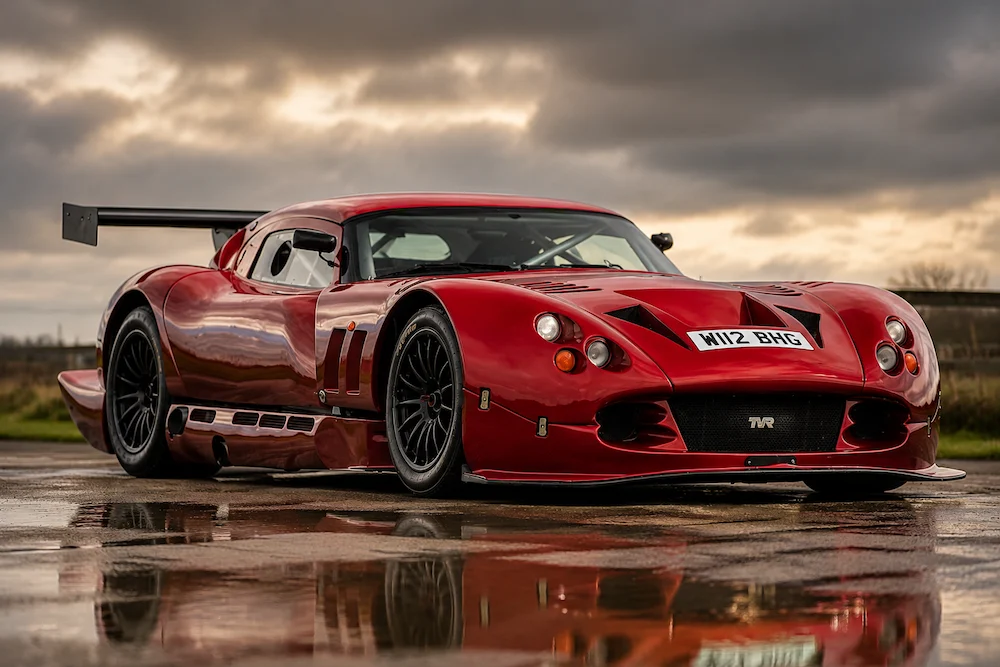
The result was the TVR Cerbera Speed 12 – a machine designed to challenge the greatest supercars of its era. It promised racing technology, enormous power, and performance capable of frightening even experienced drivers. However, instead of becoming a production icon, it became one of the most famous cars that almost existed.
In an industry where every manufacturer dreams of creating a legend, TVR discovered that some legends are born not from success, but from knowing when to stop.
How the Speed 12 Project Was Born
From GT1 racing dreams to a road-going supercar
The story of the TVR Cerbera Speed 12 began in the late 1990s when TVR wanted to compete in international GT racing. The company developed a prototype designed for the GT1 category, where manufacturers such as Ferrari, Porsche, and Mercedes were creating extremely powerful racing machines.
TVR’s goal was ambitious:
- create the fastest car in its class;
- defeat established European supercar brands;
- transfer racing technology into a road version;
- prove that a small British manufacturer could compete with industry giants.
The project was originally known as the TVR Project 7/12, referring to its massive 7.7-liter V12 engine. Later, the road-going version became known as the Cerbera Speed 12.
Unlike many manufacturers that focused on refinement and electronic assistance, TVR followed a completely different philosophy. The company believed in lightweight construction, raw mechanical performance, and a direct connection between driver and machine.
That approach created some unforgettable cars – but with the Speed 12, TVR pushed this philosophy to the extreme.
The Monster Under the Hood
A 7.7-liter V12 built for pure aggression
The heart of the TVR Cerbera Speed 12 was its enormous V12 engine. The power figures vary depending on sources and configurations, but estimates often place output between 800 and 960 horsepower.
At a time when many supercars produced between 400 and 600 horsepower, these numbers were almost unbelievable.
The engine was created by combining two six-cylinder TVR Speed Six units into one massive powerplant. The result was a lightweight but incredibly aggressive machine.
Key technical highlights included:
- 7.7-liter naturally aspirated V12 engine;
- estimated output close to 800+ horsepower;
- extremely low vehicle weight compared with rivals;
- minimal electronic driving assistance;
- racing-inspired construction.
The car was expected to deliver performance capable of challenging Ferrari, Lamborghini, and McLaren models of the period.
However, raw power was only part of the story. The real challenge was controlling it.
A Supercar Without a Safety Net
Modern performance cars rely heavily on technology. Traction control, stability systems, adaptive suspension, and advanced driver assistance help make extreme power manageable.
The Speed 12 represented a completely different era.
It was built around a simple idea: the driver should control the machine directly.
For professional racers, this approach could be exciting. For everyday owners, it created serious concerns.
The combination of:
- enormous horsepower;
- lightweight construction;
- rear-wheel drive;
- limited electronic assistance;
made the Speed 12 a vehicle that demanded respect.
It was not a car designed to forgive mistakes.
The Moment of Truth
When Peter Wheeler decided it was too dangerous
The turning point came when TVR owner Peter Wheeler personally tested the road version of the Speed 12.
According to accounts from the development period, Wheeler – an experienced driver himself – realized that the car was simply too extreme for normal road use.
After driving the prototype, he reportedly concluded that the machine was too powerful and dangerous to sell to ordinary customers.
A quote often associated with the project reflects this realization:
“It was simply too much car for the road.”
This personal evaluation became one of the most famous moments in TVR history. The company had achieved its goal of creating something extraordinary – but the result was beyond what could realistically be offered to customers.
The Speed 12 was not cancelled because it failed. It was cancelled because it succeeded too well at being extreme.
Why the Car Was Never Mass Produced
No official ban – just a decision by TVR
Despite the phrase “the car that was banned from sale,” there was no government prohibition against the TVR Cerbera Speed 12.
Instead, TVR itself decided not to continue with full production.
The reasons were practical:
Extreme handling characteristics
The car’s performance level was far beyond what most road drivers could safely manage.
Lack of modern safety technology
Unlike modern supercars, the Speed 12 lacked many electronic systems that help control high-performance vehicles today.
Massive power output
Nearly 1,000 horsepower in a lightweight road car created engineering and safety challenges.
Limited customer suitability
TVR understood that only a small number of highly skilled drivers could fully handle the machine.
The company reportedly built only prototypes and development examples, making the Speed 12 one of the rarest modern British performance cars.
A Personal Look at the Speed 12 Experience
Automotive journalists and enthusiasts who experienced extreme TVR models often described them as thrilling but demanding.
Owners of other TVR vehicles frequently mention the brand’s unique character: loud engines, lightweight bodies, and a feeling that the driver is always involved.
This philosophy explains why the Speed 12 remains fascinating today. It represents a time when manufacturers were willing to create machines without compromise.
The car was not designed to be comfortable, practical, or easy.
It was designed to answer one question:
How far can a road car go before it becomes too much?
The Legacy of TVR Cerbera Speed 12
The Speed 12 never became a common supercar parked outside luxury homes. It never achieved mass-market success and never competed directly against Ferrari or Lamborghini dealerships.
Yet, decades later, it remains one of the most memorable cars from the era.
Its legacy comes from several factors:
- it represented the final extreme vision of TVR engineering;
- it showed what a small manufacturer could achieve;
- it became a symbol of mechanical bravery;
- it proved that limits still exist, even in the world of speed.
Today, surviving examples and prototypes are considered automotive treasures. For enthusiasts, the Speed 12 is a reminder that sometimes the most impressive cars are the ones that were almost impossible to own.
FAQ
Was the TVR Cerbera Speed 12 ever sold to customers?
No. TVR developed prototypes and considered production, but the company cancelled the project before a full customer release.
How much horsepower did the Speed 12 have?
Estimates vary, but the engine was believed to produce around 800 – 960 horsepower depending on configuration.
Why was the TVR Cerbera Speed 12 cancelled?
The main reasons were its extreme performance, challenging handling characteristics, and concerns about safety for regular road drivers.
Is the Speed 12 faster than modern supercars?
Direct comparisons are difficult because it was never officially tested as a production vehicle. However, its power-to-weight ratio was extremely impressive even by modern standards.
Why is the Speed 12 still famous?
Because it represents one of the most ambitious attempts to create an unrestricted road-going performance machine.
TVR Cerbera Speed 12 became a symbol of an era when engineers tried to push automotive boundaries without compromise. Sometimes the brightest stars are the cars that never reach full production. In this story, caution defeated speed – and that is exactly why the Speed 12 remains unforgettable.