
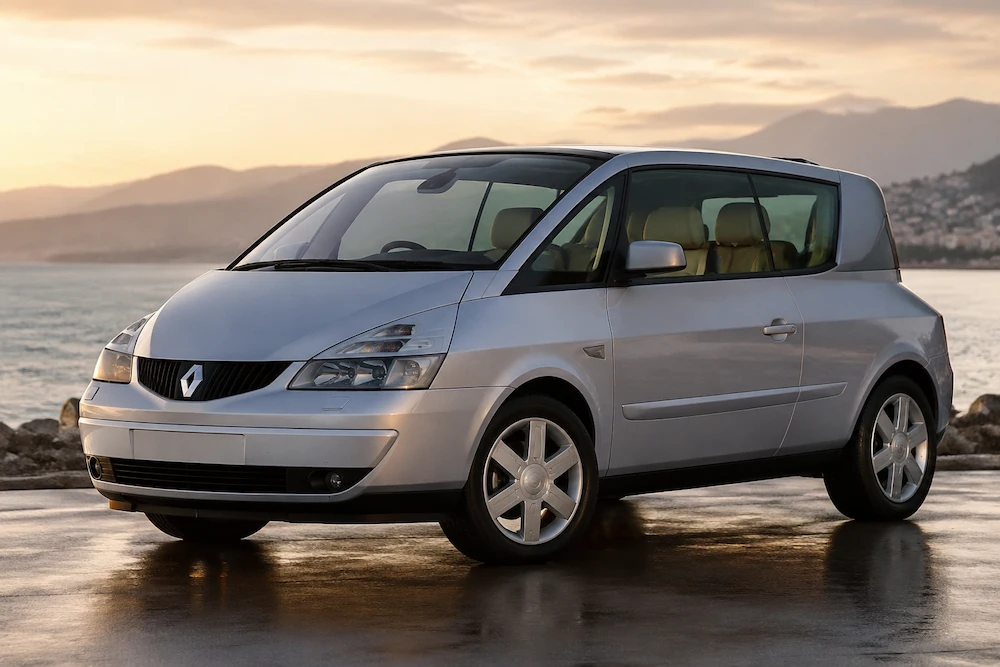
Imagine walking into a Renault showroom in 2001 and seeing a car that looks like nothing else on the road. It is too elegant to be a minivan, too practical to be a sports coupe, and too unusual to fit into any traditional category.
That was the Renault Avantime.
Renault believed it had created the future of personal luxury travel – a car for people who wanted space, comfort, and individuality without driving a typical executive sedan. Engineers created something genuinely original, but the market was not ready for such a bold experiment.
The Renault Avantime disappeared almost as quickly as it arrived. Yet decades later, the same features that confused buyers have turned it into one of the most fascinating cult cars of the early 2000s.
A Car That Tried to Invent Its Own Category
At the beginning of the 2000s, car companies were obsessed with one question: what would the car of the future look like?
SUVs were not yet dominating every market, electric cars were still a distant idea, and manufacturers were experimenting with new formats.
Renault decided not to follow the rules.
Together with Matra, the company created the Renault Avantime – a vehicle that was almost impossible to classify. It borrowed ideas from several worlds:
- the spacious interior of a minivan;
- the elegant silhouette of a coupe;
- the comfort of a luxury grand tourer.
On paper, it sounded brilliant.
Why should a buyer choose between practicality and style? Why couldn’t one car offer both? That was the question Renault wanted to answer.
The problem was that customers were not asking that question.
Design That Looked Like It Came From the Future
Even today, the Renault Avantime attracts attention.
Park one next to ordinary cars from the early 2000s and it almost looks like a concept vehicle that accidentally escaped from an auto show.
Designer Patrick Le Quément created a shape that ignored traditional expectations.
The car featured:
- enormous glass surfaces that filled the cabin with light;
- frameless doors that created a dramatic opening experience;
- no traditional B-pillar, making the side profile look incredibly clean;
- a panoramic roof that made the interior feel larger.
Inside, the Avantime was closer to a private lounge than a normal car.
The seats were designed for comfort rather than aggressive driving. The dashboard focused on simplicity. The whole experience was about relaxing and enjoying the journey.
It was a car that quietly said:
“You don’t need to rush. Just enjoy being here.”
And that was both its biggest strength and its biggest weakness.
Why Renault Believed It Had a Winner
The confidence behind Avantime was not unreasonable.
Renault already knew how to create successful unconventional vehicles. The Renault Espace had proven that European buyers appreciated spacious, comfortable cars.
The company believed there was a new group of customers waiting:
People who were too young for a traditional luxury sedan, too independent for a family minivan, and too practical for a sports coupe.
Renault imagined successful professionals choosing Avantime as a statement of personality.
A car that said:
“I could buy something ordinary, but I don’t want to.”
The idea was attractive. The reality was much harder.
The Problem: Nobody Knew What Avantime Was
The biggest enemy of Renault Avantime was not reliability.
It was confusion.
When buyers saw the car, many had the same reaction:
“Interesting… but why would I buy it?”
And that question was difficult to answer.
A minivan buyer wanted maximum practicality.
A coupe buyer wanted excitement.
A luxury buyer wanted status.
The Avantime sat somewhere in the middle.
It was not practical enough to replace a family vehicle.
It was not sporty enough to compete with a coupe.
It was not prestigious enough to challenge premium brands.
Renault had created a car for a customer who existed mostly in theory.
A Brilliant Idea That Arrived Too Early
The Avantime also suffered from timing.
Today, the idea of combining different vehicle types feels normal. Crossovers, luxury SUVs, and lifestyle vehicles dominate the market.
But in 2001, the world was different.
Buyers liked cars that were easy to understand.
The Avantime asked them to imagine a new category — and most people simply were not interested.
Sometimes being ahead of your time means nobody notices you.
The Financial Disaster
Renault hoped Avantime would become a successful niche model.
Instead, production numbers were disappointing.
Between 2001 and 2003, only around 8,500 examples were built.
The project became a major disappointment, and production ended after just a few years.
For Matra, which manufactured the car, the consequences were even more serious. The failure of Avantime contributed to the end of Matra’s automotive production.
A vehicle designed to represent the future became a symbol of how risky innovation could be.
Why People Love Renault Avantime Today
Here is the funny part of the story:
The things that made people reject the Avantime are exactly the reasons enthusiasts love it today.
Its strange shape became interesting.
Its rarity became valuable.
Its unconventional thinking became admirable.
Collectors often appreciate cars that tell a story, and Avantime tells a very unusual one.
It represents a moment when an automotive company had the courage to say:
“What if we stop copying everyone else?”
The answer did not create a commercial success.
But it created something much rarer — a car people still talk about decades later.
FAQ
Why did Renault Avantime fail?
The car failed because buyers struggled to understand its purpose. It was expensive, unusual, and difficult to compare with traditional vehicles.
Was Renault Avantime a bad car?
No. Many enthusiasts consider it a well-engineered and comfortable vehicle. Its main problem was market positioning, not quality.
Why is Renault Avantime becoming collectible?
Its limited production, futuristic design, and unique story make it attractive to collectors looking for unusual cars.
How many Renault Avantime cars were made?
Approximately 8,500 units were produced between 2001 and 2003.
Final Thoughts
The story of Renault Avantime is not really a story about failure. It is a story about courage.
Renault created a car that challenged almost every rule in the industry. It asked customers to see the future – but the future had not arrived yet.
The Avantime lost the commercial battle, but it won something more important: a place in automotive history. Many successful cars are forgotten.
But the Renault Avantime? People are still trying to understand it. And that is exactly why it remains special.