
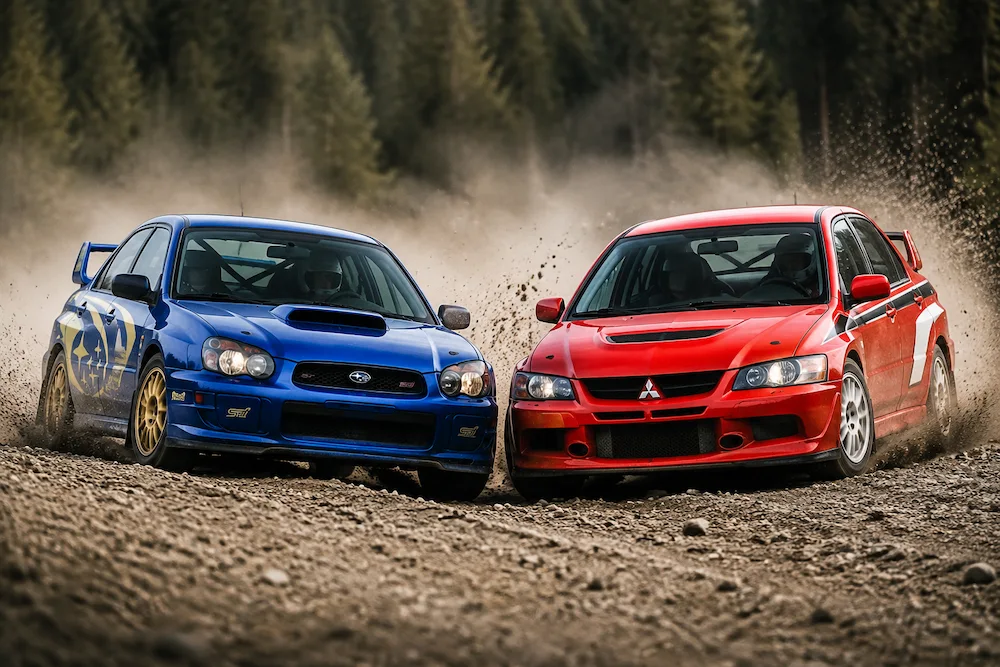
The 1990s are remembered as one of the greatest periods in motorsport history. The World Rally Championship became a battlefield where Japanese manufacturers tested their engineering limits. Subaru and Mitsubishi transformed ordinary road cars into legendary rally weapons, creating a rivalry between the Subaru Impreza WRX STI and Mitsubishi Lancer Evolution that continues to inspire car enthusiasts around the world.
The golden era of WRC: when rally became a technological war
The 1990s changed the face of the World Rally Championship. Rally cars were no longer just modified production vehicles — they became showcases of advanced engineering, aerodynamic development, and intelligent all-wheel-drive systems.
Japanese manufacturers saw WRC as the perfect place to prove their technology. Subaru and Mitsubishi entered the championship with different philosophies but the same goal: winning world titles.
The rivalry was about more than victories. It was a battle between two engineering cultures:
- Subaru focused on balance, stability, and predictable handling.
- Mitsubishi developed aggressive technology designed for maximum performance.
- Both brands created cars that became legends far beyond rally stages.
The official WRC history shows how this period helped transform rally into a global motorsport phenomenon, attracting millions of fans worldwide.
How the great Subaru vs Mitsubishi rivalry began
Subaru replaces Legacy with the Impreza
Before the Subaru Impreza WRX STI became famous, Subaru competed with the Legacy RS. However, the company needed a lighter and more competitive platform.
The answer was the Impreza. Its compact dimensions, boxer engine layout, and advanced four-wheel-drive system made it perfectly suited for rally competition.
The Impreza quickly became Subaru’s symbol in motorsport, especially after the introduction of the STI performance versions.
Mitsubishi creates the Lancer Evolution
Mitsubishi developed the Mitsubishi Lancer Evolution specifically to compete in rally. The car was created as a homologation model, allowing the manufacturer to use advanced technology in WRC competition.
The Evolution combined:
- a powerful turbocharged engine;
- advanced four-wheel-drive systems;
- lightweight construction;
- aggressive handling characteristics.
Unlike Subaru’s focus on balance, Mitsubishi created a car that felt sharper and more attacking.
The result was one of the greatest rivalries in automotive history.
Subaru Impreza WRX STI – the car that became a legend
The Subaru Impreza WRX STI became one of the most recognizable rally cars ever produced.
Its success came from several engineering advantages.
The EJ20 boxer engine
The heart of the Impreza was the famous EJ20 turbocharged boxer engine.
Its flat-cylinder design provided:
- a lower center of gravity;
- improved weight distribution;
- smoother power delivery;
- excellent traction on difficult surfaces.
The engine became famous for durability and tuning potential, making the WRX STI a favorite among performance enthusiasts.
Symmetrical AWD system
Subaru’s Symmetrical All-Wheel Drive became one of its biggest advantages.
Unlike many competitors, Subaru designed the entire drivetrain around balance. The result was a car that felt stable and predictable even in extreme conditions.
The Impreza was especially strong on:
- snow-covered roads;
- gravel stages;
- changing weather conditions.
Driver-focused handling
The suspension setup allowed drivers to confidently control the car during long slides and high-speed corners.
Rally legends such as Colin McRae showed the world what the Impreza could do.
McRae once described rally driving as a constant battle between precision and aggression — a philosophy that perfectly matched Subaru’s character.
Mitsubishi Lancer Evolution – the weapon built for victories
The Mitsubishi Lancer Evolution followed a different approach.
The Evolution I–VI generations were developed rapidly, with each version improving performance and reliability.
The legendary 4G63 turbo engine
The Mitsubishi 4G63 engine became one of the most respected turbocharged engines in motorsport.
Its strengths included:
- high power potential;
- exceptional durability;
- strong torque delivery;
- excellent tuning possibilities.
Advanced four-wheel-drive technology
Mitsubishi invested heavily in electronic systems.
The Evolution introduced technologies such as:
- Active Center Differential (ACD);
- Active Yaw Control (AYC);
- advanced traction management.
These systems allowed the car to distribute power more effectively between wheels.
The Evo often felt more aggressive than the Subaru, rewarding drivers who preferred a sharper and more dynamic driving style.
The battle of all-wheel-drive technologies
| Feature | Subaru Impreza WRX STI | Mitsubishi Lancer Evolution |
|---|---|---|
| Main philosophy | Balance and stability | Maximum attack |
| Engine | EJ20 boxer turbo | 4G63 turbo |
| AWD system | Symmetrical AWD | ACD + AYC |
| Driving style | Predictable and smooth | Aggressive and precise |
| Strength | Gravel and snow | Mixed surfaces and asphalt |
| Character | Easy to control | More demanding |
Both systems became benchmarks for performance cars.
Subaru proved that mechanical balance could win championships, while Mitsubishi demonstrated the power of advanced electronics.
Legendary drivers behind the machines
Cars alone do not win championships. The golden WRC era was defined by unforgettable personalities.
Subaru heroes
- Colin McRae – famous for spectacular driving and fearless attacks.
- Richard Burns – known for precision and consistency.
- Petter Solberg – continued Subaru’s success into the next generation.
Mitsubishi legends
- Tommi Mäkinen – one of the greatest rally drivers in history.
- Kenneth Eriksson – experienced and technically gifted.
- Freddy Loix – an important part of Mitsubishi’s rally program.
The personalities of the drivers reflected their cars perfectly. McRae’s aggressive style matched the emotional character of Subaru, while Mäkinen’s calculated speed suited Mitsubishi’s technical approach.
The most memorable seasons of the rivalry
1995 – Subaru enters history
Subaru achieved its first manufacturers’ championship victory, proving that the Impreza was a serious contender.
1996 — McRae vs Mäkinen
The championship became a direct battle between two icons. Every rally felt like a duel between Subaru and Mitsubishi.
1997 — the World Rally Car era begins
New regulations changed WRC, but the rivalry continued.
1998–1999 — Mitsubishi dominance
Tommi Mäkinen and the Lancer Evolution became nearly unstoppable, securing multiple championship victories.
Impreza WRX STI vs Lancer Evolution: who was faster?
Comparing these cars remains one of the favorite debates among enthusiasts.
Engine and performance
The Subaru offered smoother power delivery thanks to the boxer engine, while Mitsubishi provided explosive turbocharged acceleration.
Handling
The WRX STI was easier to control near the limit.
The Evolution was sharper and more aggressive, especially with its electronic systems working at full capacity.
Reliability and tuning
Both cars became icons of the tuning world.
Owners around the globe still modify:
- engines;
- suspension systems;
- transmissions;
- turbo systems.
The two models helped create the modern JDM performance culture.
Why this was the golden age of WRC
Several factors made the 1990s unforgettable:
- real competition between manufacturers;
- legendary drivers;
- cars closely connected to production models;
- rapid development of AWD technology;
- famous liveries like Subaru 555 and Mitsubishi Ralliart;
- global popularity of rally racing.
Fans could watch a rally car on Sunday and imagine owning a similar machine on Monday.
That connection created a unique emotional bond between manufacturers and enthusiasts.
The legacy of the Subaru and Mitsubishi rivalry
Even decades later, the Subaru Impreza WRX STI and Mitsubishi Lancer Evolution remain symbols of performance.
Their influence can still be seen in modern sports cars:
- advanced all-wheel-drive systems;
- turbocharged engines;
- driver-focused engineering;
- motorsport-inspired technology.
According to many automotive enthusiasts, including long-time contributors on enthusiast platforms such as Subaru and Mitsubishi communities, these cars represented an era when manufacturers competed through innovation rather than marketing alone.
The rivalry also shaped the JDM culture, inspiring generations of drivers, collectors, and tuners.
FAQ
Why were Subaru and Mitsubishi rivals in WRC?
Both manufacturers competed for world championships using advanced four-wheel-drive cars. Their different engineering approaches created one of motorsport’s greatest rivalries.
Which car won more WRC titles: Subaru Impreza WRX STI or Mitsubishi Lancer Evolution?
Mitsubishi achieved several drivers’ championships with Tommi Mäkinen, while Subaru secured major manufacturers’ titles. Both became champions in their own way.
Is the Subaru WRX STI still produced?
The STI name remains legendary, although Subaru discontinued the traditional WRX STI production in many markets.
Why are Lancer Evolution and WRX STI still popular today?
Because they combine motorsport history, unique engineering, tuning potential, and emotional connection with drivers.
The winner of this legendary war was not only Subaru, Mitsubishi, or their championship-winning drivers. The true winners were motorsport fans. The rivalry created iconic cars, unforgettable personalities, and engineering solutions that influenced performance vehicles far beyond the World Rally Championship.
The battle between the Subaru Impreza WRX STI and Mitsubishi Lancer Evolution remains one of the brightest chapters in rally history – a time when technology, courage, and passion came together on the world’s toughest roads.