
Reading Time: ~7 minutes
Table of Contents:
- Introduction — The car that wasn’t supposed to be iconic
- John DeLorean — Visionary behind the dream
- Birth of the DMC-12 — A car from the future
- The Quality Issues and Paradox of Performance
- Scandal that Destroyed the Company
- Hollywood’s Role — From Failed Car to Time Machine
- How “Back to the Future” Cemented the DeLorean Legacy
- Conclusion — Why people love imperfect cars
- FAQ
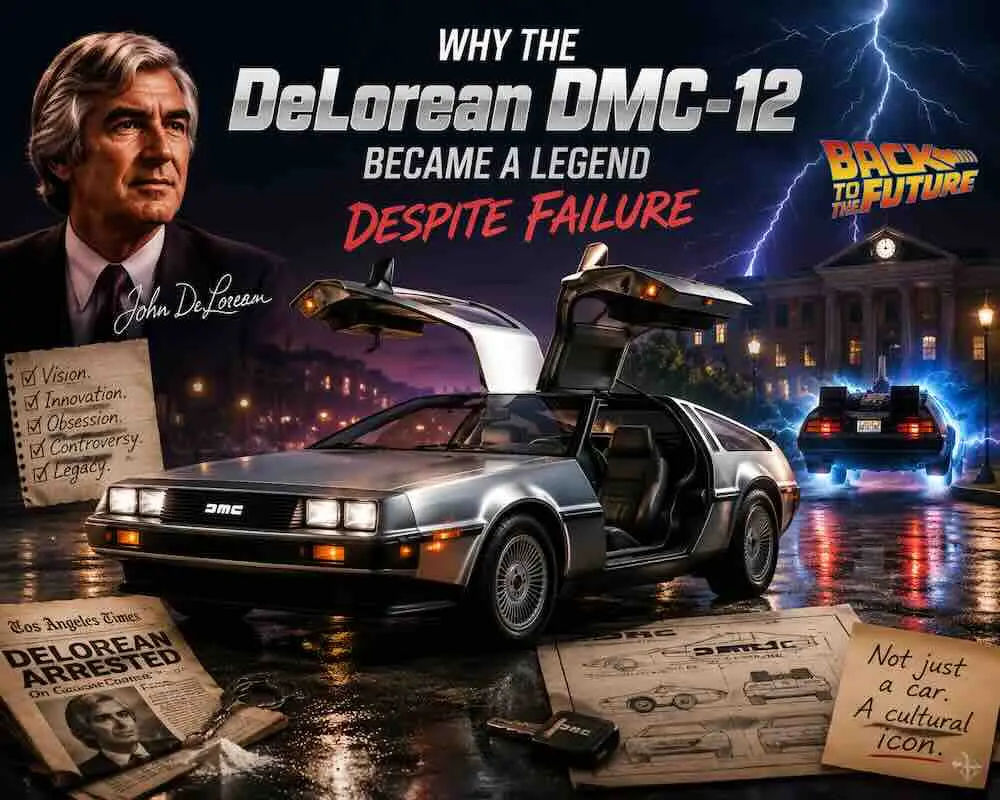
This article explores how the DeLorean DMC-12, despite financial failure, production issues, and scandal, transformed into a cultural icon thanks to John DeLorean’s vision and its starring role in Back to the Future.
Introduction — The car that wasn’t supposed to be iconic
The DeLorean DMC-12 failed almost everywhere: sales were weak, production suffered, and the company collapsed under debt and scandal. Yet decades later, the car is recognized even by those far removed from the auto world. How did a failed sports car become an immortal pop culture icon? And who was John DeLorean, the man bold enough to challenge automotive giants?
John DeLorean — Visionary behind the dream
John DeLorean was a rising star at General Motors, one of the youngest top executives in the company. He contributed to legendary cars like the Pontiac GTO and sought to create a “car of the future” under his own name. His charisma and risk-taking shaped the ambitious DMC-12 project.
“I wanted to create a car that would stand out, something futuristic yet attainable,” DeLorean once said, reflecting his personal drive.
Birth of the DeLorean DMC-12 — A car from the future
The DMC-12 was revolutionary for its time:
- Stainless steel body: brushed austenitic SAE 304 stainless steel body panels with an unpainted finish, except for a few gold-plated cars
- Gull-wing doors: instantly recognizable design, with each door supported by cryogenically treated torsion bars and nitrogen-charged struts developed by Grumman Aerospace
- Design by Giorgetto Giugiaro: Italian flair
- PRV V6 engine: a 2.85 L single overhead camshaft V6 with 130 hp at 5,500 rpm and 153 lb-ft of torque at 2,750 rpm, plus an 8.8:1 compression ratio and Bosch K-Jetronic fuel injection; available with manual and automatic transmissions
It was also engineered with input from Colin Chapman of lotus.
Challenges included constant design changes, insufficient funding, production delays, and a factory in Northern Ireland affected by political complications. Production officially began in January 1981 in Dunmurry, and for each model year the totals are estimated at 6,700 for 1981, 1,999 for 1982, and 276 for 1983, with most cars in left-hand-drive form intended for the usa. By November, the company was still making cars in relatively small numbers, and the total run is usually estimated at 8,975 built and assembled over the full production year span. The car used a rear engine layout with 35/65 front-to-rear weight balance, four-wheel independent suspension with double wishbones up front and a multi-link rear setup, and a fiberglass underbody tied to the chassis at a key point for rigidity. The stainless steel panels were made to be removable and easy to open for service or replacement.
The Quality Issues and Paradox of Performance
Early DeLoreans faced:
- Poor assembly quality
- Electrical issues
- Underpowered engine
- Transmission choice mattered, with a manual transmission generally feeling quicker than the available automatic transmission, though both transmissions still left the car expensive for its performance
Despite futuristic looks, the car performed below expectations: period road tests put 0–60 miles per hour at about 8.8 seconds with the manual, while some reviews recorded times as slow as 10.5 seconds.
Top speed was roughly 110–130 mph, and the manual usually edged the automatic on acceleration.
That helped explain why contemporary reviews often criticized the limited power on the road — the paradox was that it appeared faster than it actually was.
Scandal that Destroyed the Company
By the end of 1981, the company had built about 7,500 cars but sold only around 3,000, leaving the original DMC in deep financial trouble. By February 1982, after just 350 units were sold that month, mounting unsold inventory, pressure on dealers, too little room for stock, and the lack of enough sale activity pushed it into receivership and toward bankruptcy. Famous photos of DeLorean with a suitcase of cocaine circulated widely. Though he was later acquitted, the brand had already died.
Hollywood’s Role — From Failed Car to Time Machine
When casting a time machine for Back to the Future, filmmakers selected the DMC-12 model for the role, helping turn the original road-going car into a cultural icon. A refrigerator was rejected in favor of the DeLorean. During production of the trilogy, six DeLoreans were used, including one fiberglass car built for flying scenes. Its futuristic design and gull-wing doors made it ideal for representing “technology from the future.” Beyond Back to the Future, the DeLorean has also appeared in The Wedding Singer, American Dad!, and The Simpsons, often as a shorthand for the 1980s.
How “Back to the Future” Cemented the DeLorean Legacy
The movie transformed the DMC-12 into an icon:
- Surged in popularity among fans
- Developed a cult following that has lasted more than 40 years after the company shut down
- Became highly collectible
- Spawned clubs and communities around the world where owners share cars, stories, and replica time machines
That legacy also persists through replica builds, events, and fan communities worldwide.
Interesting fact: Most people today recognize the DeLorean not as a real sports car, but as Marty McFly’s time-traveling ride.
Conclusion — Why people love imperfect cars
The DeLorean lost as a business venture and as a sports car, yet it triumphed as a cultural symbol. Its story shows how charisma, innovation, and a touch of Hollywood magic can immortalize even imperfect machines.
FAQ
Q1: Was the DeLorean DMC-12 ever fast for its time?A1: Its 0–60 mph in ~8.8 seconds was modest; performance lagged behind looks.
Q2: Did John DeLorean profit from the DMC-12?A2: No, financial and legal troubles overshadowed any personal profit.
Q3: Can you still buy a DeLorean today?A3: Yes, they are collector’s items, often restored or modified as replicas. Values vary widely in today’s market, with an average sale price around $60,785, the highest recorded sale at $126,500, and the lowest recorded at $25,000. Original pricing also changed by model year: 1981 started at a $25,000 MSRP (about $89,000 in 2025), 1982 rose to $29,825 (about $100,000), and 1983 reached $34,000 (about $110,000). Buyers often use market data to track listings by location, compare auctions to the high bid, and check whether a car was sold, when it was purchased, and how it was registered.