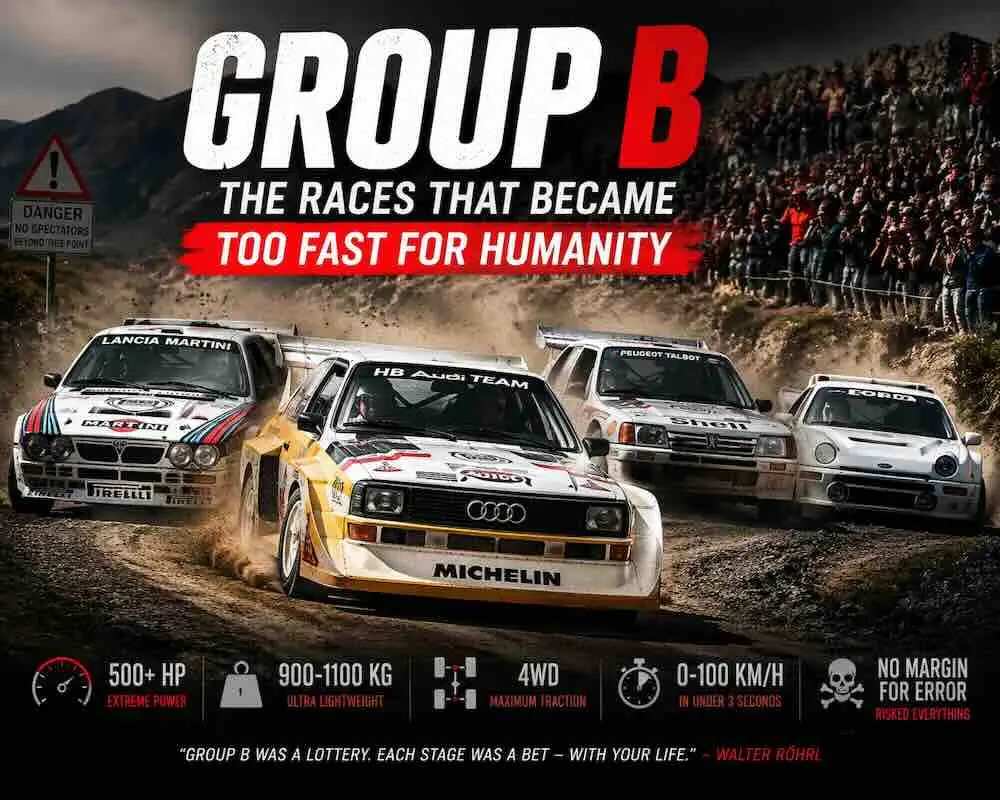
Group B racing, a unique chapter in motorsports history, is remembered as the golden era of rallying, when innovative and high-performance cars transformed the sport. Iconic group b rally cars like the Audi Sport quattro S1 and Lancia Delta S4 redefined both performance and danger, earning the nickname ‘Killer B’s’ for their legendary status and deadly risks. With horsepower over 500 and cars designed to be nearly uncontrollable, drivers were often mere inches from disaster. Despite the risks, fans loved the raw energy of the races, creating an era where every race was a thrilling game of chance. The tragic events that led to the demise of Group B highlighted the price of pushing technology too far. Today, the legacy of these supercars lives on in modern engineering, but the cautionary tale remains clear: when speed becomes a gamble, the line between legend and catastrophe is perilously thin.
When Motorsports Went Out of Control
In the 1980s, Group B was a legendary category and rally group within international rallying, recognized globally for its extreme speed and risk. These cars boasted over 500 horsepower, while the crowd stood dangerously close to the action, just meters from the racing track. With little modern safety technology and no electronic aids, the machines of Group B were a recipe for chaos. Drivers in this era were admired for their courage—often even feared by their peers. Group B was essentially a game of chance, where the stakes were life and death, and every race was a roll of the dice.
What Was Group B in the World Rally Championship and Why It Came to Be
Group B, introduced by the FIA in the early 1980s, was a legendary and short-lived (1982-1986) category of rally cars in the World Rally Championship (WRC), defined by specific regulations based on engine displacement and minimum weight. The homologation minimum was reduced from 400 in Group 4 to just 200, enabling manufacturers to develop new cars specifically for Group B without the financial burden of mass production. Group B regulations followed Articles 252 and 253, which included requirements for safety cages, fuel tanks, and other critical safety parts such as windshields and side-view mirrors.
Manufacturers competed fiercely for the manufacturers title, pushing the boundaries of what rally cars could achieve. The rules imposed minimal restrictions on technology, design, or materials, allowing the use of lightweight composite materials like fiberglass and Kevlar, with many cars weighing below 900 kg. This freedom led to the creation of some of the most powerful, technologically advanced, and dangerous rally cars in history. By 1986, Group B cars featured huge spoilers and aggressive aerodynamic kits to maintain stability at high speeds, and some could accelerate from 0-60 mph in under three seconds on gravel—matching modern Formula 1 cars.
Group B rally cars were often mid-engined, boasted massive aero kits, and were notorious for excessive turbo lag and high power outputs, with some producing over 500 hp by 1986. Innovations such as turbocharging, four-wheel drive, and lightweight chassis were pioneered in this category, significantly influencing the design of modern WRC cars. Fuel tanks and their safety considerations were also a crucial aspect of Group B regulations, reflecting the era’s focus on both performance and safety.
The Group B Rally Cars That Became Monsters
The vehicles that defined Group B were absolute monsters, both in terms of performance and danger. Among them:
- Audi Sport quattro S1 E2: This defining car of the Group B era produced up to 590 horsepower, featured sharp bodywork, and an advanced four-wheel-drive system. Its ruthless power and insane acceleration made it a driver’s worst nightmare when things went wrong. The success of the Audi Quattro popularized all-wheel drive (AWD) as a necessity in Group B, influencing later cars like the Peugeot 205 T16.
- Lancia Delta S4: The epitome of Italian engineering, the Delta S4 featured a unique engine displacement of 1959cc and a twin-charging setup that combined both a turbocharger and a supercharger. Its aggressive styling and mid-mounted engine made it one of the most powerful and technologically advanced cars of its time.
- Peugeot 205 Turbo 16: Known for its mid-engine layout, lightweight design, and advanced engineering, the 205 T16 achieved multiple rally wins and became one of the most successful cars in Group B history.
- Ford RS200: Despite its looks, it was one of the most dangerous cars in the series, capable of outpacing everything on the track—but with unpredictable handling.
- MG Metro 6R4: As part of the iconic Group B lineup, the MG Metro became highly sought after by collectors and rally enthusiasts, representing the era’s blend of innovation and raw power.
- Opel Manta 400: Opel replaced their previous models with the Manta 400 for Group B rallying. Its homologation and competitive use made it a notable entry, and today it stands as a desirable collector’s car from the Group B era.
The first car built specifically for Group B regulations, rather than adapted from existing models, marked a pioneering milestone in automotive design and set the standard for future rally cars.
These cars were technologically advanced for their time, featuring innovations like sophisticated all-wheel-drive systems, turbocharging, advanced aerodynamics, and lightweight chassis. The push for low weight combined with high speeds resulted in fragile cars with little protection for drivers in the event of a crash.
On the same stage, performance differences between these cars became evident, with each model facing unique challenges and showcasing their strengths or weaknesses under identical rally conditions.
These cars were considered as hazardous as they were exhilarating. Their insane horsepower and lightweight bodies made them fast, but difficult to control.
Drivers Against Fear
The drivers who competed in Group B races were viewed as warriors, but they faced immense risk. Even from the first stage of a rally, the immense popularity of Group B racing combined with minimal security meant that crowds often lined the road, increasing the danger for both drivers and spectators. With limited safety protocols and spectators standing just feet away from the tracks, a small mistake could lead to a devastating crash. The drivers themselves often referred to the experience as playing Russian roulette. “Each stage became a roulette wheel: the pilot put their car, career, and life on the line.”
Why Fans Loved Group B
Fans adored Group B for its raw power and unfiltered excitement. The sound of the engines roaring, the aggressive designs, and the thrilling slides were unlike anything seen in motorsports before. Legendary events like the Monte Carlo Rally, Tour de Corse, and RAC Rally became iconic stages where Group B rally cars thrilled fans and achieved memorable wins, cementing their place in rally history. It was an era where the rally cars seemed almost alive, pushing the limits of physics and human endurance. Their victories in these prestigious rallies contributed to the legendary status of Group B, making it a true era of “real” motorsport, full of danger, daring, and unforgettable moments.
Circuit Racing and Group B — Beyond the Rally Stages
While Group B is forever etched in rally history for its wild, untamed energy on narrow dirt roads, its influence reached far beyond the world of rallying. During the Group B era, from 1982 to 1986, these formidable machines occasionally made their mark on circuit racing, bringing their signature blend of power, lightweight chassis, and advanced technology to paved tracks.
The Audi Quattro, a trailblazer in four-wheel drive technology, didn’t just dominate rally stages—it also proved its mettle in circuit racing. Audi’s innovative all-wheel drive system, originally engineered to conquer unpredictable rally terrain, stunned competitors on the tarmac, demonstrating that rally-bred engineering could outpace traditional circuit race cars. The Lancia Delta S4, with its twin-charged, turbocharged engine and carbon fiber construction, was another Group B icon that showcased blistering speed and agility on both gravel and asphalt.
Despite their raw performance, Group B cars were not as prevalent in circuit racing as in rally events. The homologation requirements for circuit racing differed from those of rallying, and Group B regulations were tailored to the unique demands of rally races—where control on loose surfaces and rapid adaptation to changing conditions were paramount. On the circuit, Group B cars faced fierce competition from the GT class and other specialized race cars, but their turbocharged engines and lightweight builds often gave them an edge in straight-line speed and acceleration.
The technological advancements pioneered by Group B—such as the use of carbon fiber, advanced aerodynamics, and forced induction—quickly found their way into the broader world of motorsport. These innovations set new standards for performance and efficiency, influencing the development of future race cars across multiple disciplines. The lessons learned from Group B’s all-wheel drive systems and turbocharged powerplants became foundational for manufacturers seeking an edge in both rally and circuit competition.
However, the dangers that haunted Group B rallying were just as real on the circuit. Fatal accidents underscored the urgent need for better crowd control, improved barriers, and mandatory flame-resistant clothing for drivers and co-drivers. The tragic events that led to the end of Group B in the World Rally Championship also prompted a reevaluation of safety protocols in circuit racing, shaping the evolution of motorsport regulations for years to come.
When Group B was banned, the WRC shifted to Group A, emphasizing production-based cars with stricter modification limits. This marked the end of an era defined by minimal restrictions and maximum performance. Yet, the spirit of Group B—the relentless pursuit of speed, the daring innovation, and the unforgettable spectacle—continues to inspire historic events and captivate fans worldwide. The “Killer B’s” remain legends, their legacy woven into the fabric of motorsport history, reminding us of a golden age when the boundaries of possibility were redrawn with every race.
Formula 1 of the 1970s — A Time When Death Was Part of the Game
Racing in the 1970s, especially in Formula 1, was an inherently dangerous sport. The lack of safety gear, frequent fires, and almost yearly fatalities made it a deadly game. Drivers like James Hunt, who raced during this time, perceived every lap as a gamble. In many ways, it mirrored the mentality in Group B—each race, each lap, was a wager on their lives.
The Tragedies That Changed Everything
Tragedy struck in 1986 with the death of Henri Toivonen and his co-driver Sergio Cresto during a crash in the Portugal rally. This devastating event was the final wake-up call. It forced the FIA to realize that the cars had become too fast for human ability to control, and they made the decision to permanently ban Group B.
The Legacy of Group B and the Audi Quattro Today
Despite its tragic end, Group B’s legacy lives on. Modern supercars still carry the technological advancements that were pioneered by Group B, and enthusiasts still watch old race footage, keeping the spirit of those legendary machines alive. The influence of these technologically advanced rally cars is especially evident in today’s WRC cars, which continue to benefit from the engineering innovations—such as sophisticated four-wheel-drive systems and advanced aerodynamics—first seen during the Group B era. For many, Group B is the defining era of rally racing—proof that when speed becomes a gamble, the thrill can be both extraordinary and deadly.