
Table of Content
- IntroductionA brief history of Ayrton Senna’s legendary F1 career as a Brazilian Formula 1 driver active from 1960 to 1994, emphasizing his reputation as the best driver and his exceptional talent in qualifying sessions.
- Technical Risk and StrategyThe high-stakes nature of setting up the car for a single fast lap, highlighting the technical risks of engine overload or losing traction during the qualifying session.
- Senna’s Unique Psychological EdgeA look at Senna’s incredible focus and psychological pressure on competitors, especially in iconic qualifying sessions like Monaco 1988.
- The Balance of Talent, Risk, and DisciplineAn analysis of how Senna’s combination of raw talent, calculated risk-taking, and discipline set him apart from other drivers.
- ConclusionSummarizing how qualifying in F1, like a game of roulette, is a mini-battle of fate, where the winner is the one who balances skill and strategy perfectly.
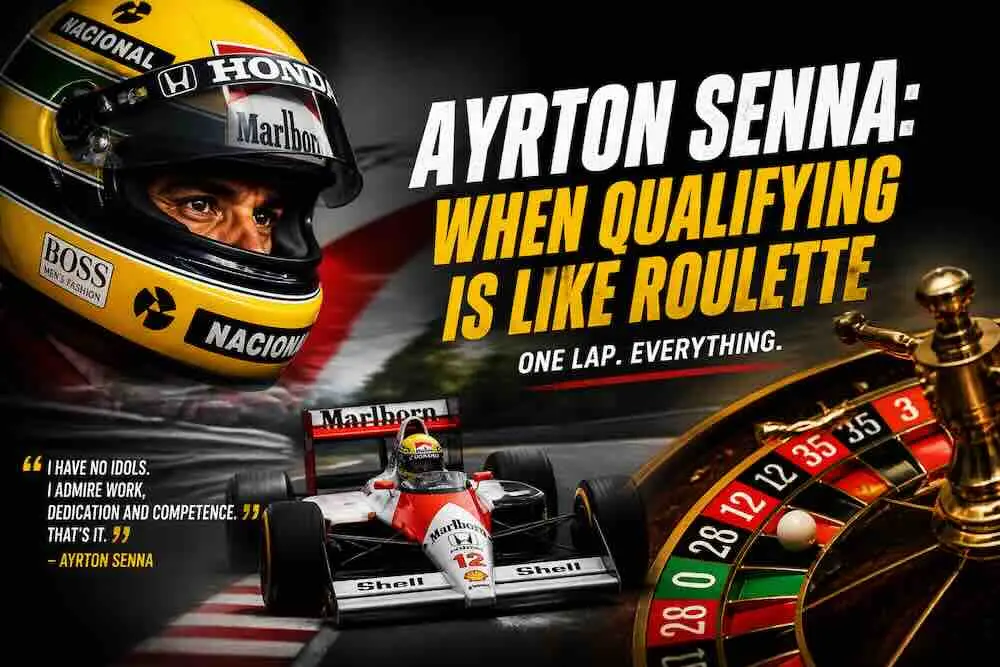
Ayrton Senna, a Brazilian Formula 1 driver active from 1960 to 1994 and widely regarded as the best driver in the sport’s history, took the qualifying session to an art form. Known for his legendary performances and ability to deliver under pressure, Senna’s qualifying sessions were like a high-stakes game of roulette where a single mistake could cost him everything. This article explores his incredible talent, the risks he took, and how he became a master of the sport’s most critical challenge—qualifying.
Introduction
Ayrton Senna’s name is synonymous with Formula 1 greatness, and as a Brazilian driver, his legacy has had a profound influence on Brazilian motorsport and the global racing community. Before reaching the pinnacle of Formula One, Senna progressed through the first formula categories, where he quickly established himself as a rising star. His early career was shaped not only by his talent but also by the influence of his family business, which played a role in his decisions to either return to Brazil or continue pursuing his racing ambitions abroad. Senna made his Formula One debut in 1984 with Toleman, and in his very first race at the South African Grand Prix, he scored his first World Championship point by finishing sixth—a remarkable achievement that signaled the arrival of a future legend. Often, his qualifying laps seemed to defy the limits of the car, pushing every single boundary to win the pole position. For Senna, each qualification was like a calculated gamble, a high-stakes game where a minor mistake could cost him everything. Deeply introspective, Senna used racing as a means of self-discovery, constantly seeking to extend his limits both on and off the track. This article delves into the unique risks and strategies that made Senna’s qualifying efforts legendary.
Introduction to Ayrton Senna da Silva
Ayrton Senna da Silva, born on March 21, 1960, in Sao Paulo, Brazil, emerged from a wealthy Brazilian family with a deep passion for motorsport. From an early age, Senna demonstrated remarkable talent behind the wheel, encouraged and supported by his father, Milton. His racing career began in karting, where he quickly made a name for himself by winning the South American Kart Championship multiple times. These early victories laid the foundation for Senna’s relentless pursuit of excellence in the sport, marking him as one of the most promising drivers to come out of Brazil. Senna’s dedication, combined with his natural ability, set him on a path toward Formula One greatness, making him a legend not only in his home country but across the world of motorsport.
Early Career
Senna’s early career was defined by rapid progression and outstanding achievements. After dominating the South American Kart Championship, Senna moved to England to further his ambitions in single-seater racing. Competing in Formula Ford, he quickly established himself as a formidable competitor, showcasing his skill and determination. His success continued in the British Formula Three Championship, where his performances caught the attention of the Formula One paddock. Senna made his Formula One debut with Toleman in 1984, impressing the racing world during his first season with his exceptional qualifying speed, including a standout pole position at the Monaco Grand Prix. These early accomplishments signaled the arrival of a future world champion and cemented Senna’s reputation as a driver with extraordinary potential.
Technical Risk and Strategy
Senna’s ability to deliver perfect lap times, especially in conditions that others would struggle with, was a reflection of his engineering knowledge and bravery. Formula 1 qualifying isn’t just about speed—it’s about setting up the formula one car for a single lap of pure performance. The team’s engineers would tune the car to extract the maximum potential, but there was always a fine line. Too much speed, and the car could lose traction; too little, and it would fall behind. Much like in roulette, Senna was willing to take the risk on a single spin of the wheel, knowing that a slight mistake could derail the entire effort. Pit stop strategy also played a crucial role in both qualifying and race preparation, as teams aimed for flawless execution to gain every possible advantage.
- Setting up the car: The key to Senna’s qualifying strategy was his ability to work with his engineers to fine-tune every aspect of the formula one car’s setup for that one crucial lap. Each of the one cars on the grid required a unique setup, and Senna’s attention to detail often made the difference in qualifying. Test drivers also contributed by providing valuable feedback during practice sessions, helping teams optimize performance before the main event.
- Engine overload risk: Pushing the engine to its limits meant risking mechanical failure.
- Loss of traction: Excess speed in the corners could send the car off the track, just as a bet on the wrong number can ruin a player’s game.
Senna achieved a record 65 pole positions during his Formula One career, a record that stood until it was matched by Lewis Hamilton in 2017. He was also renowned as the ‘Rain Master’ for his extraordinary performances in wet conditions.
Ayrton Senna da Silva’s Unique Psychological Edge
One of Senna’s greatest strengths was his psychological dominance over his competitors. His focus was unparalleled, especially when the stakes were highest. Senna’s intense rivalry with his team mate Alain Prost is one of the most famous in Formula 1 history, with both drivers pushing each other to the absolute limit in pursuit of the drivers championship. In the 1988 Monaco Grand Prix, Senna delivered one of the most iconic qualifying performances of his career, taking pole position with a commanding margin. His drive was so intense that even his fiercest rivals knew they would have to match his brilliance to compete with him. Senna was truly one of the one drivers who defined an era with his unique skills, and his passion and commitment inspired both fans and fellow drivers, as he put his very soul into everything he did.
Example: Monaco 1988 and San Marino Grand Prix
Senna’s performance in Monaco in 1988 was legendary. During the qualifying session, which set the tone for the season, Senna delivered a lap that was a work of art on a track known for its narrow, unforgiving corners. He won pole by over a second—a massive margin in the highly competitive world of F1—and this was just after the second round of the championship. That year, Senna went on to achieve eight wins out of 16 races, securing his first World Championship title with McLaren and setting a record for the most pole positions in a single season with 13. His lap at Monaco was a perfect blend of bravery, skill, and perfect timing, further cementing his reputation for technical mastery and his exceptional ability in wet-weather conditions, which contributed to his legendary status as one of the greatest drivers in Formula One history.
Championship Wins
Throughout his illustrious career, Ayrton Senna won three World Championships—in 1988, 1990, and 1991—securing a total of 41 Grands Prix victories. His first World Championship came in 1988 with McLaren-Honda, where he formed a legendary partnership and fierce rivalry with teammate Alain Prost. The intense competition between the two drivers became one of the defining stories in Formula One history, with Senna and Prost pushing each other to new heights. Senna’s ability to perform under pressure, combined with his strategic brilliance and raw speed, allowed him to claim the top spot in the world championship standings. His three world championships and numerous race wins solidified his status as one of the greatest drivers the sport has ever seen.
Competition from Michael Schumacher
As Senna’s career advanced into the early 1990s, he faced formidable competition from emerging talents, most notably Michael Schumacher. Schumacher, a German driver who would go on to win seven World Championships, quickly established himself as a major force in Formula One. The rivalry between Senna and Schumacher, though tragically brief due to Senna’s death, was marked by intense on-track battles and mutual respect. Their clashes on the track captivated fans and added a new dimension to the sport, as two of the world’s best drivers vied for supremacy. The prospect of a prolonged rivalry between Senna and Schumacher remains one of the great “what ifs” in Formula One history, underscoring the impact both drivers had on the sport.
Driver Safety Concerns
Ayrton Senna was not only a champion on the track but also a passionate advocate for driver safety. In the later years of his career, Senna became increasingly vocal about the need for improved safety standards in Formula One. His tragic death during the 1994 San Marino Grand Prix, when his car struck a concrete barrier at high speed, was a turning point for the sport. The accident highlighted the inherent dangers faced by drivers and led to a comprehensive overhaul of safety measures, including enhanced crash barriers, redesigned circuits, and stricter helmet regulations. Senna’s legacy endures not only through his racing achievements but also through his lasting influence on driver safety, ensuring that future generations of drivers compete in a safer environment.
The Balance of Talent, Risk, and Discipline
What truly set Senna apart was his ability to balance raw talent with calculated risk-taking. He wasn’t just fast—he was methodical. His understanding of the car, the track, and his competitors made him a master of the craft. He would often say that qualifying wasn’t just about pushing the car to the limit but about understanding the precise moment when to take risks and when to hold back. Senna’s discipline and technical mastery were evident from his first drivers championship—his one world championship in 1988 with McLaren marked a milestone that established his legacy. He went on to win three Formula One World Drivers’ Championship titles with McLaren between 1988 and 1991, achieving a total of 41 Grand Prix victories during his career. In 1992, after joining Williams, Senna finished fourth in the championship, demonstrating consistent performance even as Williams dominated the season. His rivalry with Alain Prost reached a turning point at the 1990 Japanese Grand Prix, where Senna’s collision with Prost at the first corner secured his second world championship title and eliminated Prost from the race.
- Talent: Senna’s driving skill was natural, honed through years of intense practice and competition.
- Risk: He constantly took risks, knowing that the difference between victory and failure could come down to the smallest detail.
- Discipline: Despite the risks, Senna maintained a level of control that made him one of the most disciplined drivers in history.
Conclusion
In Formula 1, qualifying is more than just a precursor to the race—it’s a mini-game of fate. Ayrton Senna died during the 1994 San Marino Grand Prix at Imola, in the Emilia Romagna region, after his car crashed into the concrete wall at the high-speed Tamburello corner due to a failure of the steering column, leading to fatal skull fractures and brain damage. On that tragic weekend, Senna was seen with an Austrian flag in his car, intending to honor Roland Ratzenberger, who had died the previous day. Senna’s death, along with Ratzenberger’s, prompted sweeping safety reforms in Formula One, including the redesign of dangerous corners, improved crash barriers, and stricter safety standards for cars and tracks, with computer analysis used to identify hazardous sections. Legal proceedings under Italian law followed, and individuals such as Patrick Head were found culpable for negligence related to the crash.
Senna’s passing was marked by a state funeral in Brazil, attended by an estimated three million people, reflecting his status as a national hero. A devout Catholic, Senna read the Bible for strength on the morning of his death. Quietly, he donated millions of U.S. dollars to help poor children in Brazil and laid the groundwork for the Instituto Ayrton Senna, which has since invested nearly US$80 million in social programs for underprivileged youth.
Senna’s legacy endures in the sport, with tributes from champions like Lewis Hamilton, who has honored Senna’s memory both on and off the track. His fierce rivalries with contemporaries such as Damon Hill, and his legendary performances at the Brazilian Grand Prix, Spanish Grand Prix, and French Grand Prix, remain iconic. The final race of each season still carries the weight of history shaped by Senna’s brilliance and the reforms that followed his death. Like a roulette player placing all their chips on a single number, Senna knew that success or failure could hinge on a single mistake or moment of brilliance. His ability to balance the uncertainty of risk with the certainty of talent and discipline made him one of the greatest drivers to ever race. In the end, as in casino games, it wasn’t just about making bold moves—it was about making those moves with a masterful understanding of the game.