Reading Time: ~10 minutes
Table of Contents
- Introduction — A Fast Ride Through History
- The Birth of the Cannonball — Brock Yates and the Wild 1970s
- Who Was Brock Yates
- Why the Cannonball Run Started
- The Race That Wasn’t Really a Race
- Route and Rules (or Lack Thereof)
- The Cars: From Ferraris to Huge American V8s
- How Participants Prepared
- The Characters of Cannonball — Speed, Strategy, and Personality
- Ideal Machine? Myth vs Reality
- Risk, Navigation, and Police Encounters
- Why the Original Cannonball Could Never Continue
- From Outlaw Run to Automotive Cult
- Films, Legacy, and Modern Records
- FAQ
- Conclusion — Preview Summary
In this article, we dive into the Cannonball Baker Sea‑To‑Shining‑Sea Memorial Trophy Dash — a legendary cross‑country dash that blurred the line between protest, adventure, and automotive myth. Conceived by automotive maverick Brock Yates in the era of huge American V8 engines and cultural rebellion, the Cannonball was less a formal competition and more an intoxicating test of courage, stamina, and pure freedom.
1. Introduction — A Fast Ride Through History
The Cannonball Baker Sea‑To‑Shining‑Sea Memorial Trophy Dash, commonly known simply as Cannonball, was an unofficial cross country drive and coast‑to‑coast automotive endurance sprint in the 1970s. The route later became a benchmark for the transcontinental record and, in modern usage, the cannonball record. Mixed with protest against tightening speed laws, a celebration of open highways, and the thrill of high‑speed travel, Cannonball became legendary for its audacity, its Ferrari heroes, and cars powered by enormous American V8 engines hustling across The United States.
2. The Birth of the Cannonball — Brock Yates and the Wild 1970s
Who Was Brock Yates
Brock Yates was an influential American automotive journalist and editor, best known for conceiving the original Cannonball Run. His passion for cars, love of storytelling, and frustration with increasing traffic restrictions shaped one of the most iconic automotive adventures in history. Yates’ legacy endures both in the race itself and in the 1981 cult classic film The Cannonball Run, which he helped inspire. He later inspired one lap through One Lap of America, and Brock Yates Jr. helped carry that legacy forward.
Why the Cannonball Run Started
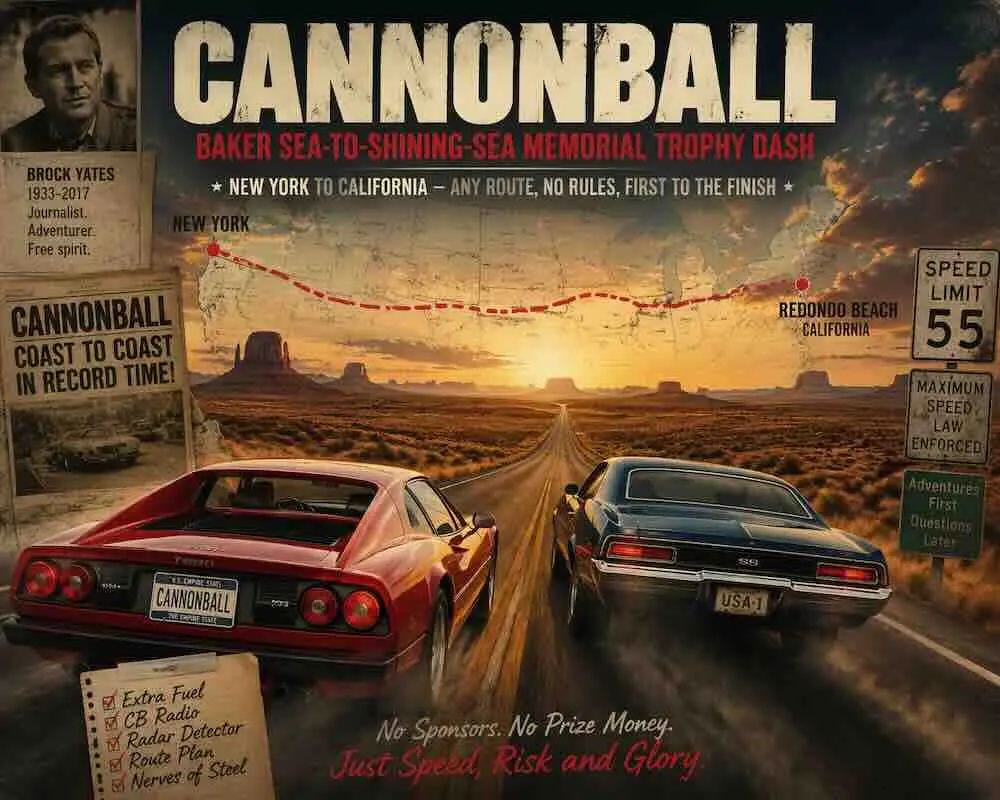
The early 1970s in the U.S. saw tightening speed limits and rising restrictions on drivers. Yates, a self‑described road lover, saw the vast American Interstate network as a symbol of freedom. In response to stricter laws and the new 55 mph national limit, he organized the first event as an underground race — not for money, but for adrenaline, pride, and the right to drive fast. When the race began, it was framed as a protest-minded challenge rather than a sanctioned competition.
3. The Race That Wasn’t Really a Race
Route and Rules (or Lack Thereof)
Unlike sanctioned motorsports, Cannonball had only one rule: start on the East Coast at the red ball garage in New York and end in los angeles, with many modern tellings tying the finish to the portofino hotel area in Redondo Beach, California. Competitors could pick any route, at any speed they felt was practical. There were no checkpoints, no lap counts, and no strict referees — just the call to be the fastest across the continent. That course became the template for later coast to coast record and cannonball run record attempts.
The Cars and Average Speed: From Ferraris to Huge American V8s
Teams used a bewildering variety of cars: sleek Ferrari coupes like the 365 GTB/4 Daytona driven to victory in 1971, experimental hot rods, and classic American muscle cars with massive V8 engines. The ideal machine had to balance speed, endurance, comfort, fuel economy, and often stealth — because outrunning the law was always part of the game, with some builds also adding an upgraded heat exchanger for sustained high-speed reliability. Some later record cars were even disguised as a Ford Taurus Police Interceptor to blend in.
How Participants Prepared
Preparing for a Cannonball meant fuel strategy — including huge auxiliary tanks — a radar detector, weather planning, and often a second driver or navigator. Some crews carried snacks and survival gear for long non‑stop legs, while others added police scanners or built beds right into the car. Careful fuel stops were essential to preserving average speed over the entire run. Some modern teams on a record run also used GPS data to document the entire run and support a claimed record time. More elaborate police evasion modifications could also include stabilized binoculars or a roof mounted thermal camera. The sheer inventiveness showed that the run was more than a race: it was an exercise in automotive improvisation and guts.
4. The Characters of Cannonball — Speed, Strategy, and Personality
Ideal Machine? Myth vs Reality
No single vehicle dominated the Cannonball scene. There was never one universally ideal machine, because different teams optimized for top speed, range, or comfort depending on the route. Some teams chose exotic European performance cars like a Ferrari for raw pace, while others trusted the torque and fuel capacity of American V8‑powered sedans and muscle cars. Comfort mattered too — tiring out drivers or stress‑fatiguing cars was just as dangerous as dodging police, and small setup details like tire pressure could affect stability during long high‑speed stints.
Risk, Navigation, and Police Encounters
Participants relied on radios, false routes, night driving, spotter support crews, and route checks on google maps to evade law enforcement. There were no manuals on how to sneak past state police or negotiate radar traps — just instinct, teamwork, and the thrill of beating the system. Crews were often taking advantage of lighter traffic or favorable enforcement patterns when planning a run in a given state. Drivers described the dash as akin to high‑stakes poker on wheels: calculating risk, bluffing authority, and betting it all on one leg of highway. (Composite narrative based on historical accounts.)
5. Why the Original Cannonball Could Never Continue
Despite becoming public folklore, the original Cannonball Run vanished after 1979. Escalating legal oversight, greater highway traffic, and rising public and police safety concerns made such unsanctioned cross‑country races untenable. Yates himself declined to revive the event, citing these realities and the need to protect both drivers and the public.
6. From Outlaw Run to Automotive Cult
Films, Legacy, and Modern Cannonball Run Records
Though the original runs ended, the spirit lived on in film — The Cannonball Run movies drew directly on Yates’ exploits — and in modern attempts to set transcontinental speed records under the Cannonball Run Challenge, where drivers have chased the overall record and, during the pandemic era, pushed for a new record. In early May 2020, some teams openly took advantage of unusually clear roads to pursue a new cannonball record. Ed Bolian and Alex Roy are two of the best-known modern figures tied to the cannonball community and its previous records. Modern claims are often debated within that scene, especially when comparing previous records, record categories, and documentation standards. These unofficial records continue to push the limits of endurance driving, but as Yates warned, the era of unregulated coast‑to‑coast dashes belongs to a different time.
7. FAQ
Q: Was Cannonball a real race?A: Yes — but unofficial and unsanctioned, with no governing body or formal rules.
Q: Did Brock Yates ever race?A: He both organized and competed in the runs, including the 1971 event, whose winning Ferrari was entered as moon trash ii; that early field also included Jim Williams and Steve Smith.
Q: Are there modern Cannonball Runs?A: There are speed record attempts known as Cannonball Run Challenge, focused on a coast to coast benchmark often framed as a cannonball run record or broader transcontinental record, but they lack the original spirit and scale.
8. Conclusion — Preview Summary
This article explored the Cannonball Baker Sea‑To‑Shining‑Sea Memorial Trophy Dash — a bold and rebellious drive across the U.S. that became a legend. Conceived by Brock Yates as a protest and celebration of speed, it drew cars from Ferrari sports cars to massive American V8‑powered cruisers, creating unforgettable stories of risk, ingenuity, and freedom. Though no longer repeatable, its impact on car culture and outlaw racing lore is undeniable.