
Reading time: 4 minutes
Contents
- Introduction — the silence no one expected
- A historic moment: Ferrari without gasoline
- What is Ferrari Luce?
- Why the market reacted with doubt
- What the automotive world may lose
- Was the risk worth it?
- FAQ
In a world where gasoline is being pushed into the past, Ferrari has taken a dangerous bet with its most valuable asset: its legend. The Ferrari Luce is not just another electric car. It is a test of whether Ferrari can survive without the sound, smell, and mechanical violence that made it famous.
The silence no one expected
For decades, you could recognize a Ferrari before you saw it. The scream of a V8 or V12 arrived first, cutting through the street like a warning. Then came the shape, the badge, the theatre.
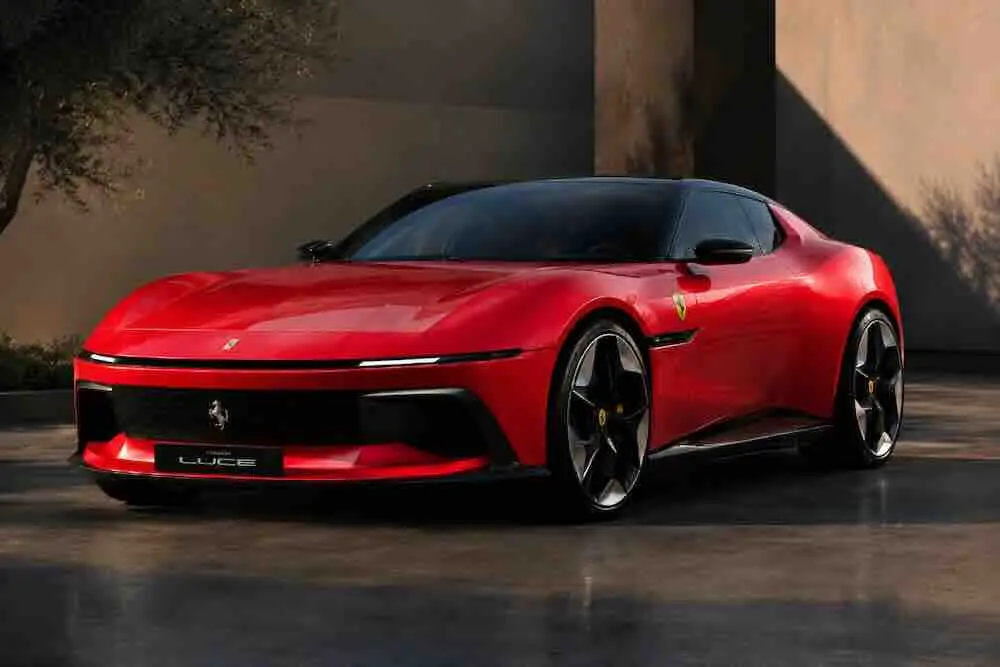
Now Ferrari has introduced the Ferrari Luce, its first-ever fully electric vehicle. It is fast, expensive, advanced — and almost silent. According to Ferrari, the Luce is designed to be tactile, intuitive, and thrilling, with a new electric architecture built around performance and driver involvement, a dedicated EV layout that gives Ferrari unusual design freedom and makes it unlike other Ferrari models as the brand looks toward an electric future.
That is the conflict at the heart of the car: technological progress versus the possible loss of Ferrari’s soul.
A historic moment: Ferrari without gasoline — a liftback sedan unlike any before
The arrival of an electric Ferrari felt inevitable. Emission rules are tightening, luxury EV competition is growing, and younger high-end buyers are more comfortable with silent speed than previous generations.
Still, Ferrari resisted full electrification longer than many expected. The brand built its myth around combustion: the smell of fuel, the vibration through the seat, the rising revs, the ritual of a machine that felt alive.
With Luce, that era changes. The model represents Ferrari’s first all-electric vehicle and a major step away from the combustion identity that defined the company for decades.
What is the Ferrari Luce electric vehicle?
Ferrari Luce is positioned as a luxury electric performance car for a new era, a four-door five seater whose EV packaging gives Ferrari its first five-seat model and its largest trunk yet at 21 cubic feet. Reports describe it as using four independent permanent-magnet electric motors with a combined 1,035 horsepower and 730 pound-feet of torque. It can accelerate from 0 to 62 mph in 2.5 seconds and reach a top speed of 193 mph. It also uses a 122-kWh battery pack for an estimated 330-mile range on the European WLTP standard. In Europe, it is expected to go on sale later this year, priced at around 550,000 euros, or about $640,000.
Key features: front and rear axles
- Fully electric Ferrari powertrain
- Four-motor all-wheel-drive layout
- More than 1,000 hp
- 0–62 mph in about 2.5 seconds
- Long-range battery system
- Interior uses tactile aluminum switches, toggles, and dials alongside digital displays
- Craft-focused materials including recycled aluminum and Gorilla Glass
- OLED displays and a central touchscreen that can pivot toward the driver or front passenger, with physical controls kept at the center
- Styling developed with LoveFrom, led by Sir Jony Ive and Marc Newson, balancing modern tech with Italian design cues
Ferrari clearly did not want to make a normal EV with a famous badge. It tried to preserve drama through sound, response, design, and “theatre” in the driving experience. Car and Driver reports that the Luce uses a patented system that processes mechanical audio from the rear axle, instead of relying only on fake speaker noise.
In other words, Ferrari did not simply sell an electric car. It tried to sell the feeling of Ferrari without the thing many fans believe makes Ferrari a Ferrari.
Why the market reacted with doubt
The launch was not received as a simple victory lap. Several reports noted that Ferrari shares dropped after the reveal, with figures ranging from about 6% to 7% in market coverage.
That reaction was not only about one car. It was about fear.
Investors may be asking:
- Can Ferrari stay unique in a crowded EV market?
- Will traditional buyers accept a silent Ferrari?
- Is the development cost worth it?
- Can an electric model protect margins and prestige?
- Does Luce expand the brand, or dilute it?
The market likes innovation, but it likes predictability even more. Ferrari has spent decades selling scarcity, emotion, and mechanical identity. Luce challenges all three.
Ferrari clearly did not want to make a normal EV, and the project leans hard into sound, response, design, and aviation-inspired details like a launch-control pull handle. One collector quoted in launch coverage reportedly dismissed the sound amplifier as gimmicky, which shows how difficult it may be to convince old-school fans that electric emotion is still real.
What the automotive world may lose
Ferrari engines were never just engines. A V12 could feel like opera. A high-revving V8 could sound like anger turned into music.
Electric power is technically brilliant. It is instant, clean, brutally fast, and efficient. But it can also feel sterile. The danger is that performance becomes too perfect, too quiet, too similar.
That is the real emotional loss. Cars like Ferrari were not loved only because they were fast. They were loved because they had character.
The Luce forces a difficult question: if speed remains, but the sound disappears, is the magic still there?
Was the risk worth it?
There are strong arguments in favour of Ferrari Luce.
Electric luxury is not going away. Ferrari needs to speak to a new generation of buyers. Canada, like many developed markets, is seeing more interest in premium EVs, and Ferrari cannot ignore where regulation and technology are going. Electric power is technically brilliant. It also uses a 48V active suspension system that removes the need for anti-roll bars. Its body is likely shaped as much for aero efficiency and weight control as for style.
But the arguments against it are just as strong. An electric supercar is no longer shocking. Many brands can build something brutally quick. But it can also feel sterile. Luce is also Ferrari’s heaviest model ever at 2,260 kg, which sharpens that trade-off. What they cannot easily build is Ferrari’s emotional heritage.
Ferrari now sells more than an engine. It sells status, speed, craftsmanship, and belonging to a legend. Luce may prove that the legend can evolve. Or it may prove that some brands are powerful because they refuse to become ordinary.
Conclusion
Ferrari Luce is not just a new model. It is the moment when the automotive industry officially says goodbye to part of the gasoline era’s romance.
Maybe Ferrari will win this race into the future. Maybe Luce will become the car that proves silence can still be emotional.
But the price of the bet is already clear: silence instead of roar.
FAQ
Is Ferrari Luce fully electric?
Yes. Ferrari Luce is described as Ferrari’s first fully electric production vehicle. Its dedicated EV architecture also gives it a form unlike any other Ferrari.
How powerful is Ferrari Luce in terms of maximum torque output?
Current reports place output at more than 1,000 horsepower, with four electric motors and all-wheel drive. It also uses a 122-kWh battery pack as a structural part of the chassis, with SK On pouch cells. The battery architecture supports charging at up to 350 kW.
Why did Ferrari shares fall after the Luce reveal?
Coverage points to investor concern about the car’s controversial design, high price, EV market uncertainty, and the risk of weakening Ferrari’s traditional identity.
Is Ferrari Luce good or bad for the brand?
It depends on what Ferrari buyers value most. The glass roof, for example, breaks with traditional sports-car styling, which is one reason opinions split so sharply. For new luxury EV customers, it may be a bold future icon. For purists, it may feel like a betrayal of Ferrari DNA. Even so, details like the recycled-aluminum steering wheel show Ferrari is trying to modernize rather than simply abandon its identity.