
Reading time: 7 minutes
- Introduction: The First Electric Vehicles – A Forgotten History
- The Flocken Elektrowagen: A Revolutionary Step in Electric Cars
- Why Early Electric Vehicles Didn’t Gain Traction
- The Modern EV Resurgence and the Popularity of Tesla
- Conclusion: Tesla and the Future of Progress in EVs and Technology
- FAQ
Introduction: The First Electric Vehicles – A Forgotten History
When most people think of electric vehicles (EVs), the first name that likely comes to mind is Tesla. The company’s revolutionary approach to electric cars has shaped the modern electric vehicle market, but it is far from the first instance of an electric car. In fact, the history of electric vehicles stretches back to the early 19th century—long before Tesla or even internal combustion engines were invented.
While the first gasoline-powered vehicles arrived in the late 1800s, electric vehicles made their debut between the 1830s-1860s, predating gasoline cars in terms of practical use. Despite their early arrival, these vehicles didn’t gain widespread adoption, and it would take over a century for electric cars to become relevant again.
The Flocken Elektrowagen: A Revolutionary Step in Electric Cars
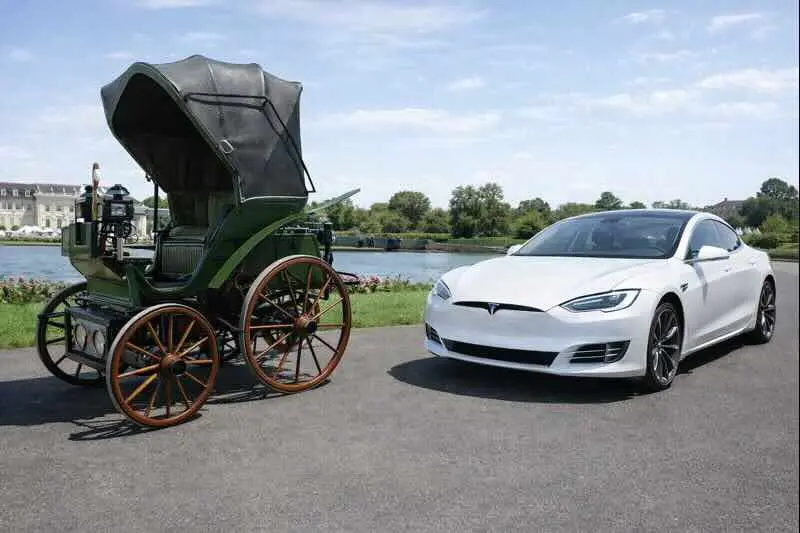
In 1888, a German engineer named Andreas Flocken created one of the earliest and most successful prototypes of an electric vehicle: the Flocken Elektrowagen. This vehicle is often credited as one of the first working electric cars that could be driven for practical purposes.
Key Features of the Flocken Elektrowagen:
- Design: The Flocken Elektrowagen was essentially an open four-wheeled cart equipped with an electric motor powered by lead-acid batteries.
- Performance: It could reach speeds of up to 14.4 km/h (9 mph)—relatively fast for its time.
- Battery Technology: The lead-acid rechargeable batteries were innovative and laid the groundwork for later advancements in electric vehicle technology.
Why Was the Flocken Elektrowagen a Breakthrough?
At the time, the Flocken Elektrowagen represented a significant leap in the world of transportation. It demonstrated that electric motors could be used to power vehicles efficiently, unlike earlier models that were often limited by their design or technology. Although it was not mass-produced, the vehicle marked the beginning of a new era for electric cars. This car was a precursor to modern-day electric vehicles and even predated Tesla’s groundbreaking designs by over a century.
Why Early Electric Vehicles Didn’t Gain Traction
Despite the Flocken Elektrowagen being a technological breakthrough, early electric vehicles struggled to gain widespread adoption. Several factors contributed to the slow progress of EV development:
Challenges Faced by Early EVs:
- Limited Range: Early electric cars, including the Flocken Elektrowagen, had a limited range, often not enough for long-distance travel.
- Lack of Infrastructure: Charging infrastructure was non-existent, making it difficult for owners to recharge their vehicles.
- Gasoline-powered Competitors: As the gasoline engine became more advanced, vehicles with internal combustion engines provided a much greater range and faster refueling times.
The Fall of Early Electric Vehicles:
- Electric cars were more silent and easier to operate than their gasoline counterparts, but their lack of range and charging difficulties made them less practical.
- By the early 20th century, gasoline vehicles became dominant due to their longer range, affordability, and the rapid expansion of gas stations.
Although electric vehicles had an early start, they couldn’t compete with gasoline-powered vehicles, which eventually led to their decline in popularity for many decades.
The Modern EV Resurgence and the Popularity of Tesla
Fast forward to the late 20th and early 21st centuries, and electric vehicles are once again gaining traction—this time in a big way. One of the driving forces behind this resurgence is Tesla, a company founded by Elon Musk that has revolutionized the EV industry.
Why Electric Vehicles Are Popular Again:
- Environmental Concerns: Growing concerns about climate change and air pollution have pushed the global automotive market to adopt cleaner alternatives to gasoline-powered vehicles.
- Advancements in Technology: Modern EVs have benefited from technological advancements in battery technology, making them more efficient and able to travel longer distances on a single charge.
- Government Incentives: Many governments worldwide are offering incentives for consumers to switch to EVs, including tax credits and rebates.
Tesla’s Role in Popularizing Electric Cars:
- Tesla played a pivotal role in making electric cars mainstream with their innovative designs, long-range capabilities, and eco-friendly approach to transportation.
- Tesla’s Milestones:
- The Roadster (2008) was Tesla’s first production car, proving that an electric car could be fast and stylish.
- The Model S (2012) cemented Tesla’s position as a leader in luxury electric vehicles, boasting remarkable range and performance.
- Tesla has also pioneered battery technology, improving the performance and efficiency of electric cars.
- With the Model 3 and Model Y, Tesla made EVs more affordable, opening up the market to a wider audience.
Tesla’s innovations have helped bring electric cars into the mainstream, and the company continues to push the envelope with self-driving capabilities, charging infrastructure, and clean energy solutions.
Conclusion: Tesla and the Future of Progress in EVs and Technology
Tesla has redefined the concept of what an electric vehicle can be. Its technological advancements and commitment to sustainability have made it one of the most influential companies in the world. In many ways, Tesla’s impact on the automotive industry can be compared to the way online casinos are transforming the retail gambling world. Just as Tesla redefined driving, online casinos are reshaping how people engage with gaming by using technology to provide more accessible and exciting experiences.
Both are pushing towards progress, whether it’s cleaner, more sustainable transportation or more immersive, accessible gaming.
FAQ
Q: What was the first electric vehicle?
A: The first successful electric vehicle is the Flocken Elektrowagen, created by Andreas Flocken in 1888.
Q: Why did electric vehicles lose popularity in the early 1900s?
A: Early EVs had limited range, lacked charging infrastructure, and were quickly overshadowed by gasoline-powered vehicles, which were more practical.
Q: How did Tesla revolutionize the electric vehicle market?
A: Tesla made electric vehicles popular by offering long-range, high-performance cars with groundbreaking features, like self-driving technology and an extensive charging network.
Q: Why are electric cars more popular today?
A: The rise in environmental concerns, advancements in battery technology, and government incentives have made electric vehicles more appealing to consumers.
Q: What are the main challenges facing electric vehicles today?
A: Despite significant progress, electric vehicles still face challenges such as limited EV range compared to gasoline vehicles, the need for widespread and convenient charging stations, and concerns about battery packs lifespan and recycling. Additionally, the availability of raw materials for batteries and the environmental impact of battery production remain important issues.
Q: How does charging an electric vehicle work?
A: Electric vehicles are charged by connecting to an electric vehicle supply equipment (EVSE), commonly known as a charging station. The vehicle’s onboard charger converts the incoming AC power from the power grid into DC power to recharge the electric battery. Charging times can vary based on the type of charger used, the vehicle’s battery capacity, and other factors such as voltage and temperature.
Q: What types of electric vehicles are available?
A: There are various vehicle types including battery electric vehicles (BEVs) that run entirely on electricity, plug-in hybrids that combine an electric motor with a traditional internal combustion engine, and hybrid electric vehicles that use electric motors to assist the engine. Each type offers different benefits depending on driving needs and access to charging infrastructure.
Q: How do electric vehicles impact the environment?
A: Electric vehicles produce zero tailpipe emissions, which significantly reduces carbon emissions and greenhouse gases compared to fossil fuels powered vehicles. They also contribute less noise pollution, improving urban living conditions. However, the overall environmental impact depends on how the electricity used to charge the vehicle is generated and the lifecycle impact of battery production and disposal.
Q: Are electric vehicles safe?
A: Electric vehicles are equipped with advanced safety features and undergo rigorous testing. While battery fires are rare, manufacturers implement robust cooling systems and fire prevention technologies to minimize risks. Additionally, the absence of a traditional fuel tank reduces certain hazards associated with gasoline vehicles.
Q: Can electric vehicles perform well in extreme weather?
A: Extreme temperature conditions can affect battery performance and EV range, especially in very cold or hot climates. Manufacturers use thermal management systems to maintain optimal battery temperature and improve efficiency. Preconditioning the vehicle before driving can also help mitigate these effects.
Q: What is the future outlook for electric vehicles?
A: The future of electric vehicles looks promising with continuous improvements in battery technology, expanding charging infrastructure, and increasing government support. Innovations such as solid-state batteries, faster charging chargers, and integration with renewable energy sources are expected to further enhance the appeal and practicality of electric vehicles for a wide range of consumers.