
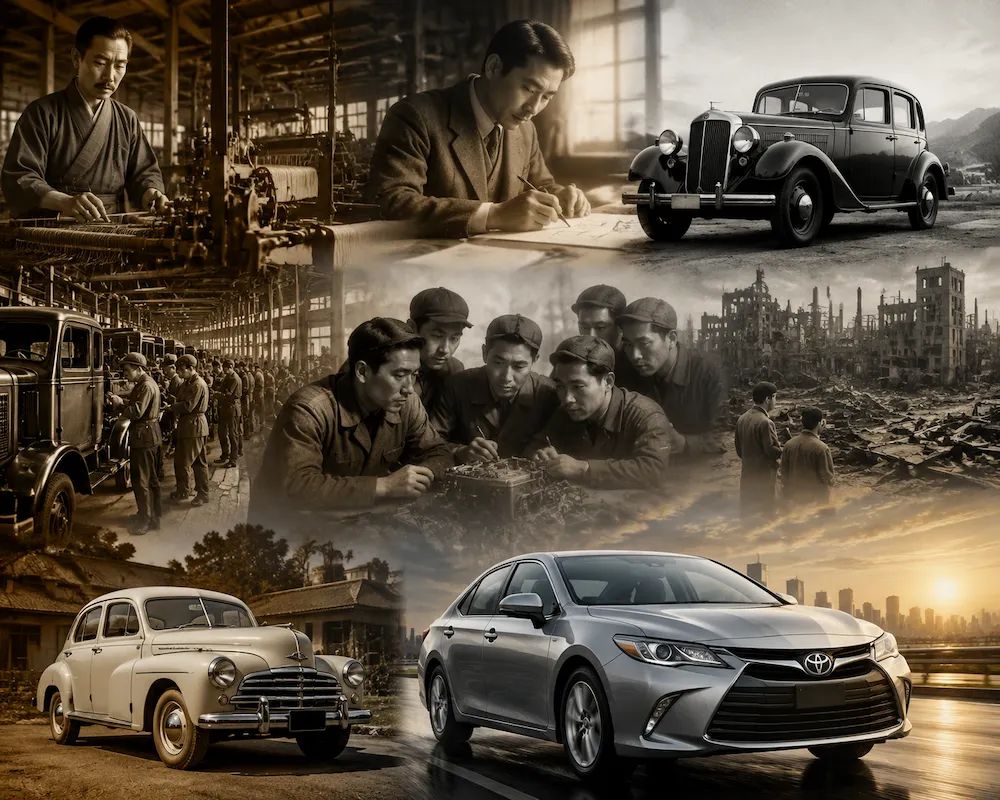
How Toyota almost never became an automaker
Today, Toyota feels almost untouchable – a symbol of reliability, efficiency, and industrial precision. But in its early years, the company was not a success story at all. It was a fragile experiment balancing on the edge of financial collapse.
What makes this history fascinating is how close it came to ending before it even truly began. The automotive division was not a guaranteed future – it was a risky bet made in an unstable economy, by people who had never built a car before.
Everything started with weaving machines
Long before engines and highways, the Toyoda family worked with something far more humble: textile machines. Sakichi Toyoda, a brilliant inventor, spent years trying to solve a simple but critical problem – how to make weaving faster and less labor-intensive.
His breakthrough came with automatic looms that could stop themselves when a thread broke. This idea alone changed industrial textile production. It also built the foundation for Toyoda Automatic Loom Works, a company that would later finance entirely different ambitions.
At one point, the company even sold patents overseas – including to British firms – generating the capital that would later quietly fuel a much bigger dream.
The vision of Kiichiro Toyoda and the first experiments
Sakichi’s son, Kiichiro Toyoda, was not satisfied with textiles. During his travels to Europe and the United States, he became obsessed with automobiles. He studied factory floors, production lines, and especially the systems used by Ford and General Motors.
What struck him most was not the cars themselves, but the scale of production. The idea that thousands of identical machines could be built efficiently fascinated him.
Back in Japan, however, almost no one shared his confidence. Investors saw the automotive idea as too expensive, too complex, and too risky. But Kiichiro believed Japan needed its own industry – not imported solutions.
The first Toyota: Toyoda A1 and early struggles
The first steps into car manufacturing were cautious and uncertain. Early prototypes, including the Toyota AA and experimental models like the Toyoda A1, were built with limited experience and even more limited resources.
Everything had to be learned from scratch – engine design, chassis construction, supply chains. There was no existing ecosystem to rely on.
Even when the first cars finally worked, success did not follow. Production was slow, costs were high, and customers were hesitant. The cars were engineering achievements, but commercially they were weak performers.
It was a classic case of innovation outpacing demand.
Financial pressure and the risk of shutdown
As development continued, so did the financial pressure. Every new prototype required investment, but returns were almost nonexistent. The company was essentially funding a dream that was not paying back.
Inside the organization, doubts began to grow. Was car manufacturing worth the cost? Should the company return to its stable textile business?
At several critical moments, discussions about shutting down the automotive division became serious. The project survived not because it was profitable, but because a few leaders refused to abandon it.
How war unexpectedly saved the company
The outbreak of war changed everything in an unexpected way. Civilian demand collapsed, but military demand surged.
The company began producing trucks and utility vehicles for government contracts. These orders were not glamorous, but they were stable. More importantly, they kept the production lines running.
This period is often viewed with mixed emotions in Toyota’s history – it ensured survival, but under extremely difficult global conditions. Still, without it, the automotive division might not have survived at all.
Post-war crisis and internal instability
After the war ended, Japan faced economic devastation. Industries were disrupted, inflation was extreme, and consumers simply could not afford cars.
Between 1949 and 1950, the company entered one of its deepest crises. Cash flow collapsed, layoffs loomed, and workers went on strike. Tension between management and employees reached breaking points.
Kiichiro Toyoda, exhausted by the pressure and responsibility, eventually stepped down as president. It was one of the darkest and most uncertain periods in the company’s existence.
The birth of the Toyota philosophy
Out of this instability came something unexpected: structure.
The company began developing ideas that would later define modern manufacturing. Instead of scaling blindly, it focused on discipline and precision:
- Continuous improvement (Kaizen) – small, constant progress
- Just-in-Time production – making only what is needed, when needed
- Waste reduction in every process
- Quality control at every stage of production
These principles were not abstract theories – they were survival mechanisms born from financial pressure.
How survival shaped a global automotive giant
Over time, these systems transformed everything. When Toyota finally expanded into global markets, it was no longer just another automaker – it was a highly optimized production system.
The introduction of models like the Corolla turned the company into a global force. Reliability became its identity, not by accident, but because inefficiency had been eliminated step by step over decades.
As one automotive enthusiast wrote in a widely shared discussion:
“Toyota didn’t become successful because it avoided failure. It became successful because it learned how to survive it.”
Toyota’s story is not a straight line of success. It is a series of near collapses, risky decisions, and repeated reinventions. The first cars did not create success – they created pressure.
And that pressure forced a philosophy that ultimately changed global manufacturing forever.