
Reading time: ~8 minutes
Table of Contents
- Introduction: when luxury bet it all
- Background of the era: crisis, economy & fear of losing market share
- Birth of the Cadillac Cimarron: luxury from a mass‑market car
- Market reaction & reputational blow
- Why this failure is still remembered
- Conclusion: GM’s biggest miscalculation
- FAQ
🚗 Preview
This article explores the notorious story of the Cadillac Cimarron, a controversial attempt by General Motors to create an “entry‑level luxury” car that backfired. We’ll look at the context of the 1980s automotive market, the missteps that led to Cadillac’s gamble, its reception, and why the Cimarron remains a cautionary tale in automotive history.
The Cadillac Cimarron was introduced during a time when American cars were struggling to maintain their foothold against the rising popularity of European imports. Models like the Volvo GL and BMW 320i were attracting younger, affluent buyers who valued efficiency, style, and refinement. Cadillac aimed to capture this market by offering a compact luxury vehicle that retained the prestige of the brand, but the execution fell short.
Despite its Cadillac badge, the Cimarron shared much of its design and mechanical components with the Chevrolet Cavalier, including the use of coil springs and a three speed automatic transmission in some trims. This badge engineering was seen as a flagrant insult by many Cadillac enthusiasts and critics, who expected more distinctive features such as a leather wrapped steering wheel, trianon deep pile carpeting, and full instrumentation including a tachometer.
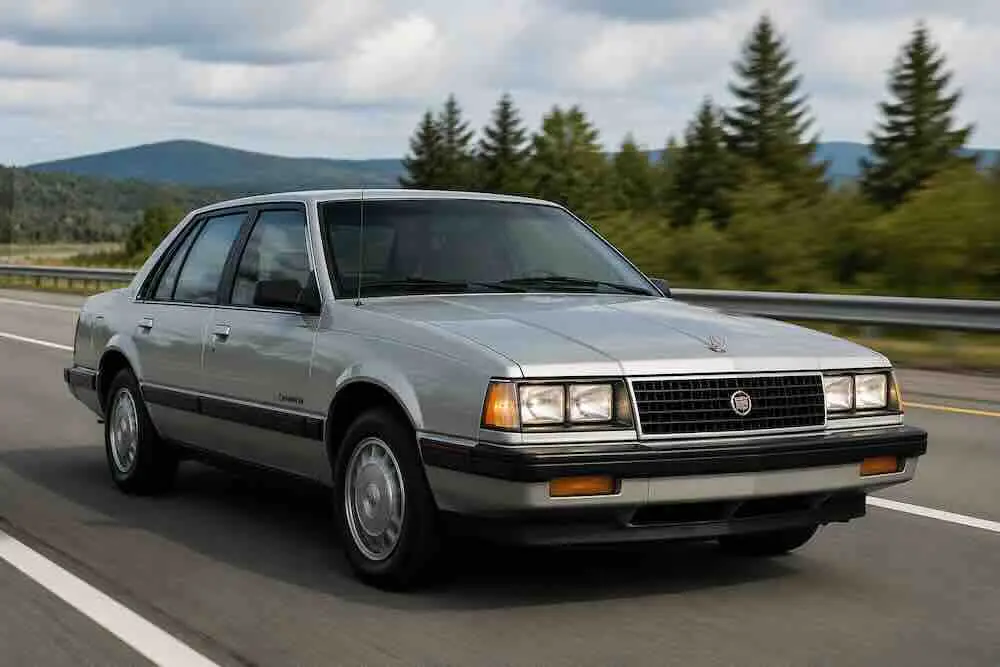
The car’s exterior styling included a new grille and unique rear fascia to differentiate it from its J-car platform siblings, but these changes were largely superficial. The interior door panels and cabin materials failed to convey the luxury expected from Cadillac, and amenities like air conditioning and intermittent wipers were standard but not exceptional for the segment.
The Cimarron’s performance was modest, and its underwhelming engine options did little to compete with the more powerful European rivals. The car’s hood and fenders closely resembled those of the Chevy Cavalier, which further diluted its premium image. Despite these shortcomings, the Cimarron did manage to attract fine customers who were new to the brand, though many viewed the car as a bad idea that damaged Cadillac’s reputation.
Produced primarily in Ohio, the Cimarron’s sales declined steadily over its production run, culminating in its discontinuation in 1988. The model’s failure is often cited as one of GM’s biggest shame and a cautionary example of how not to approach selling a luxury car. However, in recent years, the Cimarron by Cadillac has gained a cult following among enthusiasts who appreciate its unique place in automotive history as a bold but flawed attempt at redefining American luxury for a changing market.
When luxury bet it all
In the early 1980s, General Motors was under pressure to attract a younger clientele and compete with European premium compact sedans. Cadillac — long a symbol of American luxury — took the bold step of launching a more accessible model. The idea seemed smart: reach new buyers without abandoning Cadillac’s prestige. But what became known as the Cadillac Cimarron turned into one of the most infamous failures in automotive history.
Background of the era: crisis, economy & fear of losing market
By the late 1970s and early 1980s, the automotive landscape was shifting. Fuel prices and emissions regulations pushed consumers and manufacturers toward smaller, more efficient cars. European brands like BMW, Audi, and Volvo were gaining traction in North America with compact executive sedans that delivered both efficiency and a sense of prestige. Cadillac’s traditional large, V8‑powered sedans were beginning to look dated by comparison.
Faced with changing buyer expectations and competitive pressure, GM executives felt urgency — not unlike a poker player afraid to fold — and pushed Cadillac into a hurried play: enter the compact luxury segment fast, even if it meant cutting corners.
Birth of the Cadillac Cimarron: luxury from a Chevrolet Cavalier mass‑market car
The Cadillac Cimarron debuted for the 1982 model year as Cadillac’s first compact car, intended to compete with European offerings. However, beneath its Cadillac branding, it rode on GM’s J-car platform, a strategic move meant to give Cadillac an entry into the compact luxury segment, and it still shared almost everything with the Chevrolet Cavalier — from platform to much of its mechanicals.
What the Cimarron really was
- Built on the GM J‑car platform — the same basic architecture used for related GM vehicles such as Chevrolet Cavalier, Buick compacts, Oldsmobile variants, and Pontiac entries, with Opel serving only as a brief planning reference.
- It used front-wheel drive and unibody construction, with firmer suspension tuning meant to give the driver a more controlled ride.
- Only modest interior upgrades, including a leather interior, plus standard equipment and options like power windows, power door locks, and a tilt steering wheel, differentiated it from its cheaper cousins.
- Early engine choices were underpowered four-cylinders; for 1982, the DOHC inline-4 displaced 112 in³ (1840 cm³) and made 85 hp at 5100 rpm and 100 lb-ft at 2800 rpm.
- Its basic footprint was compact, with a 101.2-inch wheelbase, 173.0-inch length, 65.0-inch width, 53.3-inch height, and 2,684-lb curb weight, which helped packaging for passenger volume and a usable trunk.
- EPA ratings for the 1982 model were 26 mpg city, 42 mpg highway, and 31 mpg combined, though outright speed was never a strong point.
- Cadillac also tried to separate it visually with details like a Cadillac-style grille, but production fell off sharply by the 1988 final year.
Key missteps
Error #1: Underestimating the audienceBuyers of luxury cars expect authentic luxury — not a dressed‑up economy car. Simply adding leather seats and badging wasn’t enough to justify a premium price tag, and that high price compared with mechanically similar economy cars alienated most people and hurt Cadillac’s reputation.
Error #2: Skimping where it mattersMediocre performance, cheap materials, and little differentiation from the Cavalier diluted the Cadillac identity, with critics arguing the interior looked too much like its economy counterparts and lacked unique luxury features.
Error #3: Rushed developmentThe Cimarron was launched fast — far too fast — in a bid to capture market share before competitors could react. A deeper, more bespoke development could have yielded a stronger product. Even so, about 75% of buyers were new to Cadillac, suggesting some limited success in attracting younger buyers. From 1984 to 1986, the D’Oro package tried to give the car a more distinct appearance for the driver with gold accents.
Market reaction & reputational blow among Cadillac dealers
Autowriters and buyers alike panned the Cimarron. It has appeared on multiple “Worst Cars of All Time” lists, crystallising “everything that was wrong” with GM in the 1980s.
Sales started at 25,968 units in 1982, but production fell to just 6,454 units in its final year, 1988. It was meant to help Cadillac win younger buyers who were drifting toward luxury imports, but it failed to capture that segment. Rather than boosting Cadillac’s image, the Cimarron became a symbol of corporate cost‑cutting and missed opportunity. Its failure also fed into Cadillac’s longer-term slide in U.S. market share, from 3.8% in 1979 to 2.2% in 1997.
Why this failure is still remembered among the worst cars
The Cadillac Cimarron remains in automotive lore as a cautionary example of how not to brand a product. It showed that premium buyers won’t accept surface polish without substance, and that badge engineering can backfire spectacularly if overdone. Many modern brands still reference the Cimarron when discussing the pitfalls of diluting a luxury marque.
🏁 Conclusion: The Cimarron that nearly killed Cadillac – GM’s biggest miscalculation
The core idea behind a compact Cadillac wasn’t inherently flawed — smaller luxury cars were becoming more attractive in the early 1980s. But General Motors’ attempt to cash‑in on the Cadillac name with minimal investment was a misread of the market. The Cimarron taught a valuable lesson: consumers — especially in the luxury segment — can tell when a product isn’t genuinely premium. Even a corporate powerhouse like GM learned that some gambles don’t pay off.
📌 FAQ
Q: Was the Cadillac Cimarron based on another GM car?
Yes. It was built on GM’s J‑body platform and shared much with the Chevrolet Cavalier.
Q: Why did Cadillac build the Cimarron?
To compete with compact luxury sedans from Europe and attract younger buyers in a changing market.
Q: Is the Cimarron collectible today?
While some enthusiasts appreciate it as a quirky piece of automotive history, it generally holds little collector value due to its poor reputation.