
Reading time: 7 minutes
Table of Content:
- Introduction: A supercar born almost by accident
- Why BMW wanted the M1
- Who was responsible for what in the M1 project
- Italdesign: Exterior design
- Marchesi: Chassis production
- Lamborghini: Final assembly
- The moment everything started to fall apart
- How BMW rescued its own supercar
- Why the M1 still became legendary
- Unique design
- True supercar credentials
- Rarity and exclusivity
- The paradox of the BMW M1
- Finale: A supercar that almost collapsed
A supercar inspired by the BMW Turbo, born almost by accident
BMW M1 is considered a legend today. But the story of its creation resembles a chaotic international project more than a German engineering plan. Multiple companies across Europe, broken agreements, Lamborghini’s financial crisis, and constant rushing shaped the M1’s destiny. BMW wanted the perfect supercar but got a production puzzle instead. This complex collaboration involved Italian design houses, German engineering teams, and Italian manufacturers, each contributing their expertise yet also complicating the process. The initial plan to have Lamborghini handle final assembly was disrupted by their bankruptcy, causing significant delays and forcing BMW to take over production tasks. The M1’s interior, while modest compared to its exotic exterior, was carefully crafted to balance driver comfort and racing functionality, featuring basic but effective elements intended to protect occupants while maintaining the car’s lightweight character. Throughout its development, BMW had to constantly adapt to regulatory changes and racing homologation requirements, which added further pressure and complexity. Despite these challenges, the M1’s air of exclusivity and its limited production run of just 453 units have cemented its status as a rare and highly desirable collector’s car. Its story is a testament to perseverance and innovation in the face of adversity, embodying the spirit of competition and the passion for automotive excellence that continues to inspire enthusiasts and collectors worldwide.
Why BMW wanted the M1
At the end of the 1970s, BMW set out to create the BMW M1, a legendary sports car with a lasting place in the brand’s history and a defining model among its high-performance vehicles. The goal was twofold: build a road version for homologation and develop a race car to challenge Porsche in the right class and formula. The project was created by BMW Motorsport GmbH, and under Jochen Neerpasch its development was launched to take on Porsche in Group-5 racing. That aim later fed into the Procar series and reinforced the car’s unique position in BMW lore. Homologation rules required a street-legal version. Lacking experience with mid-engine cars at this level, BMW decided to assemble a team of Europe’s top specialists.
Who was responsible for what in the BMW Motorsport GmbH M1 project
Italdesign: Exterior design
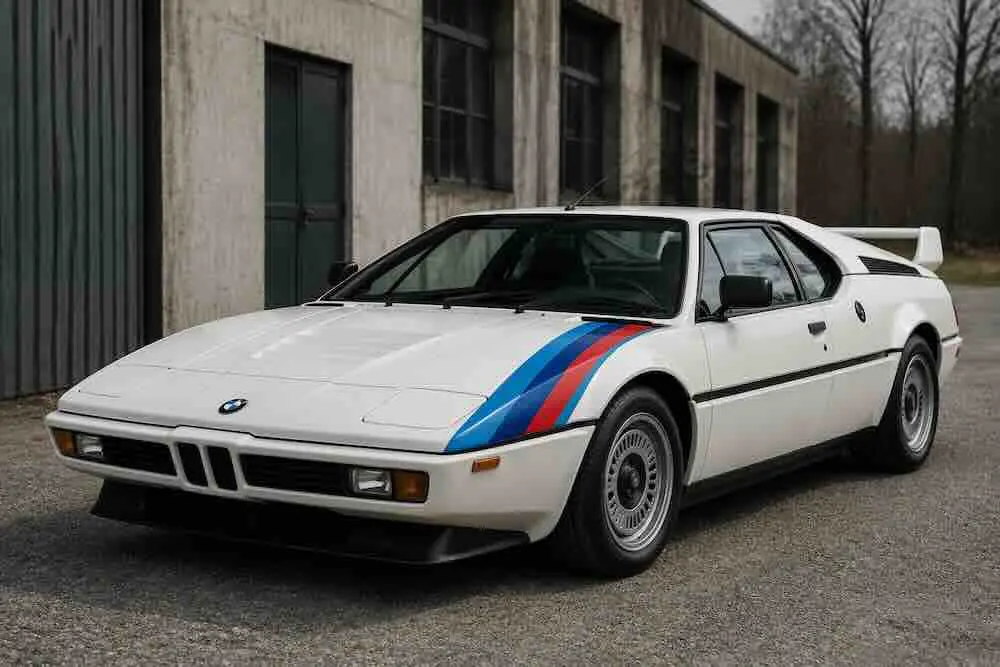
Renowned designer Giorgetto Giugiaro and Italdesign were tasked with the M1’s body. Giugiaro created a timeless concept for the production model, drawing on the bmw turbo by paul bracq and giving the car a clear head-on identity. Its distinctive cues included folding headlights, a flat kidney grille at the front, and black slats over the rear window. At only 1.14 meters tall, its low profile helped lower the center of gravity and sharpen handling. M1 looked more like a Ferrari or Lamborghini than a typical BMW, though its mid-engine layout and rear-wheel-drive balance still felt unmistakably purposeful.
Marchesi: Chassis production
Italian firm Marchesi manufactured the tubular chassis, emphasizing racing performance. The car was built with motorsport priorities from day one, using double-wishbone suspension, precise steering, and a low weight of about 1,300 kg to sharpen handling. Its wedge-shaped style also reflected the design lineage later echoed by the M1 Homage, with a head-light treatment and rear-window slats that suited the low body and its planted feel on the wheels. Paul Bracq’s BMW Turbo concept also helped inspire the M1’s look, including the mid-engine layout later revisited by the M1 Homage.
Lamborghini: Final assembly
Lamborghini was chosen to assemble the cars, and by april 1978 that plan was unraveling despite early work on seven prototypes. For BMW, this seemed ideal: experience with mid-engine supercars, necessary production capacity, Italian expertise, and several prototypes that helped prove the concept before parts were finally installed during assembly elsewhere.
The chassis was tuned for racing-style response with sharp steering, firm suspension, and the wheel setup matched to that balance. A 5-speed manual with a 40% locking limited slip differential helped put power down cleanly, while the 1,300 kg mid-engine layout gave the car agile handling and balanced weight distribution.
The moment everything started to fall apart
Lamborghini soon faced a severe financial crisis. Production timelines slipped, and BMW realized their primary partner might vanish entirely during the car’s development. The M1’s future was suddenly at risk, especially since Lamborghini was expected to handle final assembly, where major components would be installed before completion.
BMW took full control in April 1978 after seven prototypes had been completed.
How BMW rescued its own supercar
BMW quickly redistributed production responsibilities after Lamborghini’s financial crisis disrupted the M1’s development at a critical stage. Bodywork, chassis, and final assembly moved among various contractors, with key parts installed as the car moved between Germany and Italy. BMW took final assembly and fine-tuning of the model under its control. Instead of a perfectly calculated project, the M1 became almost a “handmade” supercar.
Why the M1 and M1 Procar still became legendary
Unique design
The M1 remains one of the most beautiful BMWs ever made. Its iconic wedge shape has influenced supercar styling for decades.
True mid engined car supercar credentials
Mid-engine layout, straight-six engine with racing potential — the M1 delivered on performance. As a mid engined car, it used a six-cylinder line layout with 277 horsepower of power and 330 Nm of torque from its 3.5-liter cylinder engine, enough for strong acceleration and a top speed of 262 km/h. BMW unveiled the M1 Homage concept in April 2008 to mark the model’s 30th anniversary. It then made its public debut at the Concorso d’Eleganza Villa d’Este, where its double headlights and rear double badge clearly echoed the original M1.
Rarity and exclusivity
Limited production numbers, combined with production challenges, made the M1 highly sought-after and often sold for strong prices, especially when a well-documented owner history shows who purchased the car and when. As a mid-engined car, it used a 3,453 cc (3.5 L) straight line six-cylinder M88/1 engine producing 277 PS (204 kW; 273 hp) at 6,500 rpm and 330 N⋅m (243 lbf⋅ft) at 5,000 rpm, with a top speed of 265 km/h (165 mph); this M88 later powered other notable BMW models. It also delivered strong acceleration with an unusual level of everyday drivability for such an exotic sports car.
“The chaos behind the scenes gave the BMW M1 its mystique, turning obstacles into legend.” – BMW M Magazine
The paradox of the BMW M1
Commercially, the project was complex and costly. Yet the production chaos is what made the M1 a cultural and automotive icon, a rare sports car whose surviving examples are closely tracked by owner history, including time in California. Its legend also grew through Le Mans, where the Group 4 class car’s position against tougher rivals added to its appeal for any driver. Surviving cars are often purchased and sold with strong emphasis on provenance. It symbolizes an era when manufacturers could create a supercar almost on enthusiasm alone.
Finale: A supercar that almost collapsed
BMW M1 exemplifies how ambitious projects can slip out of control. But even near-failures can produce legends. By linking the project to multiple partners and rescuing it at the last minute, BMW preserved its gamble and gifted the world a timeless supercar.