
Reading time: 5 minutes
What You’ll Read:
- Why the McLaren F1 is now considered one of the greatest supercars ever made;
- How an ambitious idea turned into a no-compromise road car;
- Why its engineering shocked the automotive world;
- Why buyers in the 1990s did not immediately understand it;
- How Le Mans, speed records, and real owner experience changed its reputation;
- Why collectors now treat the McLaren F1 like automotive art;
- Whether another modern car could repeat the same story
Today, a rare McLaren F1 can sell for a price that feels closer to private aviation than ordinary car collecting. It is admired in Canada and around the world as one of the purest, most important supercars ever built. But in the mid-1990s, the story was very different. Buyers hesitated. The price seemed absurd. The design was hard to explain. Even people who loved cars were not always sure what to make of it. The McLaren F1 is a reminder that the market does not always recognize greatness when it first appears.
The Supercar Everyone Understands Now
Today, the McLaren F1 has almost mythical status. Mention its name at a collector event, and the conversation changes. People do not talk about it like they talk about an ordinary fast car. They talk about it like a rare watch, a famous painting, or a piece of motorsport history that somehow received license plates.
For Canadian collectors, the attraction is easy to understand. The McLaren F1 is rare, beautiful, mechanically honest, and tied to one of the most romantic eras of performance cars. It belongs to a time before touchscreens, hybrid systems, and software-defined driving modes. It asks the driver to be present.
But the strange part is this: when it was new, the world did not fully know what it was looking at.
In the 1990s, the McLaren F1 was not instantly treated as a future masterpiece. It was expensive, unusual, and difficult to place. Some buyers saw genius. Others saw risk. And McLaren had to convince people that this strange three-seat machine was worth more than almost anything else on the road.
The Birth of an Impossible Idea
The McLaren F1 began with a simple but almost unreasonable question: what would happen if a team tried to build the best road car in the world without compromise?
That vision came from Gordon Murray, one of the most respected engineers in motorsport. He did not want to create a comfortable luxury grand tourer with impressive numbers. He wanted something lighter, sharper, more focused, and more honest.
The goal was not just speed. Speed alone is easy to advertise. The harder goal was purity.
The car had to feel special at every moment:
- when the driver opened the door;
- when they sat in the central seat;
- when the V12 started;
- when the manual gearbox clicked into place;
- when the road opened ahead.
Everything had a purpose. The central driving position was not a gimmick. It gave the driver a clearer view and a sense of total control. The carbon-fibre monocoque was not used for marketing drama. It helped make the car lighter and stronger. The naturally aspirated BMW V12 was not chosen because it looked good in a brochure. It gave the F1 the response, sound, and character that helped define its legend.
A Supercar That Felt Years Ahead of Its Time
In the early 1990s, the McLaren F1 must have seemed almost unreal.
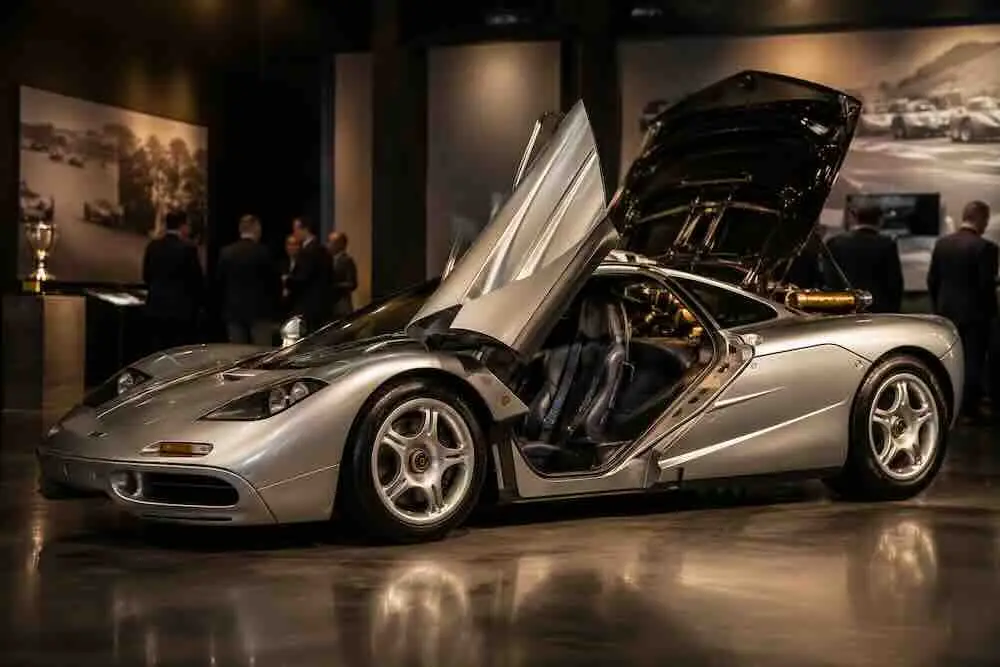
It had three seats, with the driver placed in the middle. It used a carbon-fibre structure when that technology still felt closer to Formula 1 than to normal roads. Its engine bay famously used gold foil because gold reflects heat extremely well. Even today, that detail sounds excessive. In context, it shows how seriously McLaren approached the car.
This was not a machine designed by accountants first and engineers second. It felt like the opposite. It was a car where the engineering team kept asking, “What is the best solution?” and only then dealt with how difficult or expensive that answer might be.
That is why the McLaren F1 still feels different from many later supercars. It was not chasing trends. It was not designed to win a social media moment. It came from a deeper philosophy: make the lightest, most involving, most complete road car possible.
Why the McLaren F1 Was Hard to Sell
Looking back, it seems obvious that the McLaren F1 should have been a success from day one. But the 1990s were not today’s collector market.
Modern buyers understand limited-production hypercars. They understand investment-grade cars. They understand that a rare machine from a serious brand can become more valuable over time. In the 1990s, that thinking was less developed.
The McLaren F1 also faced a branding problem. McLaren was legendary in Formula 1, but it was not Ferrari. It was not Porsche. It did not have generations of road-car customers waiting for the next dream machine. For many wealthy buyers, spending a huge amount of money on a McLaren road car required imagination.
And then there was the price. It was not merely expensive. It was difficult to justify in the language of the time. People could understand buying a Ferrari because Ferrari had emotional history. They could understand buying a Porsche because Porsche had road-car credibility. But McLaren was asking buyers to believe in something new.
That is often how future icons begin: not as obvious winners, but as uncomfortable questions.
The Moment the Story Started to Change
The McLaren F1 did not need marketing slogans forever. Eventually, it built its own evidence.
The most important moment came in 1995, when the McLaren F1 GTR won the 24 Hours of Le Mans outright. That victory changed how people saw the car. Suddenly, the F1 was not just an extreme road car with unusual engineering. It was a machine with racing greatness in its blood.
Winning Le Mans matters because it is not a simple test of speed. It is a test of endurance, design, preparation, and character. A car can be fast for one lap and still fail there. The F1 proved it could survive and triumph on one of motorsport’s most demanding stages.
Then came the speed record. The McLaren F1 became famous for reaching over 240 mph, a number that still feels dramatic today. But the number alone is not the whole story. What made the record so powerful was that the car achieved it without losing its identity. It remained naturally aspirated, manual, and deeply connected to the driver.
Real Owners Helped Build the Legend
The McLaren F1’s reputation was not built only by journalists or auction houses. It was also shaped by people who actually lived with the car.
Jay Leno, one of the most famous McLaren F1 owners, has often spoken about the car with genuine affection. His view matters because he is not just a collector looking at value. He is known for driving and understanding his cars. When he said, “I like to drive, I like the look and the feel of this car,” it captured something important.
The F1 is not loved only because it is rare. It is loved because people who drive it describe it as alive.
That personal experience gives the story more weight. A car can become expensive through scarcity. But to become truly legendary, it needs something more. It needs people to remember how it made them feel.
From Misunderstood Supercar to Collector Treasure
As the years passed, the same qualities that once made the McLaren F1 difficult to explain became the reasons collectors wanted it.
The central driving position became iconic. The manual gearbox became precious. The naturally aspirated V12 became a symbol of an era that will probably never return in the same form. The limited production numbers made every example feel important.
By the 2000s and especially the 2010s, the collector world had changed. Buyers were no longer asking why the McLaren F1 cost so much. They were asking how many great examples were left.
This is the moment when a car stops being just a car. It becomes a reference point.
For Canadian enthusiasts watching the global collector market, the F1 represents something rare: a machine that is historically important, technically fascinating, and emotionally powerful at the same time.
Why the McLaren F1 Costs Millions Today
The value of the McLaren F1 is not based on one factor. It is the result of several rare qualities meeting in one car.
Rarity
Only a small number of McLaren F1 cars were built. That alone creates demand, but rarity is only part of the story.
Engineering
The carbon-fibre monocoque, central driving position, BMW V12, and extreme weight-saving philosophy still feel special today.
Motorsport credibility
The 1995 Le Mans victory gave the F1 a heroic chapter that most supercars never receive.
Analogue character
Modern hypercars are often faster, but many are also more filtered. The McLaren F1 belongs to the last great age of direct mechanical connection.
Cultural importance
Over time, the F1 became the car that other supercars are measured against. That kind of status cannot be manufactured quickly.
Could the Market Make the Same Mistake Again?
Almost certainly.
The market often struggles with cars that do not fit existing categories. A machine that feels too strange, too expensive, or too focused in its own time can later become exactly what collectors want.
Some modern limited-production cars may follow a similar path, especially those with manual gearboxes, naturally aspirated engines, lightweight construction, or a clear engineering philosophy. But repeating the McLaren F1 story will be difficult.
The F1 arrived at a rare moment. It came before the digital age reshaped performance cars. It carried Formula 1 thinking into a road car. It won Le Mans. It broke speed records. It had a personality. And it was misunderstood just long enough to make its later rise feel even more dramatic.
FAQ
Why is the McLaren F1 so famous?
The McLaren F1 is famous because it combined radical engineering, extreme performance, rare production numbers, and real motorsport success. It was not just fast; it was thoughtfully designed from the ground up.
Why did the McLaren F1 not sell easily when new?
Its price was extremely high, McLaren was not yet established as a road-car brand, and the market in the 1990s was not as focused on collectible hypercars as it is today.
What makes the McLaren F1 different from modern supercars?
The F1 is lighter, more analogue, and more driver-focused than many modern performance cars. It uses a manual gearbox, a naturally aspirated V12, and a central driving position.
Why do collectors in Canada and worldwide value it so highly?
Collectors value the McLaren F1 because it is rare, historically significant, technically unique, and connected to an important moment in automotive history.
Did the McLaren F1 win Le Mans?
Yes. The McLaren F1 GTR won the 24 Hours of Le Mans outright in 1995, which strongly increased the car’s reputation.
Can another car become the next McLaren F1?
It is possible, but rare. A car would need limited production, genuine innovation, emotional appeal, and a story that grows stronger over time.
The Market Was Late, Not the Car
The McLaren F1 did not become great because auction prices rose. The prices rose because people finally understood how great it had always been.
In the 1990s, it seemed too expensive, too unusual, and too hard to explain. Today, those same qualities make it one of the most desirable cars on earth.
That is the main lesson of the McLaren F1: sometimes the market is not wrong forever. Sometimes it is simply late.