Time to Read: ~8 minutes
Table of Contents
- What This Article Will Explore
- What the Isle of Man TT Really Is — and Why It Was a Nightmare
- Why Honda Entered — and What Was at Stake
- Risking Almost Everything: Honda’s Gamble
- European Perceptions: From Dismissal to Shock
- The Victory That Changed Everything
- How That Win Influenced Honda’s Cars
- Final Thoughts — “Sometimes One Race Changes History”
- FAQ
In the early 1960s, Honda was just a small Japanese motorcycle company with big dreams. Entering the legendary and terrifying Isle of Man TT — one of the world’s most dangerous races — was a bold gamble that could have ended the company’s global ambitions before they began. This article explores why Honda risked it all, how it shocked Europe, and why that one race helped build a global automotive powerhouse.
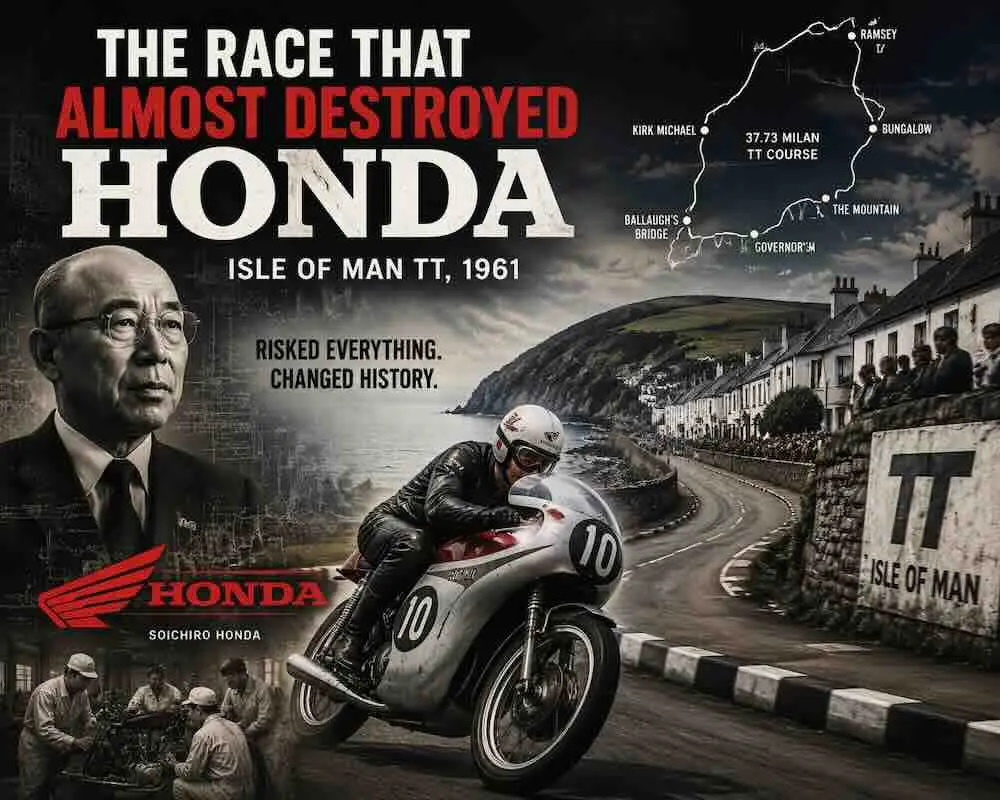
The Isle of Man TT, known for its grueling 37.73-mile mountain course, is not just a test of speed but also of endurance, precision, and courage. Riders face over 200 kilometers per hour speeds on narrow public roads lined with stone walls, buildings, and telegraph poles, making it one of the most perilous motorsport events in the world. For a relatively unknown company like Honda at the time, participating meant exposing itself to immense risk — both in terms of rider safety and corporate reputation.
Despite these dangers, Honda saw the TT as the ultimate proving ground. Success here would demonstrate the reliability, performance, and engineering excellence of their motorcycles on an international stage dominated by British and European manufacturers. The company’s bold decision to enter the TT was part of a larger vision to expand beyond Japan, challenge established industry leaders, and ultimately become a global powerhouse in motorcycles and automobiles.
Honda’s entry into the TT required meticulous preparation. Their engineers developed high-revving, lightweight machines designed to handle the demanding course. The team also focused on rigorous testing and training for riders to face the course’s unique challenges. This commitment to excellence and innovation laid the groundwork for Honda’s future successes, influencing not only motorcycle racing but also the design and engineering of their consumer vehicles.
The impact of Honda’s TT participation extended far beyond the race itself. Their performance at the Isle of Man TT shifted European perceptions of Japanese motorcycles from cheap imports to serious contenders. This newfound respect helped open international markets and paved the way for Honda’s expansion into the automobile industry, including the launch of iconic models like the Civic and Accord.
In summary, Honda’s gamble at the Isle of Man TT in the early 1960s was a defining moment that showcased the company’s determination, technical skill, and vision. It transformed Honda from a small Japanese motorcycle manufacturer into a respected global brand, setting the stage for decades of innovation and success in the automotive world.
Today, Honda is one of the largest and most respected automakers in the world with millions of cars and motorcycles on roads across Canada and beyond. But back in the early 1960s, Honda was a young, relatively unknown company from Japan taking a huge risk — entering the terrifying and prestigious Isle of Man TT motorcycle race to prove itself on the world stage.
Honda Canada Finance played a key role in supporting customers across the country to purchase Honda vehicles, helping the brand grow steadily in international markets. The company’s commitment to innovation and quality was put to the ultimate test during the Isle of Man TT, an event known for its grueling schedule that includes a qualifying week followed by intense race week, culminating in the adrenaline-filled race day.
The Isle of Man TT festival, held annually in June, attracts thousands of spectators who watch the thrilling qualifying sessions and races, often streaming official videos and live coverage on various devices. Honda’s involvement in such high-profile events helped raise brand awareness and showcased the durability and performance of their motorcycles under extreme conditions.
This exposure was crucial in building trust with consumers, leading to increased delivery volumes and expanding dealership networks worldwide. Honda’s ability to manage complexities such as taxes, financing payments, and timely delivery contributed to its reputation as a reliable and customer-focused manufacturer.
Moreover, Honda’s engagement with fans through platforms like Instagram and official websites allowed enthusiasts to subscribe for updates, watch exclusive content, and stay informed about schedules and cancellations, further strengthening the community around the brand.
Entering the Isle of Man TT was not just about racing; it was a strategic move that combined technical excellence, marketing savvy, and an understanding of global markets, setting Honda on a path to becoming a dominant force in both motorcycles and automobiles.
At that time:
- Post‑war Japan was not yet seen as a leader in advanced engineering by Western markets;
- British and European manufacturers dominated motorcycle racing;
- Honda was almost unheard of outside Asia, with no global reputation.
What This Article Will Explore
We’ll dive into what the Isle of Man TT is, why Honda decided to enter, the massive risks involved, how European perception of Japanese bikes shifted, and how Honda’s success there changed its fate forever.
What the Isle of Man TT Really Is — and Why It Was a Nightmare
The Isle of Man TT (Tourist Trophy) is a historic road racing event, and the first TT races were held on Tuesday, May 28, 1907, with Charles Collier winning the single-cylinder class at an average speed of 38.22 mph. Its mountain course, built from the island’s public roads, is a 37.73-mile circuit with 219 turns and a 421-meter elevation change, making this mountain route one of the most challenging in the world. The man tt races later formed part of the FIM Motorcycle Grand Prix World Championship from 1949 to 1976, including classes such as the sidecar and Senior TT.
Why It Was Terrifying:
- The course runs on public island roads that form the mountain course, not a closed track; houses, stone walls, telegraph poles, and trees line the route.
- Racers hit extremely high speeds — often exceeding 200 km/h — with virtually no run‑off or safety barriers;
- Over the decades, dozens of riders and spectators have died, making the TT infamous for its risk. Many have lost their life in TT competition, and even a single accident on this course can become part of the event’s grim history.
- Riding it demands exceptional skill because the mountain section and public-road layout leave almost no margin for error.
This fearsome mix of speed and danger was exactly why winning here meant so much — and why Honda’s decision was so bold.
Why Honda Entered — and What Was at Stake
The story really begins with Honda’s founder, Soichiro Honda, who had already released the company’s first complete motorcycle, the D-Type, in 1949, and his belief that winning on a global stage was essential for the company’s success.
Soichiro once wrote a powerful declaration to his team, vowing to take on the Isle of Man TT and prove that Honda had the engineering capability to compete with European manufacturers.
He understood that:
- Without an international racing victory, Honda would be dismissed as a minor Asian brand;
- Even with successful products like the Honda Super Cub, the most produced motor vehicle in history, Honda still needed a win abroad to validate its engineering;
- Victory at TT would send a clear message: Japanese machines could out‑engineer Europe.
This wasn’t a marketing stunt — it was a strategic, high‑stakes gamble. It also fit Honda’s wider expansion, which included entering the automobile market in 1963 and building a strong presence with the launch of the Civic in 1973.
Risking Almost Everything: Honda’s Gamble
Honda put a huge portion of its resources into this plan:
- Engineers worked around the clock to build competitive, high‑revving racing machines;
- The company poured funding into research, development, and logistics;
- They had nowhere near the resources of European legacy manufacturers.
Many inside Honda thought it was reckless. One engineer later recalled, “We had no budget for mistakes — every dollar, every hour mattered.” (Paraphrased based on internal histories shared on the Honda Racing site.)
The risk was enormous:
- A poor performance could ruin Honda’s finances;
- A failure might confirm European critics who said Japanese bikes were inferior;
- A fatal crash could permanently tarnish the brand.
Honda literally invested in risk — and the clock was ticking.
European Perceptions: From Dismissal to Shock
In the 1950s and early 60s, European riders and fans often saw Japanese motorcycles as cheap and unproven. Honda, in particular, was considered an exotic outsider, not a serious contender among the British and Italian heavyweights.
But things changed quickly once Honda entered the TT.
After fierce competition and intense preparation in 1959 and 1960, Honda finally achieved a breakthrough. By 1961, the company not only won its classes but also took the top five spots in both 125cc and 250cc races at the Isle of Man TT — stunning the motorcycle world.
The Daily Mirror at the time was quoted saying something akin to: “How did a Japanese manufacturer that had only competed three times achieve such an astonishing success?” (Paraphrased from period accounts.)
This performance dramatically shifted perception: reliability, engineering prowess, and competitive spirit were suddenly associated with Honda.
The Victory That Changed Everything
The 1961 TT wins were a turning point. The Isle of Man TT now includes multiple classes with distinct specifications, including Superbike, Supersport, Superstock, and Supertwin.
7.1 Modern TT classes
- Superbike
- Supersport
- Superstock
- Supertwin
Modern Superbike machines are the highest-performance class, typically 1,000 cc four-cylinder race bikes built for TT competition. Supersport is the modern version of the Junior TT class and follows stricter specifications based on FIM Supersport rules. The Supertwin class was introduced in 2022, with a maximum 700 cc capacity and minimum weight rules that vary by engine size.
What Changed Afterward:
- Honda gained worldwide attention and credibility;
- Sales in Europe and North America surged;
- Riders and engineers began to see Honda as a serious player.
This wasn’t just a sporting success — it was the moment Honda became known worldwide.
How That Win Influenced Honda’s Cars
Honda’s motorsports philosophy didn’t stop at motorcycles. The racing DNA forged on the Isle of Man carried into cars and technology, shaping Honda’s broader approach to product development:
- VTEC engines — inspired by racing innovations;
- Civic Type R and NSX — road cars with strong performance heritage, while Honda vehicles also became known for reliability, high resale value, advanced safety features, and durable engines that can exceed 300,000 kilometres with proper maintenance;
- Honda’s later participation in Formula 1 racing also reflects this legacy.
Modern Honda models also use the Honda Sensing Suite with standard driver-assist tools.
Honda was also the first Japanese automaker to build cars locally in the United States in 1982, launched Acura in 1986 as the first dedicated luxury vehicle brand from a Japanese automaker, and earlier introduced the CVCC engine, which met strict emissions standards without needing a catalytic converter.
The risk taken at the Isle of Man TT helped shape engineering approaches that defined Honda automobiles for decades, while a vast global production and R&D network, equipment such as portable generators and lawn care products, and newer ventures including the HondaJet, artificial intelligence, aviation, and future mobility show how far that reach now extends.
Final Thoughts — “Sometimes One Race Changes History”
Most global brands grow cautiously. But Honda’s leap — driven by boldness and a willingness to challenge the establishment — paid off beyond expectations.
One race on narrow island roads helped transform Honda from a humble Japanese company into a global engineering leader and household name.
Sometimes the destiny of a company isn’t decided by markets or advertising — but by the courage to enter the race.
FAQ
Q: Why was the Isle of Man TT so challenging?A: It used public roads with high speeds, narrow turns, and virtually no safety barriers, making it one of the deadliest races.
Q: When did Honda first compete there?A: Honda first entered the TT in 1959, marking its first major international racing challenge.
Q: Did Honda win on its first attempt?A: No — but after dedicating years to development, Honda scored dramatic wins by 1961.
Q: How did that influence Honda’s future?A: The success built global credibility, boosted exports, and influenced Honda’s engineering culture and automotive ventures, later supporting a broader vehicle business backed by dealership networks.
Q: What can Honda owners expect from dealerships?A: Many dealerships offer finance options for new and used vehicles, along with routine maintenance, repairs, and parts replacement. Owners can also expect factory-trained technicians who service vehicles to manufacturer standards.