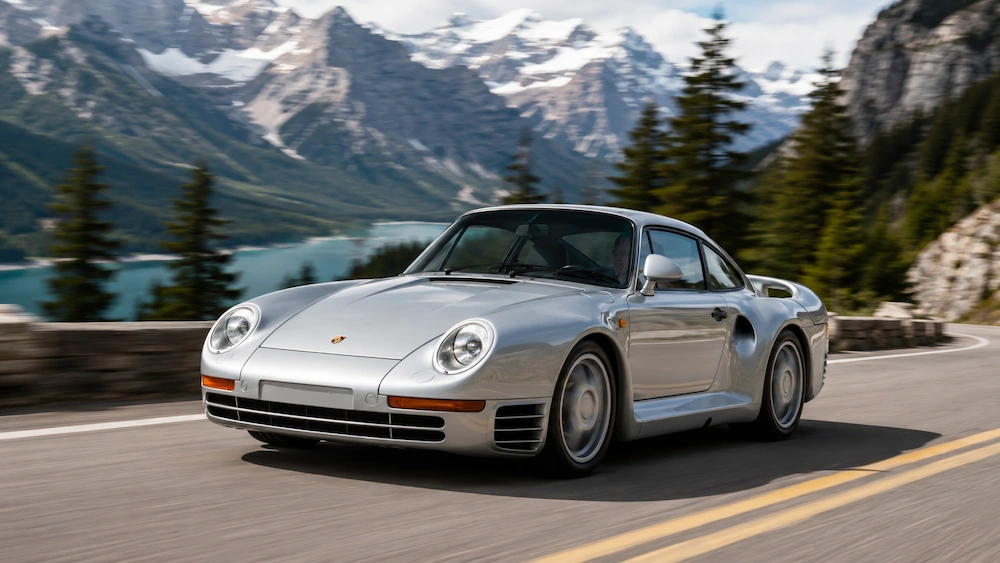
In the mid-1980s, Ferrari focused on emotion, naturally aspirated engines and dramatic styling. Lamborghini built cars that looked like spacecraft. Porsche chose a different path. Its engineers created a machine that resembled a familiar 911 but contained technology that would not become common for decades. The result was the Porsche 959, a Group B project often described as one of the first true hypercars.
Why Porsche Created the 959
The Porsche 959 was not originally designed simply to beat Ferrari at traffic lights. It began as a technological laboratory connected to the FIA’s Group B regulations.
To homologate a Group B model, manufacturers had to produce at least 200 road-going examples. Porsche saw this requirement as an opportunity to develop new systems while demonstrating what its engineers could achieve.
The objectives were ambitious:
- compete in international rallying;
- develop an advanced all-wheel-drive system;
- explore turbocharging and electronic controls;
- create a road car capable of challenging Ferrari and Lamborghini.
The 959 project eventually moved away from traditional Group B competition, but its motorsport ambitions survived. In 1986, Porsche 959 rally cars finished first and second in the Paris-Dakar Rally.
A Car Decades Ahead of Its Time
Revolutionary PSK All-Wheel Drive
The Porsche-Steuer Kupplung, or PSK, system could continuously adjust torque distribution between the front and rear wheels.
During hard acceleration, it could direct most of the power toward the rear axle. When conditions changed, it transferred more torque forward to improve traction. This was extraordinary in an era when most supercars were powerful, rear-wheel-drive machines that demanded constant respect.
Sequential Twin-Turbo Engine
The 959 used a 2.85-litre flat-six producing approximately 450 horsepower. Its two turbochargers operated sequentially, reducing the dramatic turbo lag associated with many high-performance cars of the period.
This helped the Porsche deliver strong acceleration without behaving like an engine that had suddenly remembered it was attached to explosives.
Adjustable Suspension
The road-going 959 offered electronically controlled suspension and adjustable ride height. Drivers could increase ground clearance when necessary and lower the car for high-speed stability.
For a production car launched in 1986, changing the ride height at the touch of a button sounded less like automotive engineering and more like science fiction.
Advanced Electronics and Materials
The car also featured intelligent torque control, tyre-pressure monitoring, lightweight aluminium and aramid body panels, magnesium wheels and carefully developed aerodynamics.
Automotive journalists who drove the car confirmed that the technology did not make it intimidating. During its period test, Car and Driver described the 959 as “astonishingly easy to drive,” noting its stability and comfort at extreme speeds.
Was the Porsche 959 Faster Than Ferrari?
The Porsche 959 was among the fastest road cars of its generation, although the later Ferrari F40 achieved a slightly higher claimed maximum speed.
| Car | Approximate top speed |
|---|---|
| Porsche 959 | 317 km/h |
| Ferrari F40 | 324 km/h |
| Lamborghini Countach 5000 QV | 295 km/h |
The Ferrari F40 was lighter, more dramatic and marginally faster in a straight line. The Porsche, however, was far more technically complex. It offered all-wheel drive, adjustable suspension and a level of stability that made its performance easier to access.
Ferrari built a thrilling machine. Porsche built a supercomputer with number plates.
Why the 959 Is Called the First Hypercar
There is no official rule defining the first hypercar, but the Porsche 959 fits many modern criteria:
- exceptional performance;
- extremely limited production;
- advanced materials and electronics;
- enormous development costs;
- technology taking priority over raw horsepower;
- influence extending far beyond one model.
Rather than simply installing a larger engine, Porsche combined speed, intelligence, comfort and all-weather capability. That philosophy later became central to cars such as the Bugatti Veyron and modern all-wheel-drive supercars.
The Car That Cost Porsche Money
The 959 was enormously expensive to develop and build. Its complex electronics, sophisticated drivetrain, lightweight materials and extensive hand assembly reportedly meant that production costs exceeded the price charged to customers.
Porsche treated the difference as an investment in research. The company may have lost money on individual cars, but it gained knowledge that influenced decades of future models.
The Legacy of the Porsche 959
The 959 helped establish the idea that electronic systems could enhance a sports car rather than dilute it.
Its influence can be seen in modern Porsche all-wheel-drive models, advanced turbocharged engines and electronically managed chassis systems. Similar principles later appeared in the Nissan GT-R, Audi RS range and high-technology hypercars from Bugatti.
Approximately 337 cars were produced when prototypes and special examples are included, although totals vary depending on how later cars are counted.
One famous owner was Bill Gates. His 959 could not initially be registered in the United States because it had not been certified under local safety and emissions requirements. The case became closely associated with the federal Show or Display exemption, introduced in 1999 to permit limited use of historically significant vehicles.
FAQ
Was the Porsche 959 created to defeat Ferrari?
Not officially. It was primarily a Group B development project and technological showcase. However, its speed and price placed it in direct competition with Ferrari and Lamborghini.
Did the Porsche 959 win the Paris-Dakar Rally?
Yes. Porsche 959 rally cars took first and second place in the 1986 event.
Was it the fastest production car in the world?
The 959 was widely regarded as the fastest series-production road car when introduced, with a top speed of approximately 317 km/h. Later rivals, including the Ferrari F40, claimed higher speeds.
Why is the Porsche 959 so important?
It demonstrated that a supercar could combine extreme speed with all-wheel drive, electronics, comfort and everyday usability. Most modern hypercars follow a similar philosophy.
Conclusion
The Porsche 959 changed expectations of what a supercar could be. While Ferrari and Lamborghini competed through power, sound and visual drama, Porsche created an intelligent performance car with twin turbos, adaptive suspension and electronically controlled all-wheel drive.
Almost every modern high-performance car now uses ideas that the 959 introduced or helped popularize. That makes it more than a rare 1980s Porsche. It is one of the most influential performance cars ever created.