
📖 Reading time: ~10 minutes
Table of Contents:
- Introduction — Japan’s Gamble on a Supercar;
- Japan vs. the Automotive World;
- The Birth of the Toyota 2000GT;
- How the Toyota 2000GT Conquered the World;
- Why the Toyota 2000GT Became a Legend;
- Legacy and the Passion of Collectors;
- FAQ
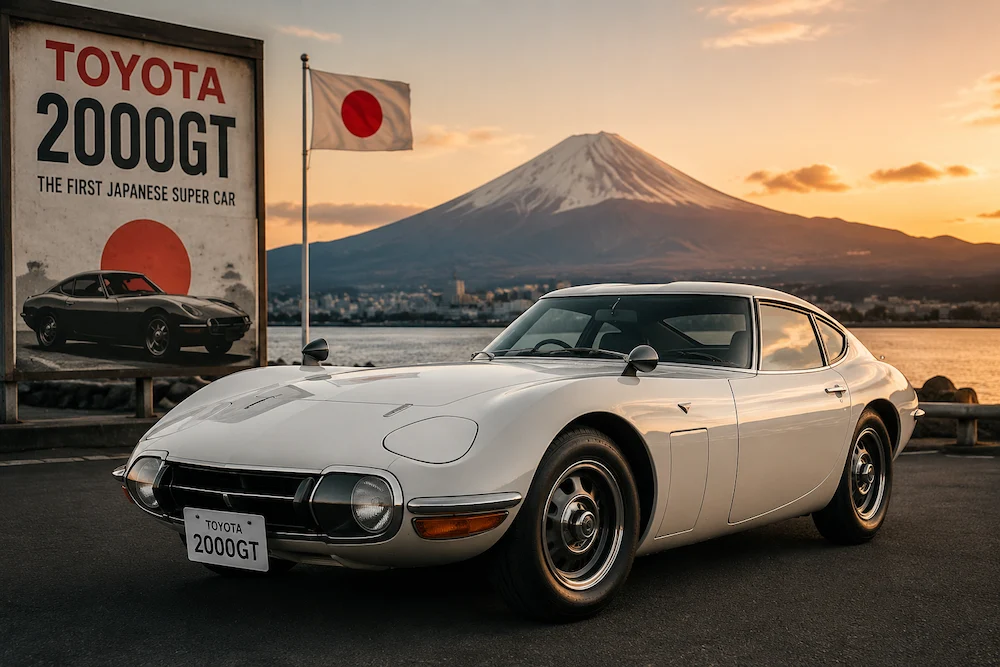
The Toyota 2000GT was more than a car — it was a statement. In the 1960s, Toyota risked everything to build Japan’s first true supercar. This story traces the people, the innovation, and the bold gamble that turned a small Japanese company into a contender on the world stage.
Japan’s Gamble on a Supercar
In the 1960s, Japanese cars were known for practicality, fuel efficiency, and reliability — not speed or glamour. For most of the world, Japan was a country of small, sensible cars. But Toyota dared to dream bigger. Their ambition? Build a sports car that could stand shoulder to shoulder with Ferrari, Jaguar, and Porsche.
Imagine the tension in Toyota’s design rooms: engineers pacing, sketches pinned to walls, debates over every curve, every gram of weight. “It’s crazy,” some must have whispered. “Can Japan really do this?” Yet the company plunged forward, and the Toyota 2000GT was born — elegant, fast, and fearless.
2. Japan vs. the Automotive World
A Transformative Era
Japan in the 1960s was rapidly modernizing. Factories hummed, cities expanded, and car ownership was booming. Yet high-performance vehicles were virtually unknown. Toyota’s plan to develop a supercar was audacious — it wasn’t just a new model, it was a challenge to decades of European dominance.
Engineering Boldness
To succeed, Toyota partnered with Yamaha, specialists in lightweight engineering and performance tuning. Yamaha’s engineers were the “rock stars” of precision engineering, bringing racing know-how to a production car. Together, they worked in near secrecy, blending innovation with courage. It was a bold gamble, and everyone knew it.
“Toyota engineers were obsessed — not with profit, but with proving that Japan could compete on the world stage.” — Automotive historian, Top Gear.
3. The Birth of Toyota 2000GT
Design Inspired by Europe
The 2000GT’s design was breathtaking: long, low, and curvaceous. Pop-up headlights, sweeping fenders, and a cockpit made for a driver. It borrowed cues from European GTs but had a unique Japanese elegance — understated yet sophisticated. Designers literally sculpted clay models by hand, obsessing over every angle.
Innovative Tech for Its Time
- Lightweight Construction: Using aluminum panels and meticulous design, the car remained nimble.
- DOHC Inline-6 Engine: Yamaha helped refine the engine to deliver smooth power and high revs, unmatched in Japanese cars at the time.
- Precision Handling: Independent suspension and carefully tuned balance made it a joy to drive on twisty roads or highways.
Engineers weren’t just building a car; they were chasing a dream. Rumor has it, some spent nights sleeping in the workshop just to keep perfecting the prototype. Every test drive was a thrill — or a nail-biting risk.
4. How the Toyota 2000GT Conquered the World
Records and Racing
The 2000GT proved itself on the track and in controlled speed runs. It set three world speed records and thirteen international records at the Yatabe testing grounds. For a car from a country not yet famous for performance, this was monumental.
Western Praise
When journalists from Road & Track and Car & Driver first drove it, they were stunned. Reviews praised its balance, responsiveness, and elegance. Some called it “a Porsche killer from Japan.” The global auto world began to sit up and take notice.
A Bond With Hollywood
The 2000GT’s role in You Only Live Twice wasn’t just a cameo. Two special convertibles were made for the film, giving the car an unforgettable place in pop culture. Suddenly, the world associated Japan with not just efficiency, but excitement and style.
5. Why the Toyota 2000GT Became a Legend
Rarity and Exclusivity
Only 351 units were ever built. This rarity added mystique. Each car was handcrafted, each a small piece of automotive art.
Changing Perceptions
The 2000GT reshaped how the world saw Japanese engineering: precise, innovative, daring. It proved that Japan could create something extraordinary, challenging the assumption that European or American cars held all the prestige.
Influence on Future Toyota Sports Cars
The lessons learned influenced models like the Supra, Celica, and GT86. The 2000GT was not just a car; it was a template for Japanese sports car excellence for decades to come.
6. Legacy and the Passion of Collectors
Today, the Toyota 2000GT is one of the most coveted Japanese classics. Auctions regularly see it reach seven-figure sums. Collectors chase it not just for its speed, but for its story — the story of a small nation daring to dream big, of engineers pouring their heart into metal and machine.
“Owning a 2000GT is like holding a piece of history — a symbol of courage, imagination, and risk.” — Classic car collector, Tokyo
FAQ
Q: Was the Toyota 2000GT Japan’s first supercar?
A: Yes — widely recognized as Japan’s first true supercar, it set a benchmark for style, performance, and innovation.
Q: Why were so few made?
A: Limited production due to high costs, complex engineering, and hand-built assembly meant only 351 units were ever completed.
Q: Is the Toyota 2000GT valuable today?
A: Absolutely — modern auctions often see prices exceeding $1 million for well-preserved examples.