
Table of Contents
- First impressions at the 1954 New York Auto Show
- Engineering innovation behind the Gullwing doors
- Technical and economic risks of production
- Enthusiasm and thrill of engineers and buyers
- Legacy and modern-day value
- FAQ
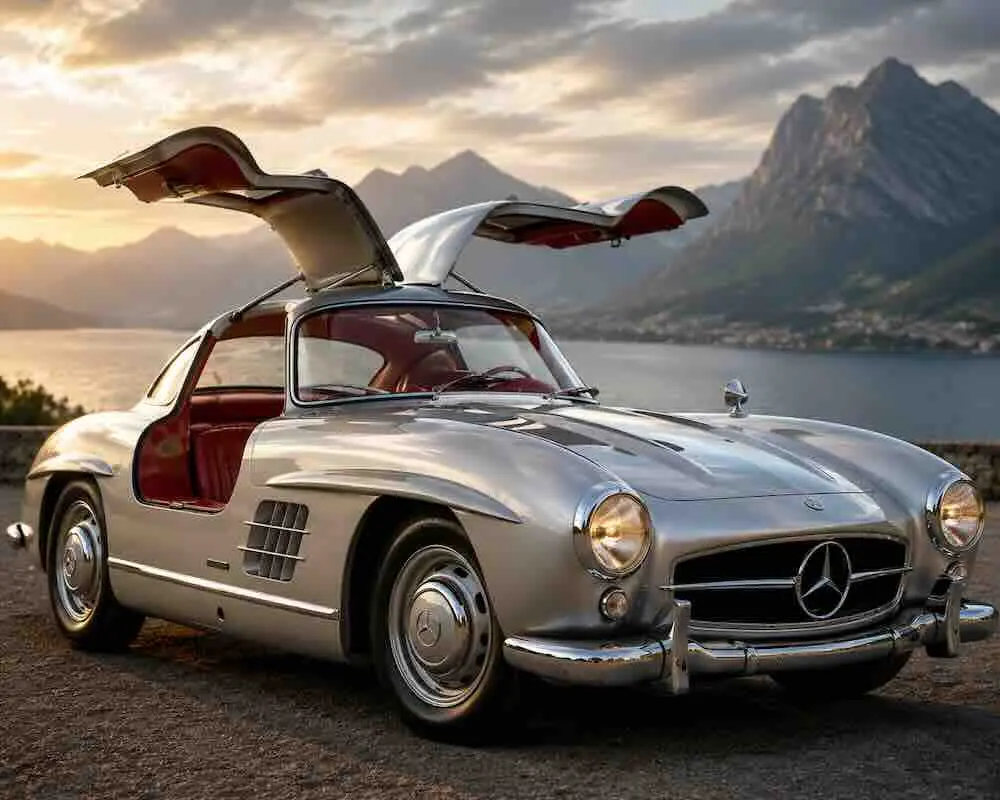
The Mercedes 300 SL ‘Gullwing’ captured imaginations with daring design, groundbreaking engineering, and doors that became a symbol of risk and innovation. This article explores its creation, technical challenges, and why it remains an icon.
First impressions at the 1954 New York Auto Show
When Mercedes revealed the Mercedes-Benz 300 SL Gullwing at the 1954 New York Auto Show in New York, the crowd was electrified. The idea came from U.S. importer Max Hoffman in 1953 to target the American market, a move that reshaped Mercedes-Benz strategy. Its Gullwing doors immediately became a symbol of bold innovation. Visitors marveled at the futuristic aluminum body and sleek racing-inspired silhouette. As automotive historian John Lamm recalls, “The public didn’t just see a car—they saw a statement about speed, risk, and engineering daring”—a fitting reaction to the Mercedes-Benz 300 SL, the W198 produced from 1954 to 1957 and often regarded as the world’s first true supercar, while the Mercedes-Benz 300SL Gullwing remains a benchmark for collectors.
Engineering innovation behind the Mercedes Benz 300SL Gullwing doors
The Gullwing design wasn’t mere stylistic flair—it solved a structural challenge. The tubular frame created very high sills, making a conventional door impractical, so engineers opted for the iconic upward-opening gullwing doors.
To keep the low, aerodynamic hood line, the motor was tilted 50 degrees to the driver’s side.
- Fuel-injected engine: A 3.0-liter inline-6 with six cylinders, producing 240 hp at 6,100 rpm and 203 lb-ft of torque at 4,600 rpm; it was the first mass-production car with fuel injection, a breakthrough that raised its power and power output.
- Lightweight bodywork: The standard model used primarily steel body panels, with aluminum for the bonnet, doors, dashboard, and trunk lid, while a rare run of 29 all-aluminum bodies was built for competition to reduce weight.
- Suspension and handling: Independent front suspension with coil springs and hydraulic telescopic shock absorbers, plus a low-pivot rear axle layout that shaped the rear end, worked with precise steering and strong brakes to keep the rear wheels more settled at speed.
Dry sump lubrication improved oil control at high speeds and during high speed cornering.
Its streamlined shape reduced drag, and with a low center of gravity and reduced car’s weight, it became one of the fastest production car designs of its era.
Key technical innovations:
- Tubular frame chassis
- Fuel-injected engine—a first in production vehicles
- Lightweight aluminum bodywork
- Advanced suspension and aerodynamics for road and track, paired with a 4-speed manual transmission to support balanced chassis performance
- Curb weight: approximately 2,855 lb (1,295 kg)
- Depending on the selected rear-axle gear ratio, top speed ranged from 135 mph to 163 mph (217 to 263 km/h), with acceleration from 0 to 60 mph (0 to 100 km/h) in roughly 7.7 to 8.8 seconds
These innovations showcased Mercedes’ willingness to gamble on untested engineering.
Technical and economic risks of production
Producing the 300 SL was a financial and technical gamble: it traced back to the 1951 W194 racing car, whose endurance-racing engineering Mercedes adapted for the road.
- Aluminum body required precise fabrication and welding
- Fuel injection system complicated assembly
- Unit costs were high because factory complexity demanded specialist fabrication and materials
The cost of building such an advanced vehicle in Germany and selling the vehicle in Europe and the U.S. made the business case unusually risky.
As classic car expert Jan Schmidt explains, “Every 300 SL was a triumph of precision—and a test of courage for the company.”
Enthusiasm and thrill of engineers and buyers
Engineers embraced the challenge, knowing the project could fail. Early buyers mirrored this daring, paying premium prices for the chance to own a piece of innovation.
- Early 300 SLs sold out rapidly
- Buyers accepted unconventional handling and maintenance, including climbing over the wide, high sill and using the tilt-away steering wheel to get in
- For owners, the experience symbolized status, technical appreciation, and a willingness to take risks for the driver
A skilled mechanic was often needed to keep the complex fuel-injected engine properly tuned, especially during cold starts and with the auxiliary fuel pump system.
This synergy of engineering and buyer audacity cemented the 300 SL’s legendary status.
Legacy and modern-day value
Today, the Gullwing is a collector’s dream:
- The market benchmark for the mercedes benz 300sl Gullwing has reached $1,848,947
- Recent sale results show a price range of $1,462,500 to $2,530,000, with collectors closely watching both the Gullwing and the roadster
- Revered for both design and historic significance, with average values fluctuating sharply and exceptional cars selling for over $4 million
The 300 SL proves that innovation and audacity can create enduring legends.
FAQ
Q1: Why were Gullwing doors chosen?A1: To accommodate the tubular frame chassis; conventional doors couldn’t open.
Q2: How revolutionary was the fuel injection system?A2: Extremely; it marked one of the first uses in a production road car, enhancing performance and efficiency. It helped deliver performance that was unprecedented for a 1950s road car, with a top speed of 146 mph (235 km/h) and 0 to 62 mph (0 to 100 km/h) in 9.3 seconds.
Q3: Are original 300 SL models valuable today?A3: Yes, original models often sell for millions at auctions worldwide, remain highly valuable on the collector market, and still hold strong appeal for buyers who want a car with lasting class-leading presence in classic-car competition.