
Reading time: 4 minutes.
Table of contents
- Introduction: the race where logic failed;
- Nürburgring’s gamble: why this race cannot be predicted;
- Verstappen’s big bet;
- When everything went off script;
- The unlikely hero: Dacia Logan;
- Why this story worked so well for fans;
- The main lesson of Nürburgring;
- FAQ
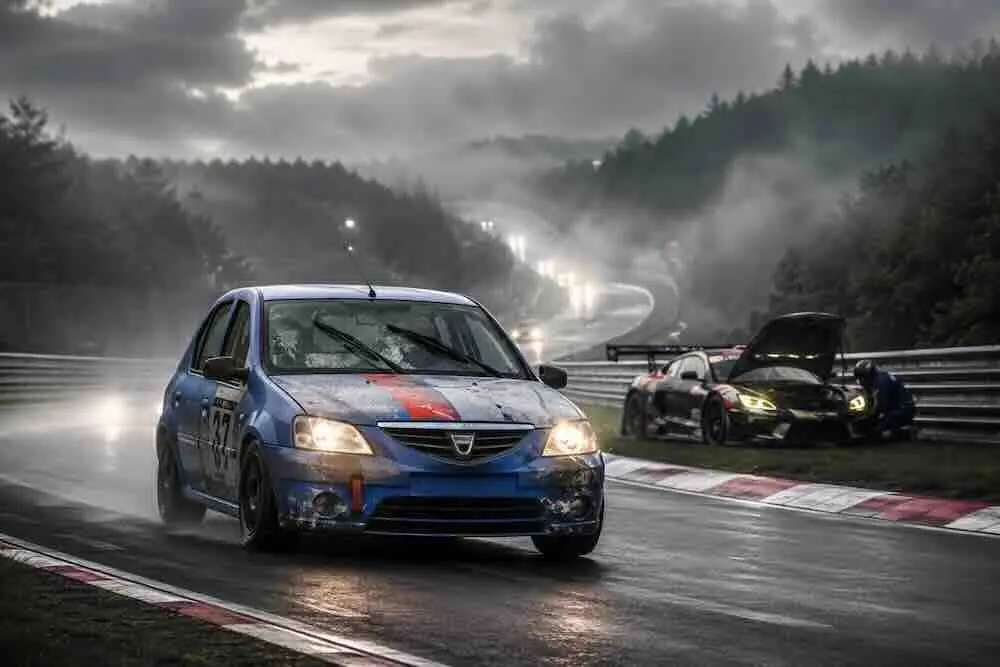
The Nürburgring 24 Hours is one of those races where logic enters the track confidently and often leaves on a tow truck. In 2026, many fans followed the event because of Max Verstappen and the high-profile GT3 project connected with him. But while the spotlight was expected to stay on speed, status, and ambition, another machine became part of the story: Dacia Logan. Slow, stubborn, imperfect, and unforgettable, it reminded everyone why endurance racing is not only about the fastest car.
Introduction: The Race Where Logic Failed
On paper, the story looked obvious. A Formula 1 champion, a serious GT3 effort, a legendary circuit, and massive fan attention. Max Verstappen’s name alone was enough to pull new viewers toward the Nürburgring 24 Hours, including many Canadian motorsport fans who usually follow Formula 1 more closely than endurance racing.
But the Nürburgring is not a place where names guarantee anything. It is too long, too narrow, too changeable, and too cruel. The track does not care about reputation. It does not care about fan expectations. It only asks one question for 24 hours: can you keep going?
That is why this race felt almost like a jackpot spinning out of control. The favourite story began with Verstappen. The emotional story ended with Dacia Logan.
Nürburgring’s Gamble: Why This Race Cannot Be Predicted
The Nürburgring Nordschleife is known as the “Green Hell”, and the nickname is not marketing poetry. It is a warning. The circuit combines high-speed sections, blind corners, elevation changes, narrow asphalt, heavy traffic, and weather that can change from dry to dangerous in minutes.
During the Nürburgring 24 Hours, the challenge becomes even more extreme. Drivers are not simply racing against rivals. They are racing against fatigue, darkness, traffic, repair time, tyre wear, and the possibility that one small technical issue can destroy months of preparation.
What makes the race so brutal?
A team needs much more than pace. It needs:
- a reliable car;
- calm drivers;
- fast but safe pit stops;
- smart traffic management;
- stable communication;
- patience during difficult conditions;
- luck when chaos appears.
This is why even a powerful GT3 car can suddenly disappear from the fight, while a much simpler machine can win the hearts of spectators just by surviving.
For Canadian fans used to hockey-style narratives of grit, endurance, and momentum swings, the Nürburgring 24 Hours feels surprisingly familiar. It is not always the prettiest team that earns respect. Sometimes it is the one that keeps standing.
Verstappen’s Big Bet
Max Verstappen’s connection to the race created huge attention. Formula 1 fans know him as one of the most dominant and aggressive drivers of his generation. His name brings expectation automatically. If Verstappen is involved, fans expect speed, ambition, and a serious attempt to make a statement.
That is why the GT3 project carried pressure before the race even fully developed. It was not just another entry. It was a story with a superstar shadow behind it.
Why everyone watched the Verstappen project
The interest came from several factors:
- Verstappen’s global Formula 1 status;
- curiosity about his endurance racing ambitions;
- the strength of a GT3 machine at Nürburgring;
- fan expectations of a strong result;
- the drama of seeing an F1 champion linked to one of motorsport’s toughest races.
The idea was exciting: a world champion’s project trying to conquer one of the most unpredictable events in racing. It sounded like the perfect motorsport headline.
But endurance racing rarely gives perfect headlines without adding pain.
When Everything Went Off Script
Then came the kind of moment that defines the Nürburgring 24 Hours: technical trouble.
A drivetrain-related issue changed the race for the Verstappen-linked car. In endurance racing, this is the nightmare scenario. The car may be fast. The drivers may be ready. The strategy may be strong. But once the machine starts fighting itself, the entire plan can collapse.
The brutal part is how quickly it happens. One lap can change everything. A team that looked competitive can suddenly become a garage story instead of a podium story. Engineers, mechanics, and drivers are left trying to save what can still be saved.
Why technical problems hurt so much at Nürburgring
At a normal circuit, a problem is bad. At the Nürburgring, it can be devastating. The track is long, so getting back to the pits can take time. Traffic is intense, so driving a damaged car safely is difficult. And while one team repairs, others continue to build distance.
This is the cruel mathematics of 24-hour racing. You do not lose seconds. You lose laps, rhythm, confidence, and sometimes the entire race.
For Verstappen’s project, the story became a reminder that even elite preparation cannot protect a team from the mechanical randomness of the Green Hell.
The Unlikely Hero: Dacia Logan
And then there was Dacia Logan.
Nobody expected it to be one of the most talked-about cars of the event. It was not the fastest car on the grid. It did not have the glamorous image of a GT3 monster. It looked humble, almost comic, next to the serious racing machines around it.
But that was exactly why fans loved it.
The Dacia Logan became the perfect underdog. In a field filled with expensive, aggressive, aerodynamic machines, this modest car simply continued its battle. It was not trying to look legendary. It became legendary by refusing to disappear.
Why Dacia Logan became a fan favourite
The car stood out because it represented something pure:
- passion instead of luxury;
- persistence instead of raw power;
- humour instead of corporate perfection;
- survival instead of domination;
- a small-team spirit that fans could understand.
In endurance racing, there is a special kind of respect for any car that keeps going. A Dacia Logan at Nürburgring is not just a vehicle. It is a statement: you do not need to be the fastest machine to become the story.
One phrase from the team captured the mood perfectly: “That’s racing.” Short, painful, and honest. It is the kind of quote that only makes sense when a team has accepted that motorsport can be both beautiful and ridiculous at the same time.
Why This Story Worked So Well for Fans
The contrast was irresistible. On one side, there was Max Verstappen — elite performance, global attention, high expectations. On the other, Dacia Logan — humble, strange, stubborn, and deeply human.
That contrast is what made the Nürburgring 24 Hours feel so alive.
Motorsport often sells itself through speed, technology, and winners. But fans also love chaos. They love the unexpected machine that should not be there. They love the team fighting with fewer resources. They love the moment when a race stops being predictable and becomes folklore.
For Canadian readers, this is easy to understand. It is the same reason people remember underdog playoff runs, backup goalies, and teams that survive impossible pressure. Sometimes the result matters. Sometimes the story matters more.
Dacia Logan did not need to beat the GT3 field to become important. It only needed to keep moving while the race around it became stranger and harsher.
The Main Lesson of Nürburgring
The Nürburgring 24 Hours teaches the same lesson every year, but every year it finds a new way to make it dramatic: to win, first you must finish.
Speed is important. Nobody denies that. But over 24 hours, speed without reliability becomes fragile. Aggression without patience becomes dangerous. A perfect qualifying lap means little if the car cannot survive the night.
Reliability vs speed
The Verstappen-linked project showed the ambition and pressure of competing at the highest level. Dacia Logan showed the emotional power of simply refusing to stop. Together, they created the perfect Nürburgring contrast.
One car reminded fans how high the stakes can be. The other reminded them that motorsport still has room for strange miracles.
In a world where racing can sometimes feel too polished, too controlled, and too predictable, the Nürburgring remains beautifully unstable. It is a place where a superstar can suffer heartbreak and a humble underdog can become the soul of the weekend.
Conclusion
The 2026 Nürburgring 24 Hours delivered the kind of story no marketing campaign could design. Max Verstappen brought the attention. Technical trouble brought the drama. Dacia Logan brought the heart.
That is why this race remains one of the most fascinating events in motorsport. It is not only about who has the fastest car. It is about who survives the night, who handles the chaos, and who gives fans a story worth remembering.
The champion’s project reminded everyone that the stakes at Nürburgring are enormous. The Dacia Logan reminded everyone that miracles still happen when a car, a team, and a crowd decide not to give up.
And that mix of risk, patience, absurdity, and emotion is exactly why the Nürburgring 24 Hours continues to feel like the most unpredictable jackpot in racing.
FAQ
Did Max Verstappen race in the Nürburgring 24 Hours?
Yes. His involvement attracted major attention from Formula 1 fans and added a high-profile storyline to the race.
Why did the Verstappen-linked car leave the fight?
The car suffered technical trouble, reportedly connected with drivetrain issues. In a 24-hour race, even one serious mechanical problem can destroy a team’s chances.
Why did people talk so much about Dacia Logan?
Because it was the perfect underdog. It was modest, unusual, slower than the GT3 cars, and yet it kept fighting. Fans love cars that survive against expectations.
Is the Nürburgring 24 Hours only about speed?
No. Speed matters, but reliability, patience, smart strategy, and survival are just as important. At Nürburgring, finishing the race is already a serious achievement.
Why is the Nürburgring called the Green Hell?
The nickname comes from the track’s extreme difficulty: long distance, blind corners, elevation changes, forests, changing weather, and very little room for mistakes.
What is the main takeaway from this race?
The Nürburgring 24 Hours proves that motorsport is still unpredictable. A champion can face disaster, and a Dacia Logan can become a hero simply by refusing to stop.