Reading time: 5 minutes.
Table of contents:
- Introduction: a supercar where it did not belong;
- Why Porsche looked beyond smooth roads;
- First steps, hard lessons and one painful failure;
- How the Porsche 959 became a desert fighter;
- Dakar Rally 1986: when survival mattered most;
- The impossible victory;
- Why the Porsche 959 was more than a fast car;
- The legacy almost 40 years later;
- FAQ
In 1986, Porsche brought one of the most advanced sports car concepts of its time to the Dakar Rally — a place where comfort, beauty and perfect engineering usually meant very little. The Porsche 959 looked too refined for the desert, too futuristic for the dust, and too ambitious for a race famous for breaking machines and people. Yet it crossed the finish line first and turned a risky experiment into one of the most unforgettable stories in motorsport.
Introduction: a supercar where it did not belong
The Dakar Rally has never been a place for delicate machines.
It is a race where cars disappear into dust, where the heat tests every bolt, where drivers do not simply chase speed — they fight fatigue, sand, navigation mistakes and mechanical fear. Most vehicles that succeed there look like they were born for punishment: tough, high, loud and practical.
And then there was the Porsche 959.
At first glance, it did not look like a natural Dakar winner. Porsche was known for fast roads, endurance racing and elegant engineering. The 959 looked more like something created for German autobahns than African dunes.
That is what made the story so powerful. Porsche did not simply bring a car to the desert. It brought an idea: that technology, courage and stubborn belief could challenge the usual rules of off-road racing.
Why Porsche looked beyond smooth roads
The Porsche 959 was created as a technological flagship. It was not just another fast car. It was Porsche saying: this is what the future of performance could look like.
The project brought together ideas that were extremely advanced for the 1980s:
- all-wheel drive;
- adjustable suspension;
- turbocharged power;
- lightweight construction;
- intelligent torque distribution;
- electronic systems designed to make speed more controllable.
But Porsche needed more than a showroom or a test track. The brand wanted a place where excuses would disappear.
The Dakar Rally was perfect for that. Not because it was glamorous, but because it was merciless.
On a clean road, many cars can feel impressive. In the desert, a car must prove that it is more than numbers on paper. It must breathe through dust, stay cool in heat, survive impacts, and keep moving when the driver is exhausted.
For Porsche, Dakar was not only a race. It was a laboratory without walls.
First steps, hard lessons and one painful failure
The Porsche 959 story did not begin with instant glory.
In 1984, Porsche entered the Dakar with the Porsche 953, a heavily modified 911-based car with all-wheel drive. René Metge and Dominique Lemoyne won the event, giving Porsche its first real proof that a sports-car DNA could survive rally raid conditions.
That victory was important, but it was not the end goal. It was the beginning.
Porsche wanted to go further. The company prepared a more advanced machine connected to the upcoming Porsche 959. The idea sounded almost too bold: take cutting-edge sports car technology and test it in one of the least forgiving races on Earth.
Then came 1985.
The cars looked promising, but technical problems destroyed the dream. Instead of becoming heroes, Porsche had to accept failure, return home and study what went wrong.
This is the part of the story that makes the 1986 victory more human. Porsche did not simply arrive and dominate. The team made mistakes. The cars broke. The plan looked questionable.
But the engineers did what great engineers do: they listened to failure.
How the Porsche 959 became a desert fighter
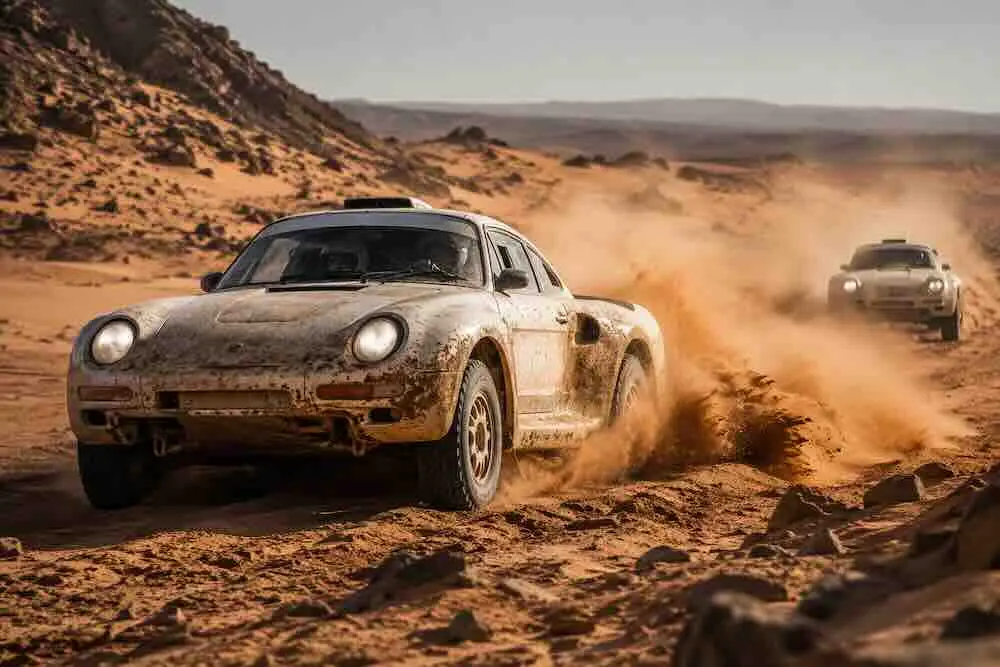
The Dakar version of the Porsche 959 was not just a road car with off-road tyres. It was a machine rebuilt around survival.
It still carried the spirit of a Porsche, but almost everything had to serve the desert.
What changed for Dakar
The rally version received:
- increased ground clearance;
- reinforced suspension;
- stronger protection underneath;
- lighter body elements;
- off-road tyres;
- rally navigation equipment;
- a powerful turbocharged flat-six engine;
- Porsche’s advanced PSK all-wheel-drive system.
The PSK system was one of the most fascinating parts of the car. It could change how power was distributed between the front and rear wheels. On sand, gravel or rough tracks, that mattered enormously.
A normal supercar wants grip on clean asphalt. The Dakar Porsche 959 had to search for grip in places where the ground itself seemed to move.
And yet, despite all the changes, it still felt like a Porsche. That was the magic. It was not a truck pretending to be fast. It was a sports car taught how to survive.
Dakar Rally 1986: when survival mattered most
The 1986 Dakar Rally was not a short heroic sprint. It was a long, exhausting test across thousands of kilometres. The race punished impatience. One wrong decision could bury a car in sand. One mechanical weakness could end weeks of preparation.
The Porsche team arrived with serious names and serious pressure.
René Metge and Dominique Lemoyne led one car. Jacky Ickx and Claude Brasseur drove another. Roland Kussmaul was also part of the effort, helping support the team’s overall result.
The rivals were not going to make it easy. Dakar had specialists, tough machines and experienced crews who understood the desert rhythm. Porsche had speed and technology, but it still had to prove that both could survive outside their comfort zone.
This is where the human side of the story becomes clear. The victory was not created only by engineers in Stuttgart. It depended on tired drivers making calm choices, co-drivers reading the route correctly, mechanics fighting dust and damage, and a team refusing to panic when the rally became cruel.
As one often repeated idea in motorsport says: “To finish first, first you have to finish.”
In Dakar, that sentence is not a cliché. It is survival advice.
The impossible victory
By the end of the 1986 Paris–Dakar, Porsche had achieved something extraordinary.
René Metge and Dominique Lemoyne won in the Porsche 959. Jacky Ickx and Claude Brasseur finished second in another 959. Porsche did not merely appear in the desert and get lucky. It controlled the story.
For the automotive world, this was a shock.
A brand famous for sports cars had won one of the hardest off-road races on the planet. A car connected to one of the most advanced supercars of the decade had beaten machines that looked far more natural in the desert.
That is why the victory still feels emotional. It was not just about a trophy. It was about watching an impossible idea become real.
The Porsche 959 did what great racing cars do best: it changed people’s imagination.
Why the Porsche 959 was more than a fast car
The Porsche 959 was special because it was not built around one simple talent.
It was not only fast. It was intelligent.
It was not only powerful. It was controlled.
It was not only beautiful. It was useful in conditions where beauty usually means nothing.
Its technology pointed toward the future of performance cars. All-wheel drive, turbocharging, electronic control systems and adaptable handling later became normal parts of high-performance engineering.
For Canadian readers, this is especially interesting. Canada is a country where driving conditions can change quickly: dry highways, rain, snow, gravel roads, cold mornings and long-distance routes. The idea of a performance car that can manage difficult conditions feels less like fantasy and more like practical genius.
The Porsche 959 was not an SUV, and it was not built for everyday Canadian winters. But its philosophy — performance with traction, intelligence and adaptability — still feels very modern.
The legacy almost 40 years later
Almost four decades later, the Porsche 959 remains a legend.
Collectors admire it because it is rare. Engineers admire it because it was advanced. Motorsport fans admire it because it won where it should not have won.
Its Dakar Rally story also helped shape how people think about Porsche. The brand was no longer only about smooth racetracks and fast roads. It had proved that its engineering could cross deserts, survive punishment and still come out ahead.
You can see part of that legacy in modern performance SUVs, all-wheel-drive sports cars and off-road Porsche projects. Today, the idea of a fast Porsche with serious traction no longer feels strange. In 1986, it felt almost absurd.
That is why the story still works.
The Porsche 959 did not win the Dakar Rally because it was the obvious choice. It won because someone believed the obvious choice was not always the most interesting one.
And sometimes, in motorsport, the wildest idea is the one that changes everything.
FAQ
Did the Porsche 959 really win the Dakar Rally?
Yes. In 1986, René Metge and Dominique Lemoyne won the Paris–Dakar Rally in a Porsche 959. Another Porsche 959, driven by Jacky Ickx and Claude Brasseur, finished second.
Why was the Porsche 959 victory so surprising?
Because the Porsche 959 was connected to a high-performance supercar project, not a traditional off-road vehicle. Seeing that kind of technology succeed in the desert was unexpected.
Was the Dakar Porsche 959 the same as the road version?
No. The Dakar version was heavily modified. It had more ground clearance, reinforced suspension, rally equipment and protection for rough terrain. However, it still used advanced ideas connected to the road-going Porsche 959.
What made the Porsche 959 technically special?
Its advanced all-wheel-drive system, turbocharged engine, lightweight construction and electronic systems made it one of the most forward-thinking performance cars of the 1980s.
Why is the Dakar Rally so difficult?
The Dakar Rally combines long distances, harsh terrain, extreme weather, navigation challenges and mechanical stress. A fast car is not enough. It must also be reliable and manageable.
Why does this story still matter today?
Because it shows how bold engineering can change expectations. The Porsche 959 proved that a sports car could be more adaptable, more intelligent and tougher than people imagined.