
Reading time: 5 minutes.
What You’ll Find Inside:
- A short, intriguing story about the Chaparral 2J and its strange genius.
- Why Can-Am was the perfect playground for radical ideas.
- How Jim Hall and his team built a car that almost pulled itself into the track.
- Why rivals saw the 2J as too fast, too clever, and too difficult to accept.
- How its ideas still echo in Formula 1, supercars, and modern race engineering.
- FAQ for quick answers.
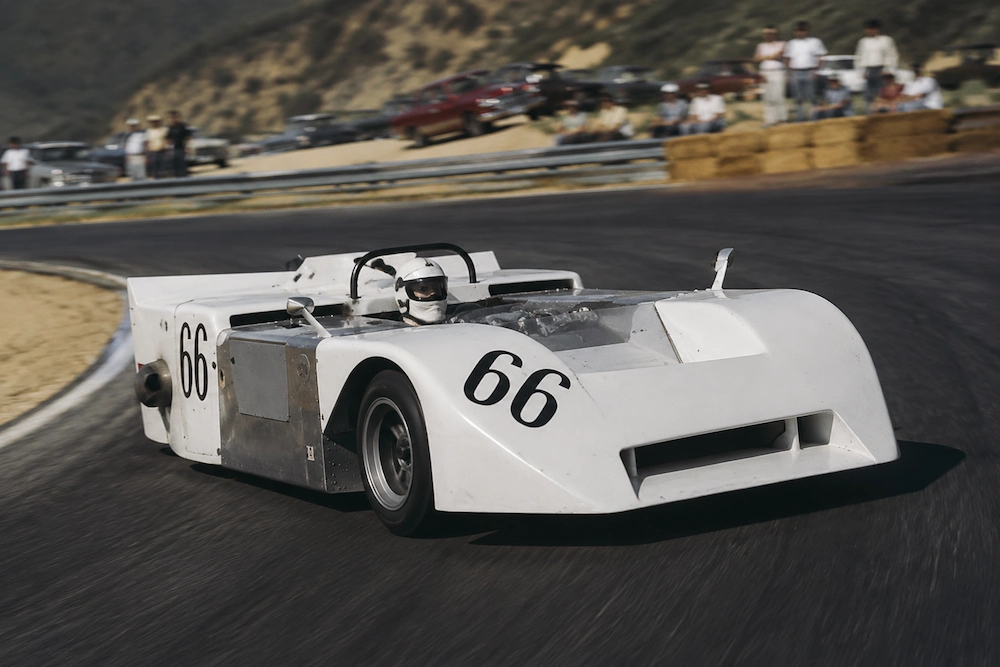
The Chaparral 2J was the kind of car that made people stop talking when it rolled into the paddock. It did not look elegant. It did not look friendly. It looked like a white box with wheels, fans, skirts, and a secret hidden underneath. But once it moved, everyone understood the problem: this machine was not just another race car. It was a warning from the future.
The Car That Was Too Smart for Its Time
Some cars become legends because they win championships. Others become legends because they change the way people think. The Chaparral 2J belongs to the second group.
Built for the 1970 Can-Am season, the 2J tried to solve one of racing’s oldest problems: how to make a car grip the road harder without simply adding more weight. Jim Hall and his team did not just add a wing and hope for the best. They looked beneath the car and asked a dangerous question: what if the car could create its own grip, even at low speed?
The answer was wild, loud, and controversial. The Chaparral 2J used fans to suck air from under the car, creating a low-pressure zone that helped press it toward the track. In simple words, it tried to vacuum itself to the road.
History and Context
Can-Am: A Series Built for Big Ideas
Can-Am was not a gentle racing series. It was a place where engineers could dream too loudly and then bolt those dreams onto a chassis. The rules were open enough to encourage huge engines, strange bodywork, and brave aerodynamic experiments.
For Canadian racing fans, Can-Am has a special meaning. The series name itself came from Canadian-American Challenge Cup, and tracks like Mosport helped shape its identity. It was a championship where power mattered, but imagination mattered even more.
In that world, the Chaparral 2J was not an accident. It was the natural result of a series that rewarded boldness until boldness became uncomfortable.
Jim Hall: The Man Behind the White Box
Jim Hall was not just building cars. He was studying airflow, grip, suspension, and driver confidence before many rivals fully understood how connected those things were. Chaparral had already experimented with wings and aerodynamic ideas, but the 2J went further.
It was created by Chaparral Cars, led by Jim Hall and Hap Sharp in Texas. Hall’s approach was practical but fearless. He did not seem interested in making cars that looked normal. He wanted cars that solved problems.
And the 2J solved one problem so well that it created another: it made rivals feel the rulebook had been outsmarted.
Technological Revolution
How the Fans Worked
At the back of the Chaparral 2J were two fans. These were not decorative. They were the heart of the car’s secret. Powered separately from the main engine, the fans pulled air from beneath the car.
Around the bottom edges, flexible skirts helped seal the gap between the body and the track. This created a low-pressure area underneath. The result was downforce — but not in the traditional way.
Most race cars need speed to make aerodynamic grip. A wing works better as air moves faster over it. But in a slow corner, when a driver needs grip most, traditional downforce becomes weaker.
The Chaparral 2J challenged that logic. Its fan system could create grip even when the car was not moving quickly. That meant it could attack corners with a confidence that seemed almost unfair.
Why It Was So Dangerous in Corners
Imagine watching a rival brake later, turn sharper, and accelerate earlier — not because they are braver, but because their car seems glued to the track. That was the emotional shock of the 2J.
On straights, other Can-Am machines could fight with horsepower. But in corners, the Chaparral 2J had a different weapon. It could hold the road in a way that made conventional cars look nervous.
This is why the car felt so threatening. It did not just improve racing performance. It changed the rhythm of driving.
Why the Chaparral 2J Was Banned
The reaction was almost inevitable. Rivals protested. Officials studied the design. The question became simple but uncomfortable: was this brilliant engineering, or was it a moving aerodynamic device hiding in plain sight?
By the end of the 1970 season, the Chaparral 2J was effectively pushed out. Its fans and sliding skirts were considered outside the spirit of the rules. To supporters, the decision killed one of racing’s most exciting inventions. To critics, it restored fairness.
Jim Hall defended the idea with a line that still feels powerful today:
“If I can come up with a better mousetrap that is within the regulations, I ought to be allowed to use it.”
That quote explains the whole debate. Racing has always said it loves innovation. But when innovation arrives too quickly, the sport often reaches for the rulebook.
Legacy of the Chaparral 2J
The Chaparral 2J did not enjoy a long career. It did not become a dominant champion. It did something more complicated: it made everyone think differently.
Years later, Formula 1 would explore ground effect with cars that used shaped floors and tunnels to create suction-like aerodynamic performance. The Brabham BT46B “fan car” of 1978 would bring the fan concept back into global attention. Modern race cars and supercars still chase the same dream: more grip, less drag, better control.
The 2J showed that the underside of a car could be as important as the engine cover, the wing, or the tires. That idea is now central to modern performance design.
Conclusion: A Masterpiece That Arrived Too Early
The Chaparral 2J remains one of motorsport’s most fascinating contradictions. It looked awkward, but it was elegant in thought. It was unreliable, but its concept was brilliant. It was banned, but its ideas survived.
In many ways, the 2J was not defeated by rivals. It was defeated by timing. The car arrived before racing was ready to understand what it had created.
For modern car lovers in Canada and beyond, the lesson is still relevant. Innovation rarely arrives politely. Sometimes it looks strange. Sometimes it sounds ridiculous. Sometimes it frightens the people who built the rules.
So here is the real question: should racing ban technology when it feels too advanced, or should the rest of the grid be forced to catch up?
FAQ
What was the Chaparral 2J?
The Chaparral 2J was a 1970 Can-Am race car known for its fan-assisted ground effect system.
Why was the Chaparral 2J called a fan car?
It used rear-mounted fans to remove air from beneath the car, helping create suction and extra grip.
Why was the Chaparral 2J banned?
Officials ruled against its fan and skirt system, treating it as an unacceptable movable aerodynamic advantage.
Did the Chaparral 2J win many races?
No. Its racing career was short and troubled by reliability, but its concept became legendary.
Why is the Chaparral 2J important today?
It helped prove the value of ground effect, an idea that later influenced Formula 1 and modern high-performance car design.