
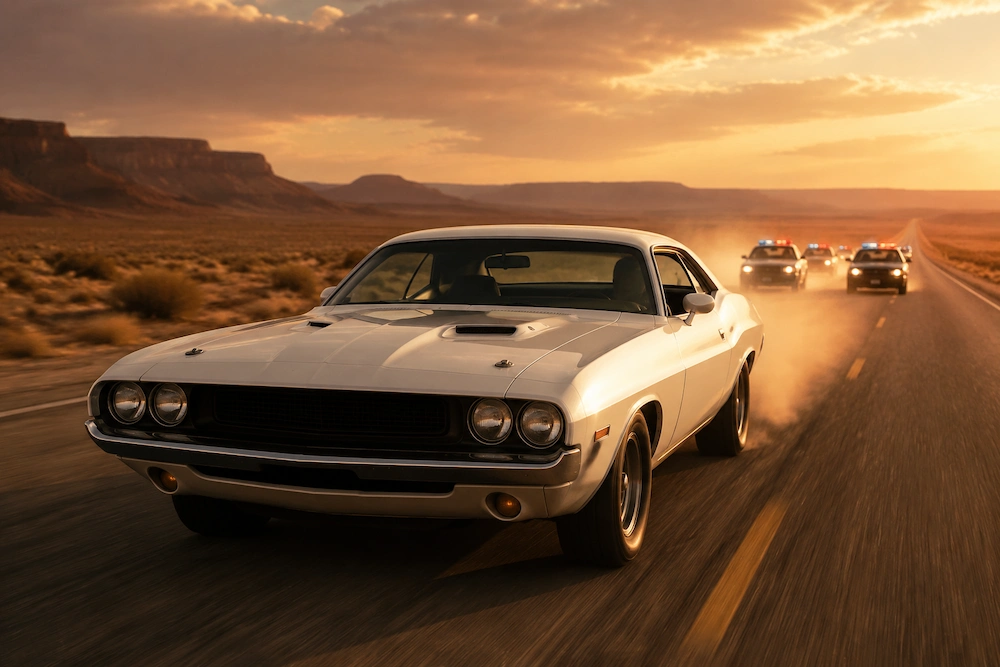
The white Dodge Challenger R/T from Vanishing Point (1971) became one of the most iconic movie cars in history. Even though the film failed at the box office, its raw highway storytelling and powerful imagery transformed the Challenger into a lasting symbol of freedom, speed, and American muscle culture.
Sometimes a car becomes more famous than the film it was built for, and in rare cases it completely overshadows the story itself. That’s exactly what happened with the white Dodge Challenger R/T from Vanishing Point (1971). The movie was never a mainstream success – critics were unsure what to make of it, audiences didn’t fully connect with its slow-burning philosophy, and the box office numbers reflected that confusion.
But something unexpected happened over time. The long desert highways, the minimalist storytelling, and especially the relentless white muscle car turned into a symbol that people kept returning to. Decades later, the Challenger from this film is remembered not as a prop, but as a cultural artifact – representing freedom, isolation, and the raw power of American automotive design.
Why the Dodge Challenger R/T Was Chosen
1970 Muscle Car Perfection
When the filmmakers were preparing Vanishing Point, they needed a car that didn’t just look fast – it had to feel inevitable, like it belonged on endless highways. The 1970 Dodge Challenger R/T was exactly that kind of machine.
Its long hood, wide stance, and aggressive proportions made it instantly recognizable. It wasn’t subtle, and it wasn’t supposed to be. In an era when muscle cars were competing for dominance on both streets and screens, the Challenger stood out as one of the most visually commanding options available.
440 Magnum V8 Power
Under the hood, the 440 Magnum V8 wasn’t just an engine – it was a statement. With massive torque and brutal acceleration, it gave the Challenger the ability to dominate open roads in a way few cars could match at the time.
This mattered for the film because so much of it relied on long, uninterrupted driving sequences. The car wasn’t just moving through space; it was owning it. Every press of the accelerator translated into cinematic tension.
Perfect Hero Car Identity
The decision to use a white Challenger was surprisingly intentional. In contrast to the dusty deserts and endless asphalt, the car almost looked unreal – like a moving idea rather than just a vehicle.
It had no flashy decals or branding. That minimalism helped audiences project meaning onto it. For some, it became a symbol of escape. For others, it represented rebellion against structure itself.
Cars Used During Filming
Production wasn’t gentle with its machinery. According to archival material from Wikipedia – Vanishing Point, multiple Dodge Challengers were used throughout filming, and several were destroyed during high-speed stunt sequences.
This wasn’t a polished studio production – it was rough, physical filmmaking on real roads with real consequences.
A stunt coordinator later reflected on the process:
“There was no safety net like today. If a shot required speed, we got speed. If it required impact, we paid for it with metal.”
Only a handful of cars survived production, and those remaining vehicles have become highly prized artifacts among collectors.
The Most Famous Chase Scene
The highway sequences in Vanishing Point remain some of the most memorable driving scenes in cinema history—not because of CGI or choreography, but because of their raw simplicity.
The production relied heavily on:
- Real desert highways instead of closed sets
- Professional stunt drivers pushing real limits
- Camera rigs mounted directly onto moving vehicles
- Long, uninterrupted takes that created tension naturally
There’s a strange honesty in these scenes. You can feel the heat of the asphalt, the instability of speed, and the unpredictability of real driving conditions. It’s not polished – it’s alive.
A Film That Failed at the Box Office
When Vanishing Point was released, it didn’t land the way anyone expected. Audiences in 1971 were still used to clearer narratives, more traditional character arcs, and obvious resolution.
Instead, they got a drifting story about a man driving across America with no clear destination and very little dialogue. Critics called it confusing. Some called it empty.
What they missed was intention. The film wasn’t trying to tell a conventional story – it was trying to evoke a feeling.
How Vanishing Point Became a Cult Classic
Over time, the film found its audience in the least expected places. Late-night television broadcasts introduced it to viewers who weren’t looking for structured storytelling. VHS tapes allowed car enthusiasts to revisit the highway sequences again and again.
Gradually, it transformed into something larger than its original release.
A cultural analyst once wrote:
“Vanishing Point didn’t succeed as a movie. It succeeded as a mood.”
Motor culture communities, especially fans of American muscle cars, embraced it as a defining piece of automotive cinema. The Challenger became less of a prop and more of a legend.
Legacy of the White Challenger
Today, the influence of the film continues to grow rather than fade.
- Restored Dodge Challengers from the era now command high collector value
- The white Challenger design appears in games, art, and modern films
- Automotive enthusiasts still reference Vanishing Point when discussing pure driving cinema
What makes its legacy powerful is not nostalgia alone, but identity. The car represents something simple yet universal: the desire to move forward without restriction.
FAQ
Why is the Dodge Challenger from Vanishing Point so iconic?
Because it represents freedom and rebellion more than any traditional movie hero ever could.
How many cars were used during filming?
Several Dodge Challengers were used, and multiple were destroyed during production.
Was the movie successful when released?
No, it initially failed at the box office and was misunderstood by critics.
What engine powered the Challenger?
The 440 Magnum V8, known for its high torque and raw muscle performance.
Why the Challenger Became More Famous Than the Film
In most cases, films define their cars. In this case, the opposite happened. The Dodge Challenger R/T from Vanishing Point outgrew the movie that introduced it. Its visual presence, mechanical aggression, and symbolic meaning turned it into something larger than cinema.
Today, it stands as one of the most recognizable movie cars in history – not because the film was a hit, but because the car became a myth.