
Racing history usually remembers winners.
The cars that dominate championships become legends, while the machines that finish last quietly disappear into forgotten garages.
But every once in a while, a race car earns legendary status for an entirely different reason.
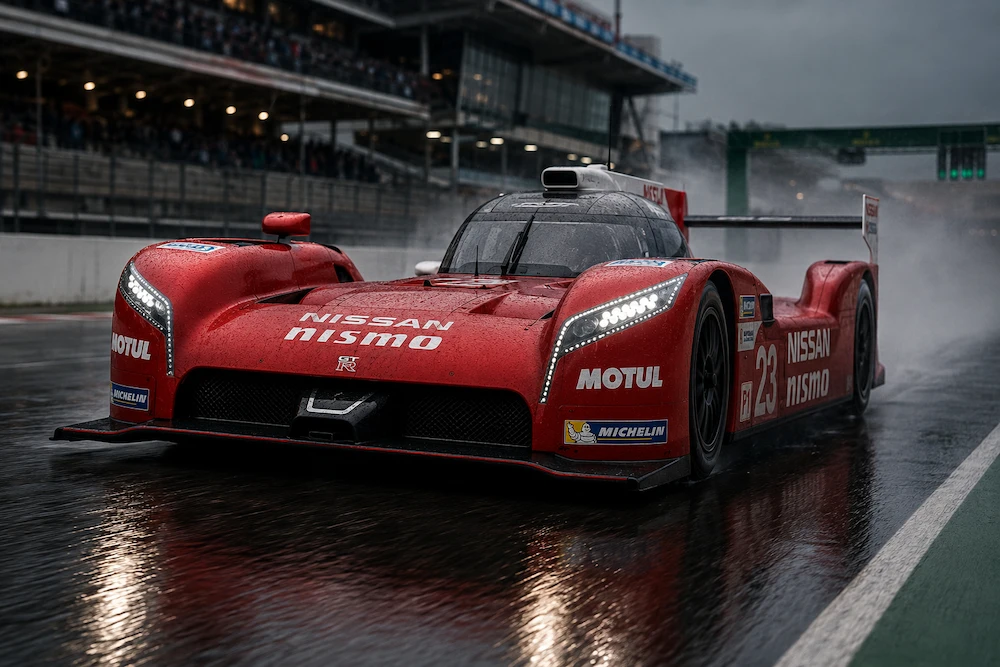
The Nissan GT-R LM Nismo never came close to winning Le Mans 2015, yet more than a decade later it is still discussed by engineers, racing fans, and automotive journalists around the world. Not because it was fast—but because it dared to ask a question nobody else was willing to ask.
“What if everyone else is solving the problem the wrong way?”
That single question led Nissan to build one of the strangest and most ambitious endurance race cars ever created.
This is the story of incredible creativity, enormous ambition, and a painful reminder that in motorsport, being different is not always enough.
Why Nissan Decided to Challenge Everyone
By the early 2010s, endurance racing had become an arms race between three giants.
Audi had perfected diesel hybrid technology.
Toyota continued improving its sophisticated hybrid systems.
Porsche returned to Le Mans with enormous financial backing and cutting-edge engineering.
Looking at the competition, Nissan’s engineers reached a simple conclusion.
Trying to build “another Audi” or “another Porsche” would almost certainly end in defeat.
If they wanted to win, they needed to change the game completely.
It was an incredibly brave decision.
Instead of asking how to improve an existing prototype, they started asking whether the accepted rules of prototype design were even correct.
Sometimes innovation begins exactly this way.
The Wild Engineering Behind the Nissan GT-R LM Nismo
At first glance, the car looked unusual.
The longer you studied it, the stranger it became.
Unlike virtually every modern Le Mans prototype, the Nissan GT-R LM Nismo featured a front-mounted twin-turbo V6 engine driving the front wheels. For racing fans, that sounded almost impossible.
Its engineering choices included:
- front-wheel drive instead of rear-wheel drive;
- engine mounted ahead of the cockpit;
- exceptionally wide front tires;
- surprisingly narrow rear tires;
- an advanced hybrid recovery system designed to send enormous bursts of power through the front axle.
Many people laughed when the first photos appeared.
Engineers did not. On paper, the idea had genuine advantages.
Moving major mechanical components forward allowed designers to create cleaner airflow underneath the rear of the car, potentially increasing aerodynamic efficiency without creating additional drag. Less drag means higher top speed.
Higher top speed matters enormously on Le Mans’ famous Mulsanne Straight. Everything looked logical.
On paper.
When Brilliant Ideas Meet Reality
Unfortunately, race cars don’t compete on paper.
They compete on asphalt.
And asphalt has a way of exposing every weakness.
The hybrid system—which represented one of the project’s biggest technological achievements—never operated as intended during the race weekend.
Without its expected electric boost, the car immediately lost much of its competitive advantage.
Then came additional problems.
The prototype weighed more than simulations had predicted.
Weight distribution became difficult to manage.
Drivers complained about understeer entering corners and instability during long runs.
Perhaps the biggest enemy wasn’t another manufacturer.
It was the calendar.
The project simply didn’t have enough testing time.
Every kilometre completed during practice revealed another issue that engineers barely had time to understand before the next session began.
Former racing driver and journalist Chris Harris once remarked that motorsport is where “ideas meet reality at 300 km/h.”
Few projects illustrate that better than the GT-R LM.
Le Mans 2015: Hope Turns into Disappointment
When qualifying began at Le Mans 2015, expectations quickly collided with reality.
The lap times were nowhere near those of Porsche, Audi, or Toyota. Spectators who had expected a revolutionary challenger instead watched Nissan fighting merely to stay competitive. The race itself proved even more difficult. Mechanical issues appeared repeatedly. The hybrid system remained largely unavailable. Reliability concerns slowed progress.
Only one Nissan officially reached the checkered flag – and it finished dozens of laps behind the leaders. For a factory-backed effort, it was a devastating result. Yet something fascinating happened afterward.
Instead of mocking the project, many engineers praised Nissan for attempting something truly original. Failure is common in motorsport. Original failure is much rarer.
Why Nissan Walked Away
Developing a modern Le Mans prototype costs hundreds of millions of dollars.
Fixing a completely revolutionary one costs even more.
After reviewing the program, Nissan realized the redesign required would be almost as extensive as building an entirely new car.
At the same time, company priorities were changing.
Budgets shifted.
Motorsport strategies evolved.
The project quietly came to an end before its second chapter could begin.
Many believe another year or two of development might have transformed the concept into a genuine contender.
Unfortunately, motorsport rarely offers unlimited second chances.
The Legacy of an Unforgettable Experiment
Today, the Nissan GT-R LM Nismo occupies a unique place in racing history.
It failed spectacularly.
Yet engineers continue studying it.
Why?
Because innovation is rarely born from perfect success.
Sometimes progress comes from understanding exactly why brilliant ideas don’t work.
Some aerodynamic concepts explored during the project influenced later research, while the experience gained by Nissan’s engineering team became invaluable.
As endurance racing journalist Marshall Pruett wrote:
“Innovation without enough development time is simply potential waiting to happen.“
That sentence perfectly captures the GT-R LM story. The car reminds us that engineering is not simply about imagination.
It is about balancing imagination with testing, budgets, reliability, and patience. Sometimes the boldest idea changes the future.
Sometimes it simply teaches everyone else what not to do. Either way, history remembers those brave enough to try.
FAQ
Why was the Nissan GT-R LM Nismo different from every other LMP1 car?
Because it featured front-wheel drive, a front-mounted engine, an unusual aerodynamic philosophy, and a hybrid system unlike any competitor at the time.
What happened at Le Mans 2015?
The car struggled throughout Le Mans 2015 with reliability, hybrid system limitations, and overall pace. Only one entry completed the race.
Was the project a total failure?
From a results perspective, yes. From an engineering perspective, not entirely. The project generated valuable technical knowledge and remains one of motorsport’s boldest design experiments.
What can modern engineers learn from the GT-R LM Nismo?
That revolutionary ideas require not only creativity, but also time, testing, and continuous refinement. Innovation alone is never enough to win endurance racing.