
- Introduction: A brief overview of General Motors’ journey through crisis and recovery
- The State of General Motors Before the Crisis
- Strategic Missteps: A Focus on Large Vehicles
- High Costs and Inefficiencies
- The Impact of the Global Financial Crisis
- Bankruptcy (Chapter 11)
- Government Intervention: The Lifeline
- A Decisive Crossroad: Restart or Closure
- Brand Closures, Layoffs, and Asset Sales
- The Hard Decisions That Shaped GM’s Future
- GM’s Recovery and Return to Profitability
- New Strategy for a New Era
- When to Take Big Risks
- Why Radical Decisions Are Sometimes Necessary
- The Cost of Delaying Action
- FAQ
General Motors, once the largest automaker in the world, faced a critical turning point in its history. Founded on September 16, 1908, in Flint, Michigan by William C. Durant as a holding company for Buick, General Motors is headquartered in Detroit, Michigan, a city central to its manufacturing and innovation legacy. From its position as a pillar of the American automotive industry to teetering on the brink of collapse during the 2008 financial crisis, GM’s saga is a testament to corporate survival, radical decisions, and the necessity of timely intervention. This article explores GM’s story of adversity and recovery, shedding light on key moments that reshaped the company.
The State of General Motors Before the Financial Crisis
Before the 2008 financial crisis, General Motors was already struggling. The company, at the time, had become too reliant on producing large vehicles, which were increasingly out of step with changing consumer preferences. Additionally, its operational costs were high, and it struggled to compete with more fuel-efficient and innovative foreign automakers. In the years leading up to the crisis, GM’s lack of adaptability began to catch up with them, as fuel prices rose and the global automotive market evolved. GM North America was a major operational segment responsible for vehicle design, manufacturing, and sales in the region.
- Strategic Missteps: General Motors’ strategy focused heavily on large trucks and SUVs, such as the Chevrolet Silverado and Hummer. While these vehicles were popular in the early 2000s, the shift toward fuel-efficient cars in the wake of rising gas prices left GM at a disadvantage. This focus made GM vulnerable to competition from Toyota and Chrysler, who were gaining market share with more fuel-efficient models.
- High Costs: GM’s labor costs and inefficiencies in production were major contributing factors to the company’s inability to compete with more agile automakers, especially foreign competitors from Japan and Europe. GM was losing money year after year, with cash reserves dwindling and the company struggling to raise money through loans. Business decisions, such as maintaining a broad brand portfolio including Buick, contributed to these high costs.
- The Global Financial Crisis: When the global financial crisis struck in 2008, GM found itself deep in debt and unable to respond effectively. With plummeting sales and rising costs, bankruptcy loomed.
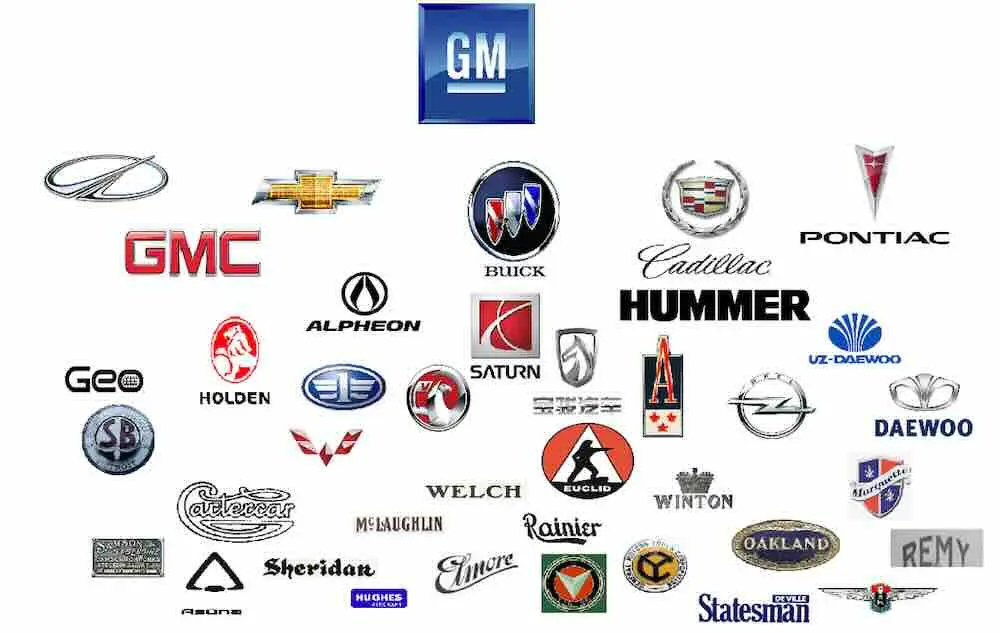
General Motors owns and manufactures four primary automobile brands: Chevrolet, Buick, GMC, and Cadillac, each operating as a separate division within the company. GM was recognized as the largest automaker in the United States by total sales and held the title of the world’s largest automaker for 77 years until 2008.
Bankruptcy (Chapter 11)
The turning point for General Motors came in 2009, when the company filed for Chapter 11 bankruptcy. In fact, General Motors filed for a government-backed Chapter 11 reorganization and emerged from bankruptcy as a new company on July 10, 2009. The bailout from the U.S. government provided the necessary funding for the company to reorganize and attempt a comeback. This moment was crucial, as it represented GM’s final chance at survival.
- Government Intervention: In one of the largest corporate bailouts in history, the U.S. government stepped in with a multi-billion-dollar package. The U.S. government invested $49.5 billion in GM through the Troubled Asset Relief Program, but only recovered $39 billion when it sold its stock in 2013, resulting in a loss of $10.3 billion. A study by the Center for Automotive Research found that the GM bailout saved 1.2 million jobs and preserved $34.9 billion in tax revenue. This intervention allowed GM to restructure its debts, streamline operations, and emerge from bankruptcy with a renewed focus on profitability. The terms of the bailout and financing arrangements were heavily influenced by Wall Street and big banks, whose actions and policies shaped the outcome.
- Restart or Closure: At this point, GM faced a hard choice: attempt to revive itself or face closure. The restructuring involved complex deals with stakeholders, including labor unions and banks, and required GM to pay significant amounts to settle obligations. The company also relied on new financing to support its operations. The decision to take radical action and focus on core brands like Chevrolet while cutting others, such as Pontiac and Saturn, would ultimately shape the company’s future.
Brand Closures, Layoffs, and Asset Sales
As part of its restructuring, GM made the painful decision to close several brands that were underperforming. Pontiac, Hummer, and Saturn were all discontinued, with the Saturn brand specifically discontinued as part of GM’s efforts to shed underperforming brands during its reorganization. A significant reduction in the workforce followed. Additionally, GM sold off valuable assets, including the Hummer brand, to shore up its financial position. General Motors Corp, as the legal entity, was responsible for these asset sales and the transfer of liabilities during the bankruptcy process.
- Brand Closures: The shutdown of these brands was a painful but necessary step. Hummer, known for its gas-guzzling SUVs, had become a symbol of GM’s struggles with consumer preferences.
- Layoffs and Asset Sales: In the process of slimming down, GM laid off tens of thousands of workers and sold off non-essential assets. These changes also had a major impact on GM’s network of dealers, leading to dealership closures and a restructuring of sales channels and after-sales services. This tough love approach allowed GM to survive, but it came at a great cost.
Electric Vehicles: The New Frontier
As the world accelerates toward a future defined by sustainability and innovation, General Motors Company (GM) is staking its claim as a leader in the electric vehicle (EV) revolution. Recognizing the growing demand for zero-emission vehicles and the shifting landscape of the auto industry, GM has made electric vehicles the cornerstone of its strategy to connect people and create a cleaner, more efficient world.
GM’s commitment to electric vehicles is more than a response to changing consumer preferences—it’s a bold move to redefine what car companies can achieve in the 21st century. The company’s expanding lineup, from the versatile Chevrolet Bolt to the luxurious Cadillac CT6, showcases a range of performance vehicles designed to deliver both excitement and environmental responsibility. Each model is engineered to maximize actual range and minimize environmental impact, making electric vehicles a practical choice for everyday drivers.
The transformation didn’t happen overnight. In the wake of the financial crisis, GM received crucial government aid, with the US Treasury and other agencies recognizing the importance of supporting innovation in transportation. This support, combined with a renewed focus on technology and efficiency, propelled GM to invest over $20 billion in electric vehicle research and development since 2019. The result is a new generation of vehicles that rival traditional cars in performance, quality, and affordability.
Government incentives have played a significant role in accelerating the adoption of electric vehicles. In the United States and Canada, tax credits and other programs have made it easier for consumers to make the switch, while also encouraging automakers to ramp up production. GM has responded by expanding its manufacturing facilities, partnering with leading suppliers to develop advanced battery technologies, and working closely with dealerships to ensure a smooth transition for customers and employees alike.
The numbers tell a compelling story: GM aims to offer 20 electric vehicle models by 2025, with some models achieving up to 300 miles on a single full charge. Sales of GM’s electric vehicles have surged by more than 50% in the past year, reflecting both the company’s commitment to innovation and the growing appetite for sustainable transportation options. These achievements are not only helping GM regain its footing in the market but are also creating new jobs and driving economic growth across North America.
As GM continues to invest in the future, its focus on electric vehicles is reshaping the company and the industry at large. By prioritizing advanced technology, performance, and sustainability, GM is positioning itself at the forefront of a global movement that will define the next era of transportation. With every new electric vehicle that rolls off the production line, GM is not just building cars—it’s building a legacy of innovation, resilience, and leadership that will connect people and communities for generations to come.
GM’s Recovery and Return to Profitability
Despite the losses and tough decisions, GM emerged from bankruptcy in 2009 with a clear goal: to return to profitability. The company streamlined its operations, focusing on more fuel-efficient and technologically advanced vehicles. Chevrolet became the cornerstone of GM’s recovery strategy, and the company made significant strides in electric vehicles (EVs) with models like the Chevrolet Volt.
GM’s recovery was supported by improved cash flow and careful cash management, which strengthened its financial position. GM Financial, the company’s financing arm, played a key role in supporting vehicle sales and providing customer financing options, such as auto loans and leases. The importance of the fiscal year is central to tracking GM’s financial progress and planning, as it aligns with industry trends and consumer cyclicality.
- New Strategy: GM’s new strategy involved cutting costs, improving efficiency, and investing in future technologies like electric vehicles. By focusing on high-demand segments and improving product quality, GM was able to return to profitability. General Motors reported a trailing twelve months (ttm) revenue of $185.02 billion and a net income of $3.18 billion. GM’s stock has shown a 1-year return of 69.46%, significantly outperforming the S&P 500’s 25.06% return during the same period, and the company’s market capitalization is approximately $65.57 billion as of early April 2026. As of 2024, GM ranks 25th by total revenue on the Fortune 500, 50th on the Fortune Global 500, and was ranked 70th in the Forbes Global 2000.
When to Take Big Risks
GM’s story is a clear example of when it is necessary to take bold, radical decisions. The company’s survival depended on making difficult choices and taking risks that no one thought possible. For businesses facing tough times, the GM example underscores the importance of acting decisively.
- Radical Decisions: Sometimes, a company must be willing to cut ties with the past, even if it means losing loyal customers or valuable brands.
- The Cost of Delaying Action: In GM’s case, delaying restructuring could have meant the company’s collapse. For businesses, taking timely, sometimes painful decisions is crucial for long-term success.
FAQ
Q1: What led to GM’s bankruptcy in 2009?
GM’s bankruptcy was largely due to high operational costs, poor strategic decisions (like focusing too much on large trucks), and the global financial crisis. The company was unable to adapt quickly enough to the market shifts.
Q2: Did the U.S. government bail out General Motors?
Yes, in 2009, the U.S. government provided GM with a bailout package, which allowed the company to undergo restructuring and avoid liquidation.
Q3: What brands did GM close?
GM closed several brands during its bankruptcy process, including Pontiac, Saturn, and Hummer, in an effort to focus on more profitable and sustainable brands like Chevrolet.
Q4: How did GM recover after bankruptcy?
GM focused on streamlining operations, reducing costs, and improving product quality, including investing in electric vehicles. The Chevrolet brand became the centerpiece of GM’s recovery strategy.
Q5: What are some of GM’s most iconic vehicles?
Some of GM’s most iconic vehicles include the Chevrolet Suburban, which is the longest-running vehicle nameplate in automotive history (in production since 1935), the Pontiac GTO, introduced in 1964 and often cited as the trendsetter for the American muscle car era, and the Chevrolet Corvette, introduced in 1953, which is one of the most famous American sports cars and featured the first mass-produced plastic (fiberglass) body.
Q6: What brands does GM own and operate?
GM’s four core brands are Chevrolet, GMC, Cadillac, and Buick. In addition, GM has interests in Chinese brands Baojun and Wuling through its joint venture with SAIC-GM-Wuling Automobile.
Q7: What are some of GM’s major innovations?
GM introduced the first mass-produced fully automatic transmission, known as Hydramatic, on the 1940 Oldsmobile. The electric self-starter, invented by Charles Kettering and introduced by GM in 1911/1912, eliminated the dangerous hand crank. GM was the first major automaker to offer airbags (Air Cushion Restraint System) in production vehicles in the 1970s and implemented catalytic converters across its entire 1975 fleet. GM also designed and built the Lunar Roving Vehicle for the Apollo 15 mission in 1971, the first vehicle driven on the moon.
Q8: What is GM’s strategy for electric and autonomous vehicles?
GM is committed to a zero emissions future and carbon neutrality by 2040. The company is developing the Ultium battery platform, a modular EV battery system enabling diverse electric vehicles, and established Ultium Cells, a joint venture with LG Chem, to support EV production. The Chevrolet Bolt EV, released in 2016, was the first mass market all-electric car with a range of more than 200 miles. In 2021, GM introduced a new logo and the ‘EVerybody in’ tagline, and announced plans to end production of internal combustion engine vehicles by 2035. In January 2024, GM announced it would manufacture a plug-in hybrid electric vehicle (PHEV) to balance battery electric vehicle supply with demand.
Q9: How is GM advancing autonomous driving?
GM is advancing autonomous driving through its Super Cruise advanced driver-assistance system, which enables semi-autonomous driving at SAE Level 2 and is available on vehicles like the Cadillac Escalade. GM is also developing self driving cars and autonomous ride-sharing vehicles via its Cruise subsidiary, working toward fully autonomous vehicles and regulatory approvals for driverless deployment.