
Table of Contents
- Introduction
Brief overview of Oldsmobile’s history and its significance in American car culture. - The Legacy of Oldsmobile
The brand’s origins in 1897, its climb to success, and the innovative advancements it brought to the automotive world. - Oldsmobile’s Innovations in Technology and Design
Innovations in transmissions, safety features, and the designs that made Oldsmobile cars iconic. - 1950s-1970s: Symbol of the American Dream
The role of Oldsmobile in pop culture, influencing cinema, television, and music. The brand’s connection with luxury, performance, and even casino culture. - The End of an Era
Why Oldsmobile ultimately failed to stand the test of time and how it left a lasting mark on the automotive industry. - Conclusion
Reflection on Oldsmobile’s enduring legacy and its impact on car design and American pop culture.
Introduction
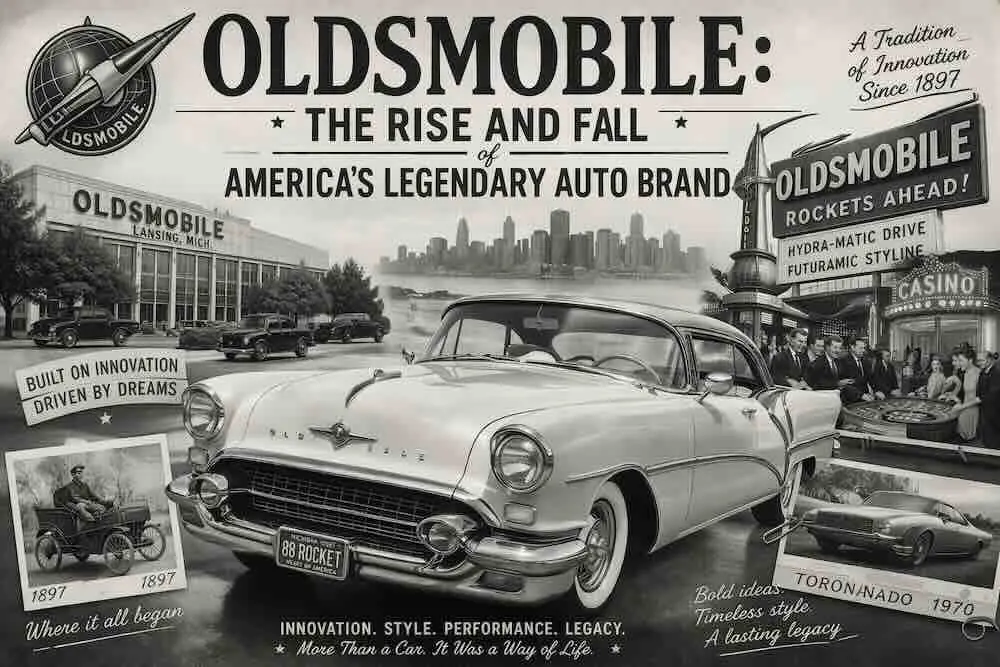
Oldsmobile, founded in 1897, is one of America’s oldest automotive brands. With deep roots in Detroit and a major manufacturing presence in Lansing, Michigan, Oldsmobile produced over 35 million vehicles during its existence, including at least 14 million built at its Lansing factory. For much of the 20th century, it played a pivotal role as a cutting edge innovator in shaping the country’s car culture. In this article, we will explore the brand’s rise, its contributions to the automotive world, and why it ultimately couldn’t withstand the changing tides of the industry.
The Legacy of Oldsmobile
Oldsmobile’s story began in 1897 when it was founded by Ransom E. Olds in Lansing, Michigan. The original Lansing factory played a significant role in automotive history, serving as the birthplace of many pioneering vehicles. Oldsmobile was among the first manufacturers to build cars on an assembly line, laying the groundwork for mass automobile production in the U.S. The Oldsmobile Model R ‘Curved Dash’, introduced in 1901, was the first mass-produced car, made on a progressive moving automotive assembly line from 1902 to 1907. This vehicle set a new standard for manufacturing efficiency and accessibility. Oldsmobile was also the first high-volume gasoline-powered car manufacturer. General Motors purchased Oldsmobile on November 12, 1908, marking the beginning of its operations under GM.
The brand quickly became synonymous with innovation, offering some of the first automatic transmissions, and its vehicles were considered reliable and stylish, attracting a loyal customer base. Oldsmobile’s influence spanned more than a century, shaping the automotive industry across each decade with groundbreaking models and technologies.
Oldsmobile’s Innovations in Technology, Design, and V8 Engines
Oldsmobile’s commitment to innovation began early, with one of its most significant contributions being the introduction of the automatic transmission in the 1940s. Known as the “Hydra-Matic” transmission, it revolutionized driving by making it easier for people to operate vehicles without the need to manually shift gears.
Building on this legacy, Oldsmobile introduced the first turbocharged engine and a factory water injection system in 1962 with the Turbo Jetfire, showcasing cutting edge technology that set new standards in performance. In 1966, Oldsmobile launched the Toronado, the first American car manufacturer to mass-produce a front-wheel-drive car, further cementing its reputation for innovation. The brand also pioneered the first heads-up display (HUD) in a production vehicle in 1988, and was the first to introduce a driver-side airbag in 1974, adding to its suit of advanced safety and driver-assist features.
The brand was also known for its stylish and elegant designs, particularly in its sedans and coupes. The Oldsmobile 88, introduced in the late 1940s as a first generation model, became a favorite for its sleek design and powerful V8 engines, earning it a reputation as one of the most desirable cars of the era. Many Oldsmobile models were powered by robust V8 engines, reflecting the brand’s focus on performance. As a division of GM, Oldsmobile shared technology and innovations with other General Motors brands, helping to advance the entire industry. Oldsmobile’s advertising campaigns often highlighted these technological breakthroughs, promoting their cutting edge features and helping to establish the brand’s image as a leader in automotive innovation.
1950s-1970s: Symbol of the American Dream and Muscle Cars
During the 1950s and 1970s, Oldsmobile was a cultural icon. The brand became synonymous with the American Dream, representing luxury, speed, and freedom. In popular culture, Oldsmobiles frequently appeared in films, TV shows, and music, often symbolizing wealth and success.
Among its most legendary models, the Oldsmobile 442 stands out. Produced from 1968 to 1971, the 442 was named for its four-barrel carburetor, four-speed transmission, and dual exhausts. The highest-output W-30 package was powered by a 455 cubic inch V8 engine, delivering 370 hp and 500 lb-ft of torque to the rear wheel drive layout. These muscle cars were known for their aggressive styling, including prominent front fenders and flared fenders, and were available as convertibles, two-door coupes, and four door sedans. The 442’s performance stuff made it a favorite on the drag strip and among old car enthusiasts, with quarter mile times that rivaled many competitors. Some features were nearly identical to those found in other GM muscle cars, but the 442’s unique combination of power and design set it apart.
Oldsmobile’s Rocket 88 was also a dominant force in stock car racing, making a significant impact in nascar competition and race events, especially with its impressive quarter mile performance. In the 1980s, the Oldsmobile Cutlass led the brand into the nascar circuit before GM shifted focus to Chevrolet and Pontiac.
Additionally, Oldsmobiles made appearances in casinos and night-time road trips to gambling events, highlighting their association with the lifestyle of the times. The brand’s luxury vehicles, such as the Oldsmobile Toronado, were particularly popular in these circles.
Oldsmobile’s sales peaked at over one million vehicles sold annually from 1983 to 1986, reflecting its broad appeal. The brand’s lineup included not only classic muscle cars but also trucks and a variety of body styles, catering to a wide range of buyers. The third generation of Oldsmobile models and rapid production cycles, sometimes lasting only three years, contributed to the rarity and collectibility of certain editions, affecting their price in today’s market.
Classic Cars and Collectibility
Classic cars have long captured the imagination of car enthusiasts and collectors alike, with muscle cars and high-performance vehicles standing out as some of the most coveted treasures in the automotive world. These classic cars, especially limited edition models like the Dodge Challenger or the legendary Ford Mustang, are more than just vehicles—they’re rolling pieces of history. The market for these cars is robust, with demand driven by nostalgia, rarity, and the thrill of owning a high-performance machine from a bygone era.
Auction houses such as Barrett Jackson regularly see record-breaking sales, with pristine examples of classic muscle cars fetching staggering prices. For instance, a rare 1970 Plymouth Superbird can command over $1 million, while a well-preserved 1969 Ford Mustang Mach 1 might sell for upwards of $500,000. The value of these models is influenced by factors like originality, condition, and production numbers, making limited edition and high-performance variants especially desirable. Collectors are not just buying a car—they’re investing in a slice of automotive history, with each model telling its own unique story of American innovation and performance.
Competition and Rivals
The golden age of classic cars was defined by fierce competition among American automakers, each vying to outdo the others in the quest for performance and prestige. Brands like Ford, Chrysler, Chevrolet, Cadillac, Pontiac, Buick, Dodge, and American Motors produced some of the most iconic performance cars ever built, fueling the legendary horsepower wars of the 1960s and 1970s. This era saw the introduction of high-performance models such as the Dodge Charger, Plymouth Barracuda, and Chevrolet Camaro, each designed to dominate both the street and the track.
The rivalry extended to the racing world, with the Trans Am series showcasing the best from each manufacturer and pushing the limits of engineering and design. These competitions not only elevated the status of performance cars but also spurred innovation, resulting in faster, more powerful, and more desirable vehicles. Today, the legacy of these battles lives on, as collectors and enthusiasts continue to seek out rare models and celebrate the spirit of competition that defined an entire generation of American automobiles.
Preservation and Restoration
Preserving and restoring classic cars is a labor of love that requires patience, expertise, and a keen eye for detail. For many car enthusiasts, the journey begins with tracking down rare parts and original components, often scouring swap meets and online forums to find the perfect fit. Restoration projects can involve everything from rebuilding engines and transmissions to meticulously reupholstering interiors and refinishing bodywork, all in the pursuit of returning a classic car to its former glory.
Some owners choose to enhance their vehicles with modern upgrades like power steering or a manual transmission, blending classic style with improved drivability. However, purists often strive to maintain the original specifications, preserving the authenticity and character that make these cars so special. Whether restored to showroom condition or kept as a survivor, classic cars are cherished not only for their beauty and performance but also for the stories they carry and the history they represent.
Enthusiast Community
The classic car enthusiast community is a vibrant and welcoming world where passion for old autos brings people together from all walks of life. Whether you’re drawn to the raw power of a muscle car, the craftsmanship of a vintage hot rod, or the elegance of a classic convertible, there’s a place for every car lover. Publications like Old Autos, online forums, and social media groups provide spaces for enthusiasts to share stories, exchange advice, and showcase their prized vehicles.
Events such as car shows, rallies, and swap meets offer opportunities for owners to connect, compete, and celebrate their shared love of automotive history. In Canada, for example, the classic car scene is thriving, with a wide variety of models from Ford, Chevrolet, Chrysler, and Dodge available for sale through dealerships and online marketplaces. The community’s dedication ensures that the legacy of classic cars endures, keeping the spirit of these remarkable vehicles alive for future generations to enjoy.
The End of an Era
Despite its rich history and numerous innovations, Oldsmobile was unable to adapt to the changing demands of the automotive industry. The brand’s decline began in the 1980s, with a reduction in demand for its once-popular models, and by 2004, General Motors, the owner of Oldsmobile, decided to discontinue the brand altogether. The last Oldsmobile, an Alero, rolled off the assembly line at the factory on April 29, 2004.
Oldsmobile’s inability to evolve with new automotive trends, such as the growing interest in more fuel-efficient cars, contributed to its demise.
Conclusion
Though Oldsmobile no longer exists as a brand, its impact on American automotive history is undeniable. From its groundbreaking innovations to its cultural significance, Oldsmobile shaped the design, technology, and lifestyle of the 20th century. Oldsmobile remains a favorite among old car enthusiasts and continues to influence the design and appreciation of classic vehicles, with many still admiring the unique features and performance of each vehicle produced. Despite its downfall, it remains a symbol of an era in American history when cars were more than just machines—they were a way of life.
FAQ
1. What was Oldsmobile’s most iconic model?
One of Oldsmobile’s most iconic models was the Oldsmobile 88, introduced in the late 1940s. It became synonymous with style, performance, and reliability, offering a combination of sleek design and powerful engine performance. The 88 was available in various body styles, including convertibles and different door configurations, which contributed to its appeal among classic American car enthusiasts.
The Oldsmobile Toronado also stood out, known for its front-wheel drive and futuristic design, making it a symbol of luxury and innovation in the 1960s. The Toronado was offered in multiple body styles as well, featuring distinctive doors and options that highlighted its unique character.
2. Why did Oldsmobile fail?
Oldsmobile’s decline can be attributed to a failure to adapt to changing consumer preferences and industry trends. The brand was slow to embrace fuel efficiency and new technologies, which led to a drop in sales. Additionally, as General Motors consolidated brands and streamlined its offerings, many Oldsmobile models were replaced by newer vehicles from other GM divisions. As a result, Oldsmobile was discontinued in 2004.
3. What role did Oldsmobile play in American car culture?
Oldsmobile played a significant role in American car culture, especially in the mid-20th century. It was a symbol of the American Dream, representing innovation, luxury, and performance. Oldsmobile’s innovative advertising campaigns, such as the 1933 Oldsmobile Program on CBS radio and other marketing efforts, helped cement its place in American pop culture. Oldsmobiles appeared frequently in popular culture, including films, TV shows, and even casino scenes, embodying the spirit of adventure and success associated with American vehicles of that time.
4. Was Oldsmobile involved in any automotive innovations?
Yes, Oldsmobile was a pioneer in several key automotive innovations, often introducing cutting edge features for their time. One of its most notable contributions was the Hydra-Matic automatic transmission, introduced in 1940, which revolutionized the driving experience by eliminating the need for manual gear shifting. This made driving more accessible to a broader audience and set a standard for the industry.
5. Can you still buy Oldsmobile cars today?
Since Oldsmobile was discontinued in 2004, new Oldsmobile cars are no longer available. However, classic and vintage Oldsmobile vehicles can still be found through collectors, private sales, or auctions. These models remain popular among car enthusiasts who appreciate their unique design and historical significance.
6. What is the legacy of Oldsmobile in the automotive industry?
Oldsmobile’s legacy lives on through its pioneering designs and innovations that influenced the automotive industry. As one of the oldest divisions of GM (General Motors), Oldsmobile played a significant role alongside other GM brands such as GMC, Buick, and Cadillac. The brand’s contributions to safety features, car design, and the development of the automatic transmission had a lasting impact on the industry. Oldsmobile vehicles helped set standards for performance and technology, influencing not only GM’s lineup but also the broader direction of American automotive engineering. Oldsmobile also holds a special place in automotive history as a symbol of 20th-century American car culture, remembered fondly by enthusiasts and collectors alike.